|
||||||
|
"This is a Cobra R with all the comforts and amenities included," said John Coletti, chief engineer for Ford�s Special Vehicle Team. "And because we used a supercharger to make that tremendous power, it�s also a very driveable package. It has power that gives gratification on demand. When you open the throttle, it just goes!" "This car really has a split personality," Coletti continued. "It can be very docile and comfortable, but when you want to go, along comes the wild side." To breathe in the great quantities of air required by this supercharged engine, the mass-air flow sensor has been increased from 80mm to 90mm, feeding the twin 57mm bores of the throttle body.
The Eaton™ Roots-type supercharger is the same model used on the SVT F-150 Lightning, with a cast aluminum case, machined aluminum internal rotors, and its own dedicated drive belt. The supercharger compresses intake air to a pressure of 7.5 to 8.0 pounds per square inch, and under the supercharger the compressed air passes through a water-to-air intercooler. This removes heat gained during compression to make a denser, more powerful compressed air charge. The upper and lower intake manifolds are revised to accommodate the supercharger installation, and also to give greater airflow to the cylinder heads. The aluminum alloy 4-valve heads are new to the Cobra. They were chosen because they provide greater flow capabilities, and help give increased low-end torque without sacrificing peak horsepower. The valve head diameters are unchanged, at 37mm for the intakes and 30mm for the exhaust valves, but the camshafts have been reprofiled to give increased low-end torque. Due to a 20 percent increase in power output from the 2001 engine, SVT engineers needed extra strength in the block to withstand increased stresses. The cast-iron version of the 4.6-liter block was the answer. It is fitted with the forged steel crankshaft used in previous Cobra engines, and the block needed some additional machining on its interior side bulkhead areas to make room for the counterweights of this crank.
The SVT engineers specified forged "H-beam" connecting rods from Manley Manufacturing, which have the strength to withstand the engine�s high torque output. The rods are fitted with new forged pistons with dished tops similar to those on the SVT Lightning. These pistons lower the compression ratio to 8.5:1, which is necessary to handle the higher compression pressures developed in the supercharged engine. The 2003 SVT Cobra�s flywheel, similar to the one on the 2000 Cobra R, is made of aluminum and weighs 11.2 pounds. This flywheel not only helps reduce vehicle weight, it also reduces inertia to increase the engine�s free-revving capabilities. The clutch is an 11-inch, single-plate unit as in the 2001 Cobra, but its pressure plate has increased clamping capabilities to help handle the higher torque output. The 2003 SVT Cobra joins the 2000 Cobra R as the only Mustangs ever factory-equipped with a six-speed gearbox � the TTC T-56. A new aluminum drive shaft with upgraded universal joints, a 3.55:1 gearset in the differential, and higher capacity half-shafts complete the changes to the 2003 powertrain.
Bill Lane, SVT powertrain engineer and aficionado of late �60s big-block Detroit iron, notes that this supercharged 4.6-liter (280 cu. in.) engine, at wide-open throttle and 7.5 psi boost, produces horsepower that�s essentially equivalent to a 1960s vintage 7.0-liter (427 cu. in.) naturally aspirated engine � big-block power in a small-block package. "One
of the favorite modifications for Mustangs is putting on a supercharger,"
said Coletti. |
||||||
|
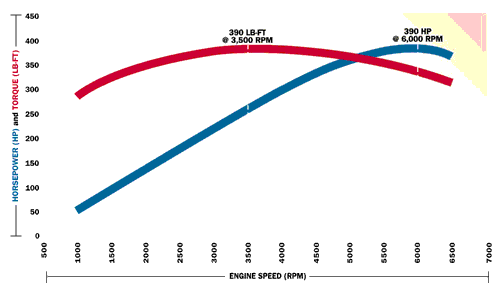 With
390 horsepower at 6,000 rpm and 390 foot-pounds of torque at 3,500 rpm,
the supercharged 4.6-liter, DOHC V-8 makes the 2003 SVT Mustang Cobra
the fastest, best-performing Mustang ever produced in volume over a
few hundred units
With
390 horsepower at 6,000 rpm and 390 foot-pounds of torque at 3,500 rpm,
the supercharged 4.6-liter, DOHC V-8 makes the 2003 SVT Mustang Cobra
the fastest, best-performing Mustang ever produced in volume over a
few hundred units