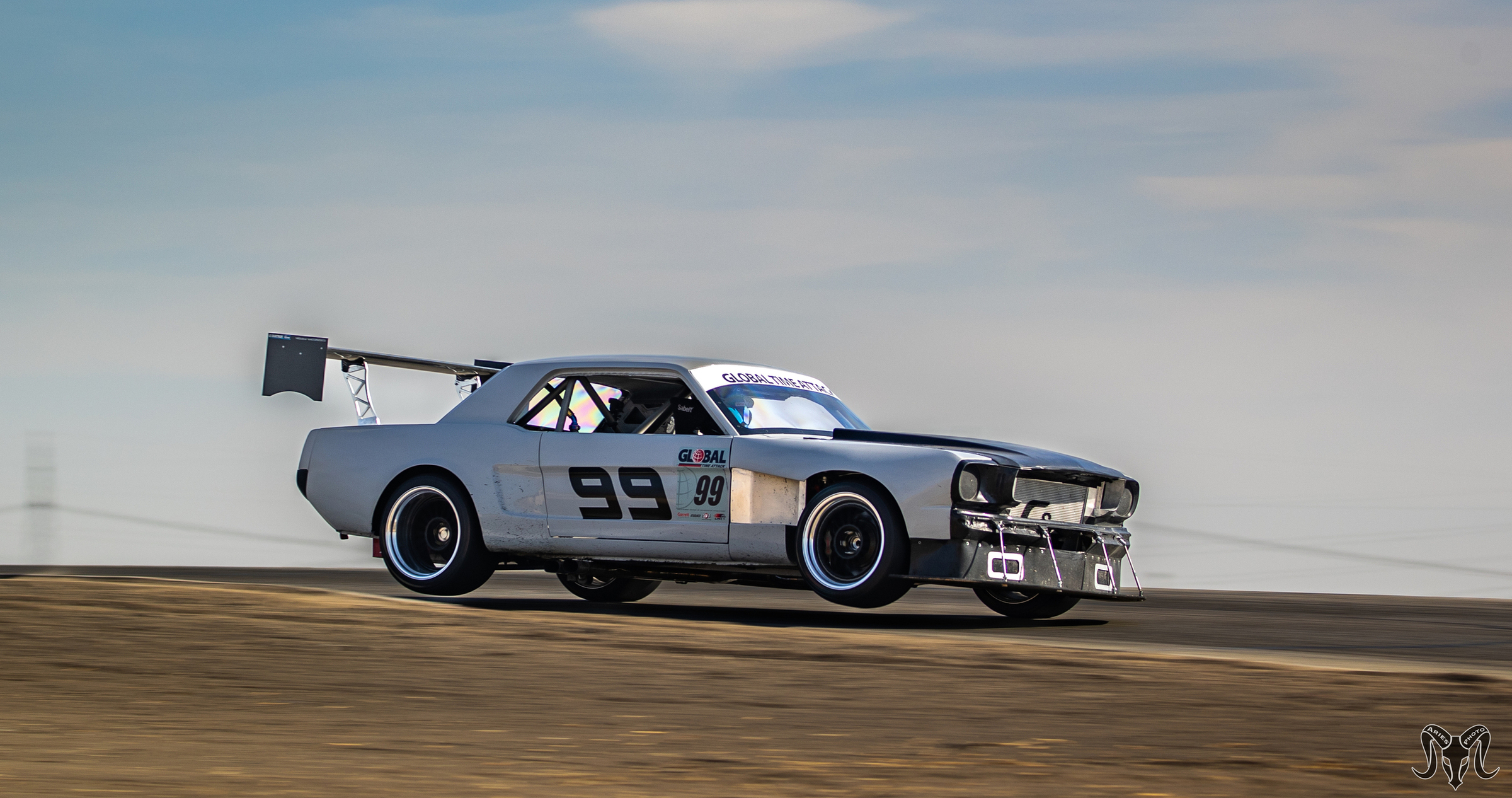
Brian Navarra’s dad knows how to set up a child for financial challenges. When he gave a teenage Brian the keys to his 1967 Shelby GT350 race car one seminal afternoon at Sonoma Raceway many years ago, his bright-eyed son, with only second-hand impressions as a baseline, realized by the second lap that all he’d anticipated fell utterly short of the real thing.
Ten years later, Navarra’s scrimping and saving had earned him his own pristine pony car. He relished the thought of turning his 1966 Mustang Coupe into a stripped and lightened track car at first, and seeing the effect his first upgrades had was encouraging. However, the reality of the situation dawned on him after a dozen days spent sorting out a 60-year-old piece of metal and, much to his chagrin, getting passed by plenty of modern BMWs.
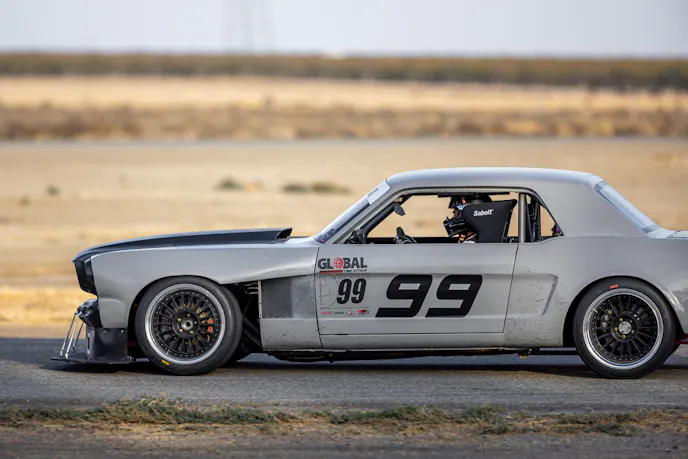
“I had to accept that, to turn an old car into something serious, I’d have to go to extremes – I would have to hack it up if I wanted to do my vision justice,” he explained.
Sensibly, Navarra sought out a new body with a few scuffs. The goal he had for this rough ’66 Coupe was to make the extensive chassis and aero modifications needed to run with the big guns and compete in a wheel-to-wheel setting. The first class considered was NASA American Iron Extreme, but since that class was on its way out, time trials would be the most accommodating for Navarra, a machinist with a wild vision. Funny how wheel-to-wheel rulebooks suddenly seemed restrictive.
Performance Tweaks
He had a new body to tweak, and his next challenge was learning how exactly to tweak it. He began by making a few roll bars with his tubing bender. As he’d been around the game long enough to grasp the essentials of welding, he was able to continue extending his roll bar into a full cage. Then Rankin started cutting any unnecessary metal from the frame to shave weight wherever possible.
Taking his cue from the old IMSA GT Mustangs from the 1980s, he tubed the front end and added about as much structural support as he could manage.
“The number and size of the subframe reinforcements make the whole thing a lot like a box frame,” Navarra said.
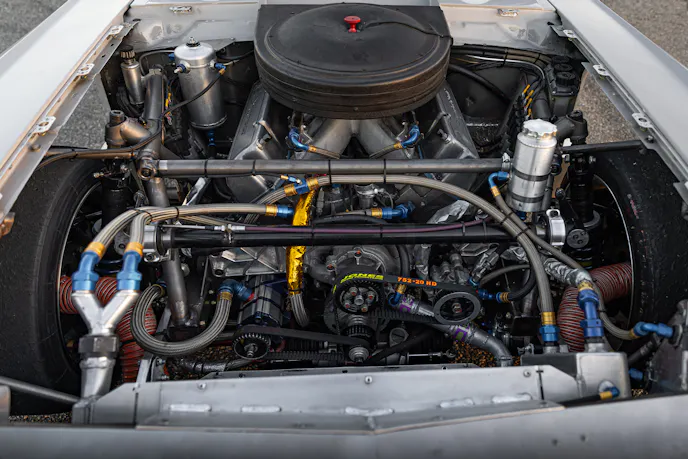
Being a bigger car with plans for 300-section slicks, he needed real stopping power. He opted for Brembo XB105 race brakes with PMU pads at the front axle. At the rear, Alcon monoblock calipers handled a large part of the braking load.
Seated further back in the body than the factory motor ever sat is a Yates 358 with 13:1 compression – essentially, a ‘90s-era NASCAR motor. Although the bottom end is basic small-block architecture, it has race heads, port injection, and an Emtron ECU to extract 600 horsepower to the wheels and a broad powerband with which to enjoy it. “It rips from 4,500 to 8,500,” Navarra exclaimed.
Planting Power
Power application is impressive, thanks in no small part to the three-link rearend planting a Ford 9-inch rearend and a basic Torsen-style differential. “I added a Watt’s link because it’s very tunable for longitudinal and lateral grip. If you’re able to make some changes at the track, it’s easy to work around its shortcomings,” he explained.
Brian’s widebody began by stretching the rear fenders to comfortably fit the footprint. Up front, he fashioned his own protruding fenders to hang nicely over his custom double wishbone/SLA front suspension, styled from a variety of race cars he’d studied.
“I had a pretty good idea of what I wanted. I still spent some time plotting the mounting points, but fabbing the arms and the uprights was easy enough,” Navarra said. “I decided to go with a pre-made spindle from CorteX Racing because it was proven.”
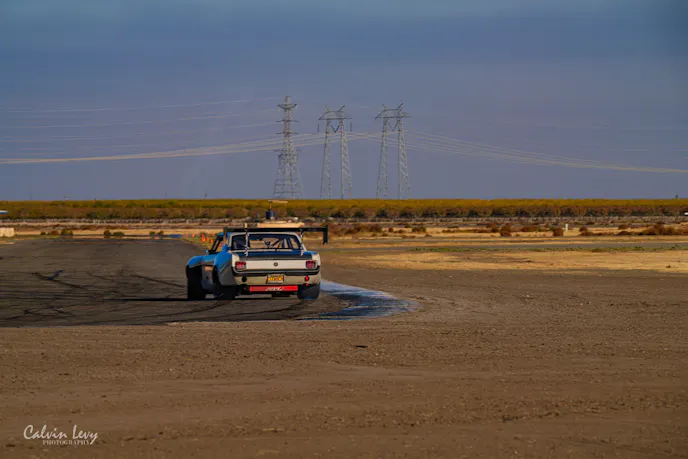
Being a bit long in the piano key tooth, the old pony was not going to be competitive without modern aerodynamics. The aero is admittedly a work in progress, with the completely unsealed front end, homemade splitter, and airdam generating relatively little downforce. Still, it works well at tracks like Laguna Seca, where the longer corners tend to highlight any understeer issues.
The rear received the bulk of the aerodynamic loading, thanks to the AJ Hartman Aero wing and tunnels in the splitter. This is an asset when administering the power, but persistent understeer has been a hindrance in high-speed corners. To distribute the aero load more evenly, Brian laid the radiator down to keep much air from moving underneath the car, and added more vents in the hood to help remove that air from the engine bay. Though these changes might sound insignificant, their combined effect raised minimum speeds at Buttonwillow Raceway’s high-speed Riverside corner by five miles per hour.
As he’s learned, finding the right balance of things changes with the progression of the build. At this stage in its development, though the car sits 50/50 statically, the steady power increases require more and more of the weight to be moved rearward toward the driven wheels.
Shedding Weight
“I wanted to shove everything to the rear, so I’ve moved the power steering and pressure relief tank away from the front of the car,” Navarra explained. Now, he has a closed cooling system with a pressure relief valve and a smaller tank next to the firewall.
He also cut a foot off the old frame rails, which now terminate at the face of the engine. This required he fab in aluminum extensions to mount the radiator and the splitter, which increased rigidity and allowed Brian to strip 60 pounds from the front without requiring any additional bracing. Following that, he replaced the splined NASCAR-style sway bar with a hollow blade-style front sway bar with cockpit adjustability.
In the coming months, Navarra hopes to install a lighter replacement motor, which will trim 85 pounds off the front axle. Currently, the motor sits squarely over the centerline of the wheels, but if he wants to continue moving it rearwards, he’ll have to open the firewall.
“It’s already pretty hot in the footwell, but I’ve thought about the touring car look; sitting next to the B-pillar will help now that the new motor will produce another 200 horsepower,” he said.
Lately, he’s come to accept the limitations of a front-engined car with a boxy shape. “I’m fine with the aero grip being what it is. Aerodynamics aren’t the priority at this point, and I still love the classic, flowing shape. I just can’t chop it up much more,” Navarra continued.
Balanced Performance
Shifting the weight to the back helped in heavy braking and also helped highlight some of the system’s current limitations. “It’s hard to find the limit in braking since the current setup lacks ABS, but I’m hoping there might be an unassisted solution, since I’d rather stay totally involved in the stopping process,” he explained.
In the coming months, Brian hopes to install his homebuilt uprights and spindles that are lighter and stronger with a GT3-style SKF Motorsport bearing pack. Getting rid of heavy, imprecise ball joints and replacing them with sphericals should find some of that precision he feels the car still lacks.
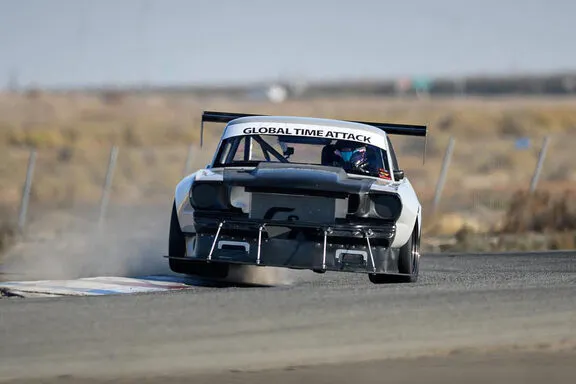
Currently, Navarra’s trimmed the Mustang’s weight down to 2,850 pounds dry, but there’s plenty left to lose. “It still has steel fenders and an iron block, but I’m not quite ready to rebuild the panels yet,” he added.
Refined Racer
Cutting overall weight has made it possible to lighten the cage with thinner-gauge DOCOL to replace the .120-wall DOM. “It’s a stronger material, so you can run .095 or lighter and retain the same rigidity,” he added.
In addition to refining the aero and tuning the car to suit the driver, Navarra’s trying to refine the car’s rear end. For more mid-corner grip, he’s decided to update the rear end with a piece of tech seen in Trans-Am cars.
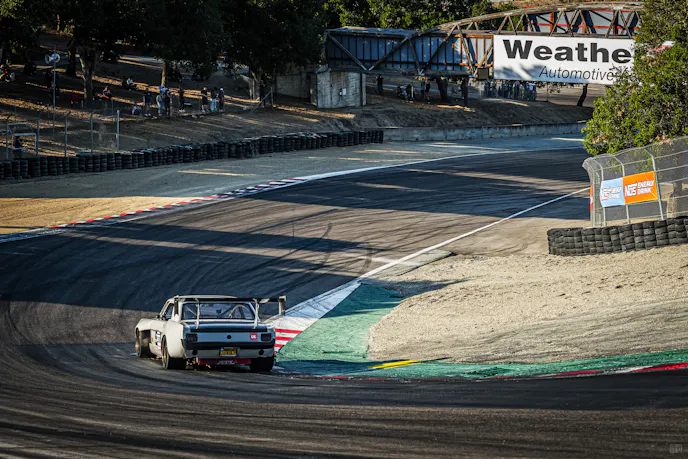
“I’m building a cambered rearend with toe and camber built into it. The hubs bolt onto a flange at the end of the axle, and the hub bolts onto the housing – like a CV joint,” he said.
That is just one consideration he’s made to help put the anticipated 800 horsepower to the pavement cleanly, such as increasing the rear tire width. “I’ve been running a 300 square setup, and I’ll move to a 330 that’s 28 inches tall, which is roughly 3 inches taller than his old tires,” Navarra added.
To keep the car mostly neutral, he’s increasing the front width to 320. This mild stagger might not help the understeer issue any, but at this stage, he’s learned that it’s wise to play to the car’s strengths — it has more than enough of those to make up for any shortcoming.
You might also like
Enhance A Modern Mustang Engine Bay With SPE Coolant Tanks
Upgrading your plastic coolant reservoirs prevents dangerous track spills. SPE offers billet and fabricated tanks for S550 and S650 Mustangs.