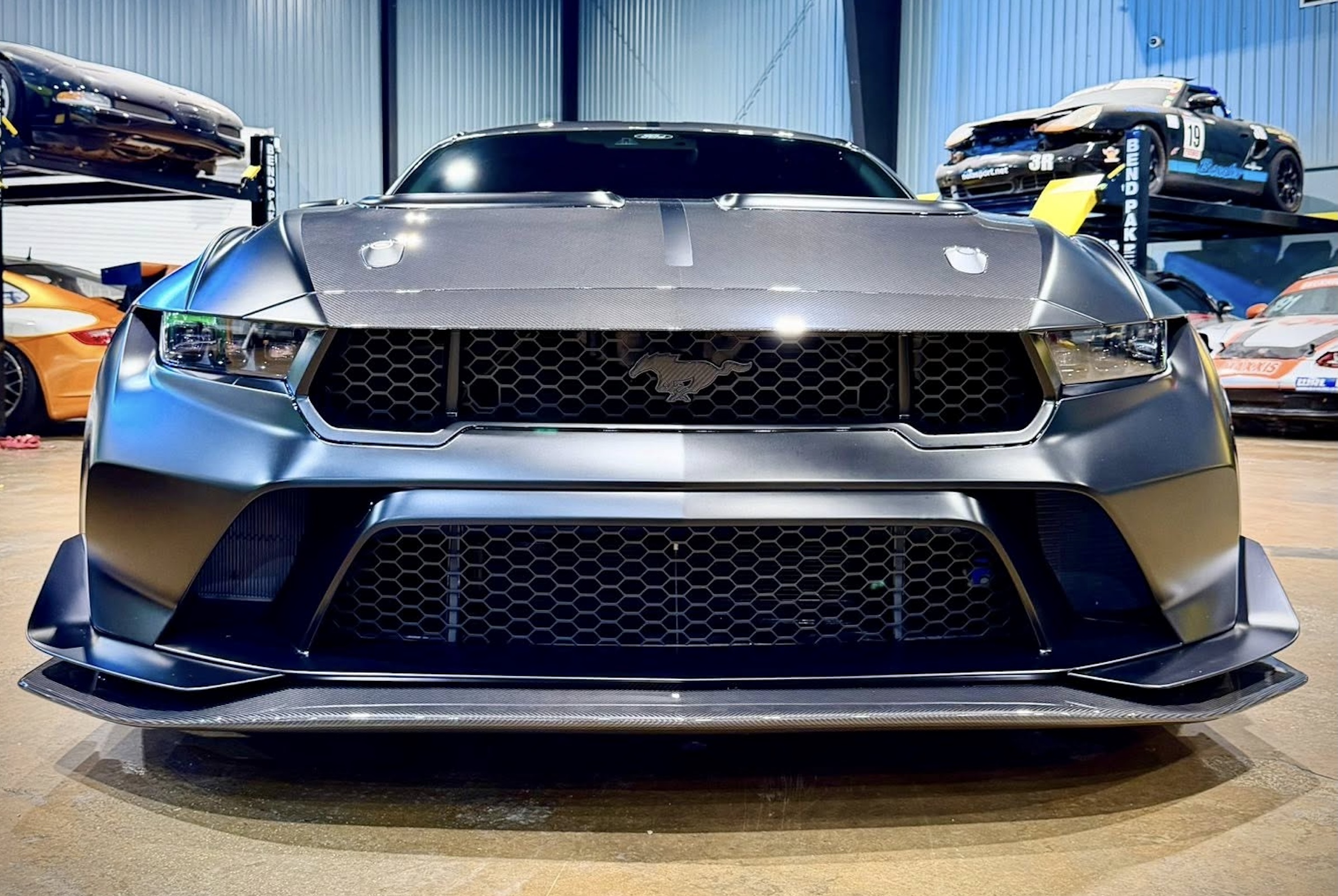
Ford engineers developed the Mustang GTD to take on Europe’s top performers on their home turf. It did so with active aerodynamics, scienced-out suspension, and 815 horsepower at the crank. It eventually added an undisclosed amount with the Mustang GTD Competition. However, like any other Mustang owners, some of those with the “standard” Mustang GTD want more power. Michael B. McAnelly set out to modify his 2025 Mustang GTD Carbon Series to exceed 1,000 horsepower. He is not there yet, but it is only a matter of time.
“The stock GTD is an awesome car. Versus a stock GT500, the GTD outperforms it in every aspect. The GTD feels like an exotic car in handling and performance. It does not feel like a GT500 or any other Mustang, but to me, I wanted more!” McAnelly said. “The GTD needs more power! It should have come with 1,000-plus horsepower from the factory.”
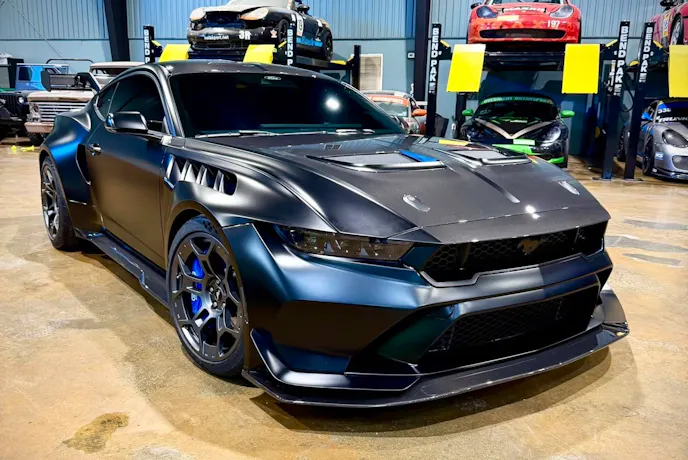
Non-enthusiasts might consider an 815-horsepower, dry-sump, transaxle-equipped Mustang supercar to be more than enough. Still, McAnelly looked at Ford’s halo pony car and saw untapped potential when he picked it up from John Juccuzzo of Terrebonne Ford.
If McAnelly’s name sounds familiar around high-horsepower Blue Oval builds, that is because this is not his first rodeo. The Baton Rouge-based electrical engineer and LSU graduate has a history of assembling serious late-model Ford combinations with tuning by Mitch Trahan of Tuned By Norm, including a 1,200-rear-wheel-horsepower 2011 Shelby GT500 and a 1,100-rear-wheel-horsepower 2022 Shelby GT500 stock-blower combo that flirted with 8-second quarter-mile times.
That prior experience with the Predator platform shaped the direction of the GTD build from the start. While the GTD is far more exotic than a 2020-2022 Shelby GT500 thanks to its rear-mounted transaxle, semi-active Multimatic suspension, and extensive carbon-fiber construction, the core 5.2-liter supercharged architecture still shares a great deal with the GT500 Predator and Raptor R Carnivore combinations.
Bolt-On Power
Rather than tearing deep into the engine, the initial focus centered on improving airflow, fuel delivery, and calibration access to see how much power the factory hardware could realistically support.
“I have a passion for modifying cars and pushing them to their limits. I feel that Ford should have built this car with 1,000-plus horsepower from the factory,” McAnelly reflected. “With my previous experience with the ’20-’22 GT500 platform, I knew it would only need a few mods to get the GTD where it should be! I also ended up in a position to be the first person to modify the GTD, so I went for it.”
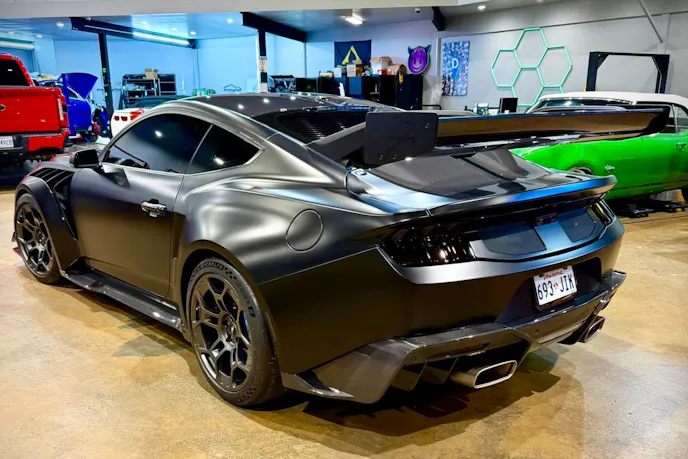
The foundation certainly looked promising. Even in stock form, the GTD’s Predator-based 5.2-liter V-8 already benefits from factory hot-rodding, dry-sump lubrication, and a chassis package developed by Multimatic to survive extended track sessions.
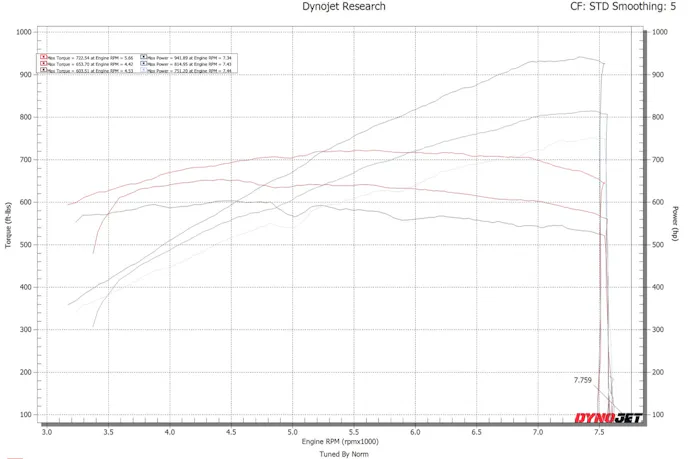
On the dyno, the stock car put down 751.20 horsepower and 603.51 lb-ft of torque at the wheels, but baseline testing also revealed conservative catalyst protection strategies and torque-management intervention built into the factory calibration. McAnelly started addressing those limitations with a set of Kooks long-tube headers for the GTD (P/N 11572600; $3,912.51) and a matching Kooks 3-inch long X-pipe system (P/N 11575180; $2,668.66), which significantly improved exhaust flow compared with the restrictive factory manifolds and catalyst arrangement.
Crucial Calibration
Before any serious tuning could happen, however, the crew first had to determine whether the GTD’s calibration could even be accessed and flashed through HP Tuners. That became one of the biggest early milestones in the project. Working alongside Eric Brooks at HP Tuners, the team successfully confirmed that the GTD would accept a flash calibration, opening the door for tuning changes that addressed airflow modeling, catalyst protection, and torque-management strategies.
Those initial changes immediately paid off. With only the Kooks exhaust system installed and revised tuning to accommodate the freer-flowing setup, the GTD jumped to 814.95 horsepower and 653.70 lb-ft of torque at the wheels. Just as important, the power curve cleaned up considerably through the midrange, eliminating many of the dips and soft spots visible in the stock dyno pull.
“While I was waiting on the GTD applications process to unfold, I began reaching out to companies that had made parts for the GT500 to see if they were interested in making parts for the GTD,” McAnelly said. “Kooks was my first choice because they are the best at what they do. They were very interested in making a system for the GTD, and it just took off from there. They were a great company to work with, and I am extremely happy with the system they built for the GTD.”
Once the team confirmed the GTD could be tuned successfully, the project escalated quickly into a full-bolt-on combination built around improving airflow and fuel delivery throughout the entire system. The stock supercharger was replaced with a Kong Performance CNC-ported Raptor R blower ($1,275 for porting service) which reshapes the blower inlet and discharge sections to move more air at elevated boost levels.
Total Package
Supporting the blower upgrades are a VMP Apex Predator supercharger lid and Race intercooler core (P/N VMP-APX023; $2,999.99), which increases intercooler capacity and improves airflow through the lid assembly. The combo also received a VMP 108mm throttle body (P/N VMP-GT108MM; $999.99), though the team says the factory inlet tract remains one of the largest restrictions until a dedicated GTD carbon-fiber intake system currently being developed by VMP becomes available.
Fuel system upgrades were equally important once the combination moved to E85 fuel. Injector Dynamics ID1300-XDS injectors (P/N 1300.60.14.14B.8; $2,125.20) and SPE Motorsport fuel rails (P/N SPE-P100143; $259.99) increased fuel delivery capacity, while a JMS FuelMAX (P/N P2000GMP2; $450.99) helped maintain pump voltage and fuel pressure under load. Installing the JMS system on the GTD proved more involved than on a standard Mustang because of the car’s unique rear packaging and transaxle layout, requiring disassembly around the rear suspension display and interior structure to properly route wiring through the chassis.
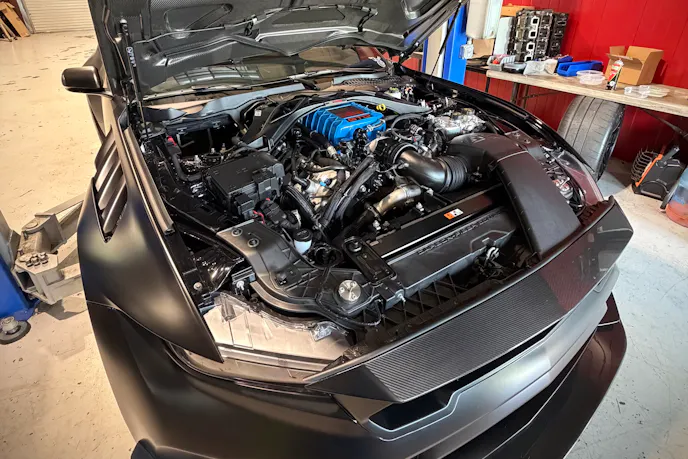
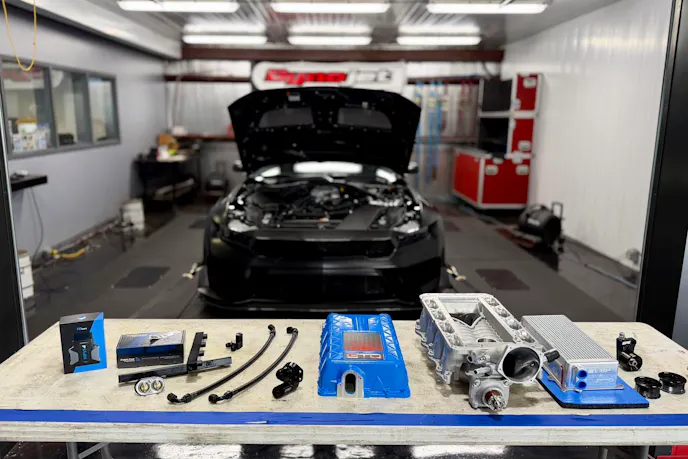
The team also added an SPE Motorsport auxiliary idler (P/N SPE-P100121; $219.00) and a 2.7-inch upper pulley (P/N SPE-P100270; $149.99) to increase blower speed, while revised calibration work optimized the setup for ethanol fuel and additional airflow. Even at that stage, the GTD still fought factory airflow and torque-management limitations, along with the stock 7,500-rpm rev limiter.
“The results look promising. The Kooks headers produced a 25-horsepower gain, and then tuned with headers produced around 63-horsepower gains,” McAnelly said. “Then we added the mod list of parts, and the GTD makes 100 horsepower more than the modified, 1,100-horsepower GT500 all the way up the curve. It made 949 horsepower, slamming against the limiter. Once we get past the limiter, figure a few more things out, and get the VMP intake installed, I believe it will make close to 1,200 horsepower.”
Super Power
At its stage, the GTD now produces 941.89 horsepower and 722.54 lb-ft of torque at the wheels. Considering the combination still retains the factory long-block and stock-style inlet arrangement, those numbers are impressive on their own, but McAnelly says the way the GTD delivers power separates it from the high-horsepower GT500 builds he is accustomed to driving.
Part of that comes from the GTD’s chassis layout. The rear-mounted transaxle, near-50/50 weight distribution, and advanced Multimatic suspension package fundamentally change how the car applies power compared with a traditional front-engine Mustang. Rather than simply overwhelming the rear tires, the GTD appears capable of putting substantial power to the ground with surprising stability and composure.
“At this point, my GTD is making around 950 at the wheels. It feels like it’s actually making over 1,000 on the street. What people don’t realize is that the 50/50 weight distribution and the trans being in the rear of the car really affect this car,” McAnelly explained.
Watching the build unfold also highlights just how extensively Ford and Multimatic reworked the GTD compared with a standard Mustang. The exposed rear suspension structure, dry-sump plumbing, carbon-intensive underbody, and integrated transaxle cooling systems reveal a platform that behaves more like a road-going race car than a traditional muscle car.
Strong Start
“It really hooks, and the power is much more usable. It’s currently in the 5-second, high-4-second 60-130 mph range,” McAnelly added. “I believe once I get the proper intake on the car, which is being made by VMP right now, and some more tuning parameters and the rev limiter patch, this car will make closer to 1,200 horsepower and a much faster 60-130 and 100-150 times. I am estimating it to easily be low-4- to high-3-second 60-130 and 100-150, no problem.”
Even so, the aftermarket wasted little time finding additional performance in the combination. The current setup has not yet crossed the four-digit threshold, but with additional inlet development, more calibration access, and room to push beyond the factory rev limiter, the combination clearly still has headroom left in it. Considering the GTD already picked up nearly 200 rear-wheel horsepower with bolt-on parts and tuning alone, the possibility of a 1,100- to 1,200-horsepower version seems reasonably attainable.
No matter how sophisticated Ford makes the platform, enthusiasts are still going to upgrade them for enhance performance. The GTD may have been engineered to battle Europe’s best on a road course, but McAnelly’s build proves V8 thrust remains a serious part of the car’s attraction, and when the rest of the mods come together, this modern supercar will flex some serious American muscle.
You might also like
Maximizing A 36-Year-Old Mustang’s Handling To Take On Exotics
A classic Mustang gets a Maximum Motorsports suspension upgrade. This serious handling hardware will help it take on exotics in Fox v Ferrari.