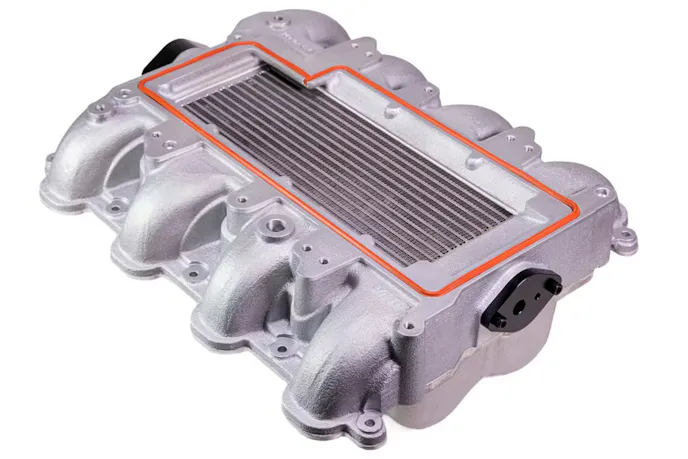
Like a titan roaring up from the depths of the ocean, Ford’s Godzilla 7.3-liter V8 engine brought pushrod power back to the Blue Oval arsenal. These engines are popping up in all sorts of projects, from restomods to race cars, and the aftermarket is embracing them with a range of upgrades. One such improvement is the VMP Performance Leviathan air-to-water intercooled manifold, and these two monsters recently met on the dyno at Willis Performance Enterprises.
By now you should know that during his time as Ford’s Director of Global Engine Engineering, Brian Wolfe shepherded the Godzilla engine into existence as an affordable, durable engine option for Super Duty trucks. Along the way, he may have also imbued it with some traits that set the platform up for a life as a performance engine. In retirement, Wolfe dedicated his time to extracting that performance at Willis Performance Enterprises.
“I want to understand the performance capabilities of the Godzilla using a lot of stock parts with various mass-produced aftermarket shelf stock parts and share the results with those building engines so they know what to expect as opposed to being told by someone what they think will work, but have no data to support their recommendations,” Wolfe said of his testing regimen.
Testing Its Mettle
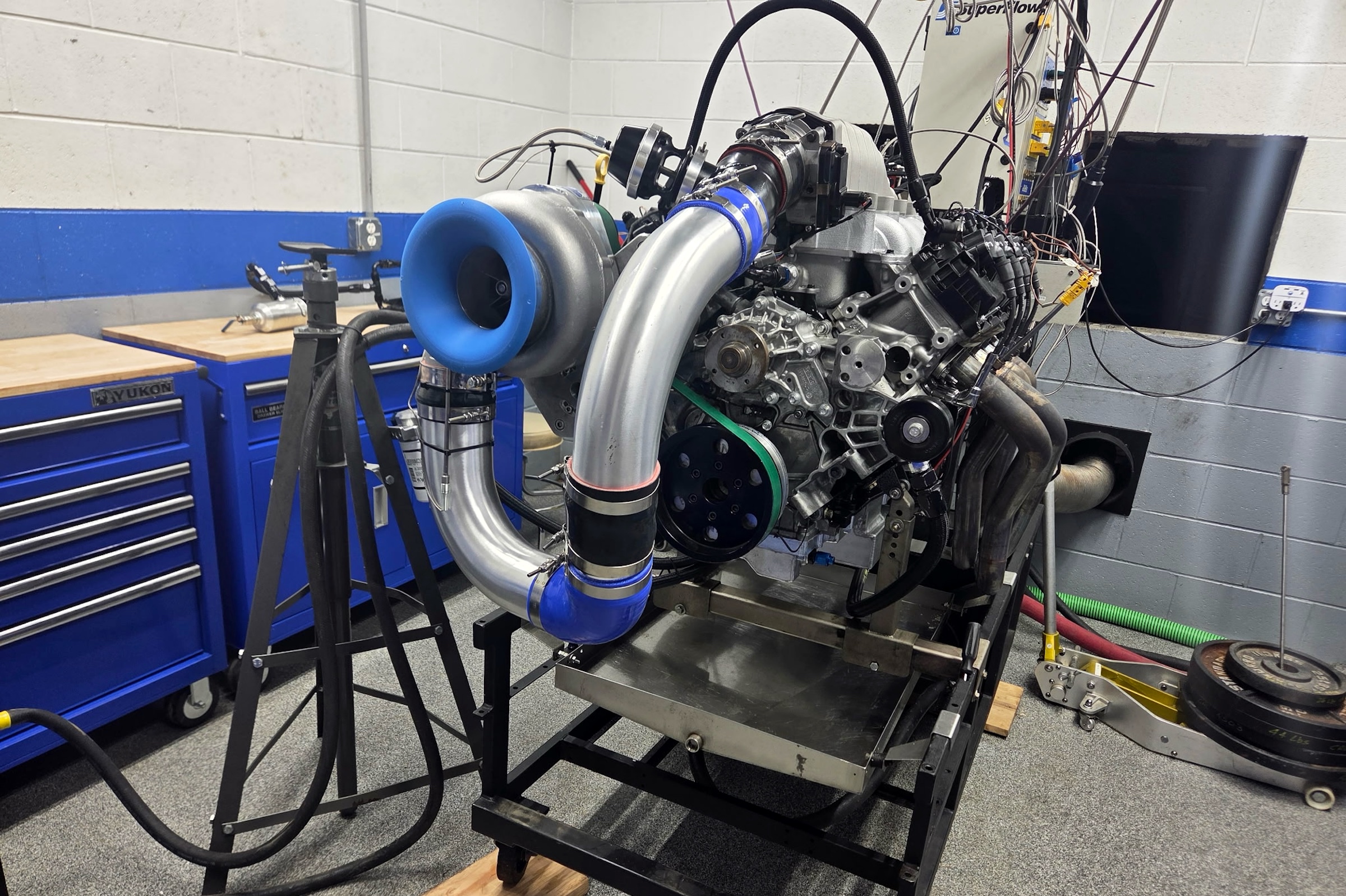
He recently put that philosophy to work by bolting a VMP Leviathan intercooled intake onto his 7.3-liter Godzilla V8 test mule. With a ProCharger F-1R-103 centrifugal supercharger providing the boost, the combination offered an opportunity to evaluate the new intake against an earlier air-to-air intercooler setup.
“This is a new product, and I wanted to see how it performed, which was quite exceptional,” Wolfe said of why he wanted to test the Leviathan.
For VMP Performance founder Justin Starkey, this intake also represents an expansion beyond the positive-displacement superchargers that established the company’s reputation. The Leviathan brings VMP’s experience with airflow and charge cooling to an engine platform that has attracted attention from street-car builders and racers alike.
“We’ve always been a positive-displacement blower company. In my early days of hot-rodding, I dabbled with everything on my own cars. After 20 years of PD-style blowers, I really wanted to be able to support customers on their power adder journey,” Starkey said of the Leviathan’s origin story. “In those 20 years, we’ve developed a bunch of very deep airflow and cooling experience, so we want to support customers on their entire performance modification journey, not just with PD-style blowers.”
The Godzilla’s architecture called for a dedicated design rather than a variation on an existing intake. Its layout differs from Ford’s other popular performance engines, presenting its own packaging challenges for an intake that incorporates an intercooler into the manifold assembly.
“There’s a ton of design and engineering in that intake. My core belief is to optimize and design right the first time. The 7.3 motor is laid out very differently than a Coyote, or even a traditional 5.4/5.8 Mod Motor,” Starkey explained. “We tweaked, repositioned, and mulled over a lot of design aspects before going into production. Luckily, this was all in CAD, which sped up the process.”
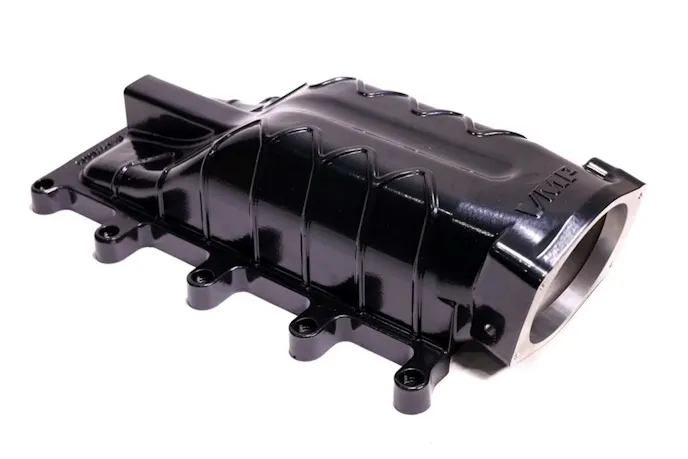
The resulting system consists of two primary components: the bare-aluminum VMP Leviathan Turbo Hat (P/N: VMP-LVN100; $799.99), and the VMP Leviathan lower intake manifold for the 7.3-liter Godzilla (P/N: VMP-LVN330; $2,399.99). The lower manifold incorporates -20 ORB connections for the intercooler plumbing, while the upper assembly completes the induction package around the integrated air-to-water intercooler. VMP also offers the turbo hats in Gloss black, while billet and low-profile versions are also on the way.
Monster Efficiency
The Leviathan had a serious assignment on Wolfe’s test engine. This wasn’t a stock Godzilla with a supercharger bolted on for a quick dyno pull. The engine retains its stock block, crankshaft, head castings, head gaskets, oil pump, cam drive, and rocker arms, but the combination includes the supporting modifications necessary to make big power.
The cylinder heads have been ported and fitted with 2.220-inch titanium intake valves and 1.700-inch stainless-steel exhaust valves. Upgraded springs, Manton 3/8-inch pushrods, and Johnson short-travel lifters work with a Brian Tooley Racing U231 camshaft.
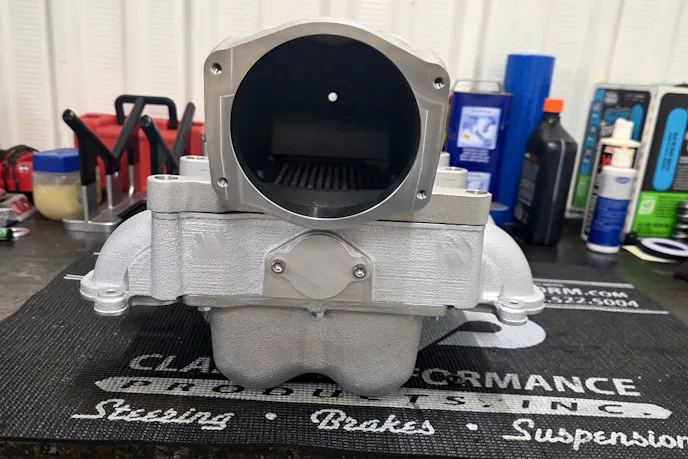
Forged pistons and connecting rods support the 10.1:1 compression ratio. Injector Dynamics 1,750cc injectors supplied the fuel, with an OBR ECU handling engine management. An Indy Power Products Eliminator oil pan rounded out the supporting hardware, while a 95mm throttle body fed the VMP intake.
The centrifugal supercharger run for this test was a ProCharger F-1R-103, driven by a 4-inch supercharger pulley and an 8-inch crank pulley. That combination yields a 10.8:1 overall drive ratio thanks to its 5.40:1 internal step-up ratio. At 7,000 engine rpm, the supercharger would turn approximately 75,600 rpm, assuming zero belt slip.
Wolfe ran verified pump E85 containing 85 to 90 percent ethanol, with conservative ignition timing and a commanded lambda of 0.82. The intercooler water started at 40 degrees, and the dyno data was corrected to standard conditions using SAE J607.
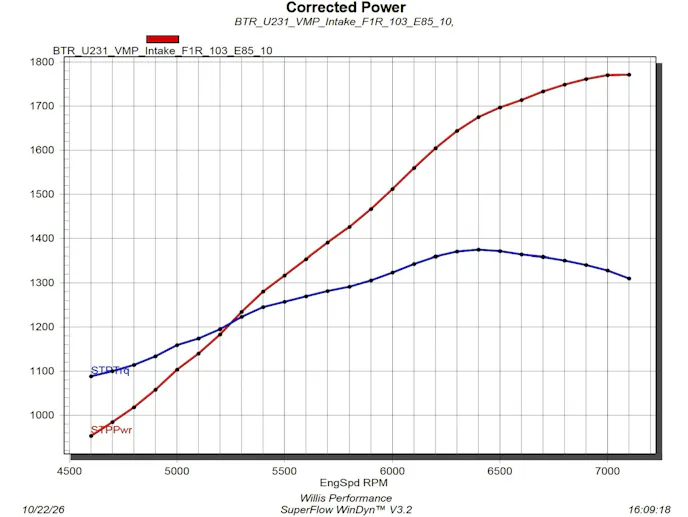
The four-digit numbers certainly got our attention. The Godzilla produced 1,771 horsepower at 7,100 rpm and 1,375 lb-ft of torque at 6,400 rpm. Those are engine-dyno figures, not rear-wheel numbers, but they illustrate the potential of a properly supported 7.3-liter combination under serious boost.
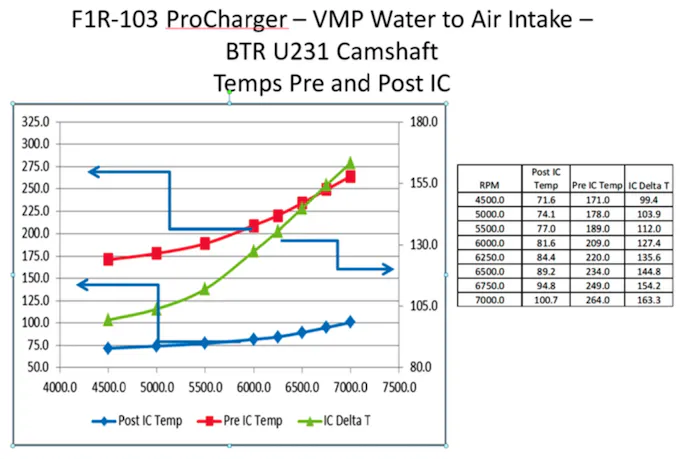
More importantly, the temperature measurements reveal what the Leviathan was doing with the incoming charge air. At 7,000 rpm, the air temperature dropped approximately 170 degrees across the intercooler, falling from about 270 degrees before cooling to roughly 100 degrees afterward.
Promising Performance
The pressure readings offer another useful data point. At 6,500 rpm, Wolfe recorded approximately 30 psi before the intercooler and 29 psi after it. That indicates about one psi of pressure drop at that point in the pull. The engine used a Ford Nano TMAP sensor rated at three bar absolute; however, the sensor could not accurately record boost at peak power.
“The results were great in my opinion; it picked up 40 horsepower over the air-to-air intercooler we tested with an F-1A-94, and although I did not run the 103 with the air-to-air, the results with the VMP were impressive, having reduced the air temp by about 170 degrees and making 1,771 horsepower,” Wolfe said.
The earlier air-to-air test used a ProCharger F-1A-94, while the latest evaluation paired the Leviathan with the larger F-1R-103. The new combination delivered approximately 200 more horsepower than the F-1A-94 reference setup, with the Leviathan helping manage the heat generated by the larger supercharger. For a high-output Godzilla, that kind of charge-temperature reduction is an important part of building a combination that can make big power without letting intake heat get out of hand.
For Starkey, the results reinforced the value of bringing effective charge cooling to the Godzilla platform, particularly for racers looking to manage heat without giving away pressure across the intercooler.
“I’m blown away; it seems this is what Godzilla has needed all along,” Starkey reacted. “We’re getting similar correlation from our racers as well,” he said. “Air to water keeps temps under control, which keeps tuners happy. Air to water also keeps pressure drop minimal, and that’s where the power differences compared to air to air are amazing.”
Street Or Race
While it is a great option for a race car, this air-to-water intercooler also makes sense for a street car, as you don’t have to run near-freezing coolant to get a performance improvement with the Leviathan.
“People often think about air-to-water as requiring ice, and that’s certainly an option, but it’s not a requirement. You can run a full cooling loop with no ice tank using conventional parts,” Starkey said of the Leviathan’s streetability. “You just need a pump, reservoir, and heat exchanger. These parts are already in the VMP catalog, and we plan to offer them for our Leviathan air-to-water customers, all for under $1,000. We’re also upping our ice tank game with some new offerings at SEMA.”
That flexibility gives builders options for configuring the system around how they use their vehicles. A street-driven Godzilla can run a heat exchanger, while a dedicated drag-race combination can incorporate an ice tank when the goal is to start a pass with the intercooler coolant as cold as practical. Either way, the supporting hardware and calibration need to suit the engine’s output and intended use.
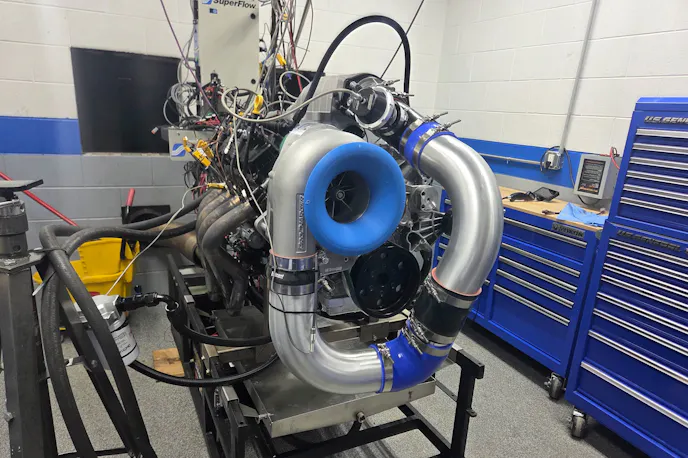
A 1,771-horsepower dyno combination is a long way from an everyday truck or street Mustang, and the Leviathan’s results shouldn’t be taken as a promise of similar numbers on every engine. Supercharger selection, pulley ratio, fuel, engine build, calibration, and intercooler conditions all play a part. However, Wolfe’s test provides a compelling look at the system’s capabilities under serious boost, though street-driven combinations will face different operating conditions and demands.
Of course, Wolfe isn’t done exploring the Godzilla’s potential. His next round of testing is slated to examine larger, crankshaft-driven ProChargers. The plan calls for initial testing with race fuel and the VMP intake before sampling other hardware.
For now, however, the early returns on the VMP Leviathan are impressive, yielding a roughly 170-degree reduction in charge temperature while supporting 1,771 horsepower. For Ford fans chasing serious pushrod power, this intercooled intake offers a promising approach to induction/charge cooling.
You might also like
Star Drivers Race For Each Military Branch In Veterans Day Classic
Ford names 12 drivers for the Veterans Day Classic at Daytona. Six Mustang Dark Horse R teams will honor America’s military branches.