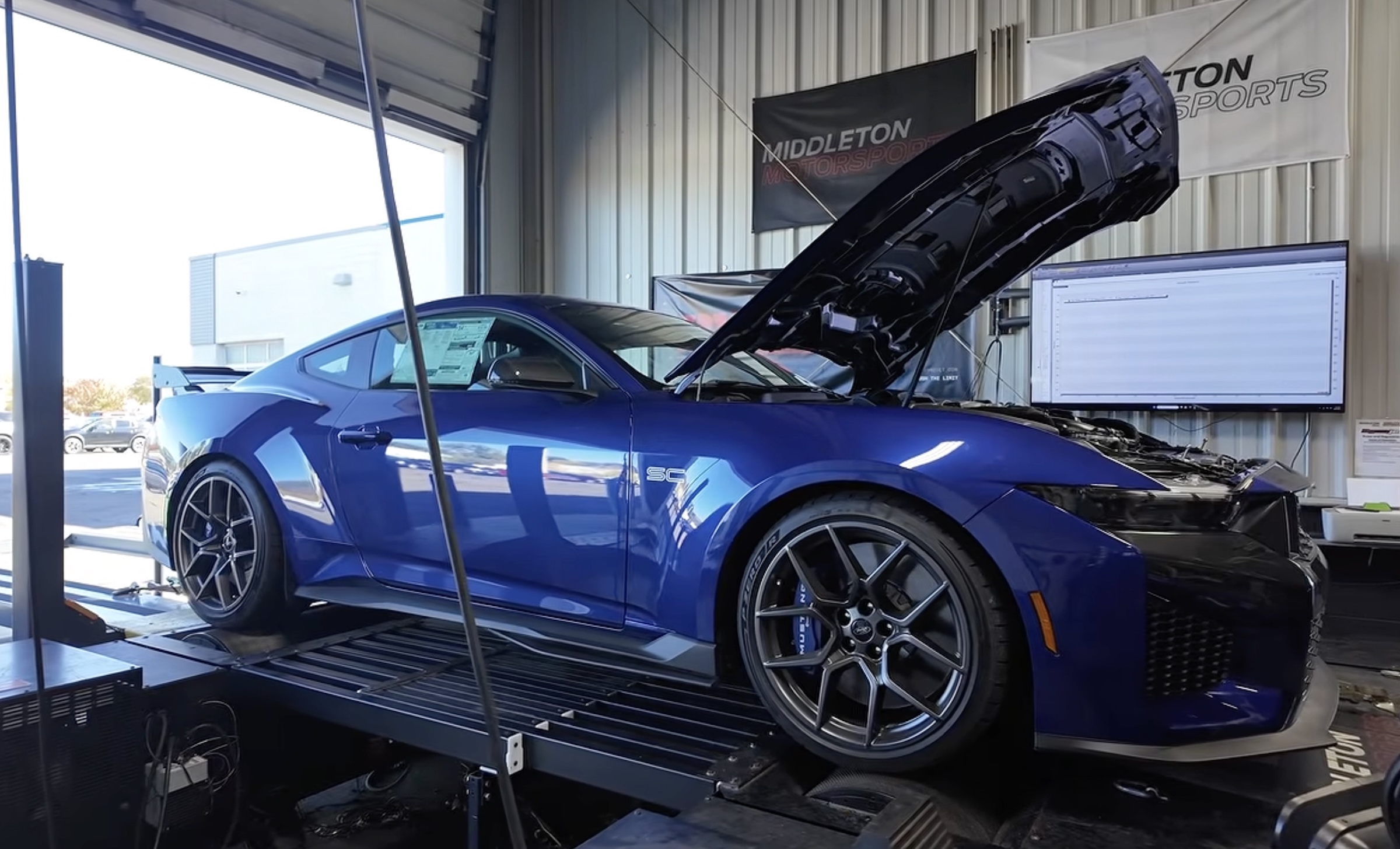
Now that the Mustang Dark Horse SCs are in the wild, we can expect their power to ramp up fast. However, before the mods start pouring in and the internet microrecords are logged, many would like to know how it stacks up to the previous Shelby GT500. The crew at Middleton Motorsports broke their car in and strapped it to the chassis dyno to see if Ford’s latest supercharged king has a performance edge.
The early verdict? Ford’s latest Predator-powered Mustang delivers more than a bump in peak output. During a stock-versus-stock comparison, the 2026 Mustang Dark Horse SC put down 703 horsepower and nearly 600 lb-ft of torque at the wheels, while its power curve showed a significant advantage over a stock 2022 Shelby GT500 through the midrange.
Matt Peckham, Lead Tuner and Technician at Middleton Motorsports, walked through the results in the shop’s Behind the Tune video series, using familiar GT500 data to examine how Ford has refined the supercharged Mustang formula.
The Dark Horse SC follows the GT500 playbook, pairing a supercharged, 5.2-liter Predator V8 with a seven-speed dual-clutch transmission. Ford rates the new Mustang at 795 horsepower and 660 lb-ft of torque at the crankshaft, a 35-horsepower increase over the S550 GT500’s 760-horsepower rating.
Baseline Model
Middleton’s test car was an Argon Blue base car fitted with the Carbon Fiber Appearance Package and dark-painted wheels. Under the hood, the Predator architecture remains familiar, but revised sensors, engine-management hardware, and calibration strategies distinguish the new car from its predecessor.
After several warm-up pulls on Middleton Motorsports’ Dynojet, the Dark Horse SC produced 694 horsepower and 594 lb-ft of torque at the wheels. With additional testing and temperature management, it delivered a best run of 703 horsepower and 599.64 lb-ft.
That’s stout output for a factory-stock Mustang, but the overlay with the GT500 tells the more interesting story. For the comparison, Peckham pulled up data from a stock 2022 Shelby GT500, a low-mileage car he knew well. Both Mustangs ran quality 93-octane gasoline, and the weather conditions were similar; although the tests took place on different days, the Dark Horse SC’s advantage was apparent across much of the pull.

“We’re making substantially more power than the GT500, which is a cool comparison to see, ” Peckham said.
That broader power advantage could matter when the car is working through the gears. With a dual-clutch transmission, engine speed drops during each upshift, making the power available after the shift an important part of the acceleration equation. More midrange grunt means the engine has more muscle when it lands in the next gear, rather than relying on a peak horsepower number that appears only near redline.
“You can see Ford did some refinements in the midrange here and gave us a lot more of a linear power curve over the previous car,” Peckham said. “You’re talking some pretty big gains. We’re talking, again, 70 lb-ft of torque in the midrange, 70 horsepower.”
Potent Predator
So where does that extra performance come from? Peckham’s data-log analysis points to changes in Ford’s catalytic-converter overtemperature protection strategy.
Under heavy load, the engine calibration enriches the air/fuel mixture to help control exhaust temperatures. That protection is necessary, but adding extra fuel can cost horsepower. In his GT500 testing, Peckham regularly observed a substantial enrichment beginning around 5,400 to 5,800 rpm. The richer mixture could remain in place until the upper reaches of the rev range, creating a noticeable dip in power before the engine recovered.
The Dark Horse SC takes a more staged approach. Peckham observed an initial enrichment event around 4,200 rpm, followed by another step toward a richer mixture near 6,000 rpm. Instead of one pronounced change followed by a return toward a leaner boosted mixture, the new calibration manages enrichment in stages.

The result is a more linear power curve, with less of the midrange sag that characterized the S550 GT500’s power curve.
“Ford has definitely changed the strategy on the Dark Horse SC, and it produces a much more linear power curve,” Peckham said.
The newer Mustang also makes use of Bosch’s MG1 engine-management processor in place of the older TC298 TriCore unit found in the S550 GT500. Peckham noted additional differences in mapped operating points and variable valve-timing strategies, areas he plans to explore further as more cars reach the shop.
During the Dark Horse SC dyno session, boost registered approximately 12 to 12.5 pounds. It also showed the familiar effects of heat during repeated pulls, losing some output after heat soaking before recovering when temperatures came back under control.
Just The Beginning
There are limits to what one dyno comparison can prove. The cars were tested on different days, and chassis-dyno results can vary with conditions and equipment. Track performance also depends on vehicle weight, tire grip, launch strategy, transmission calibration, and race-day conditions.
Middleton’s test car was a standard Dark Horse SC, not a Track Pack model. The optional package adds carbon-fiber components and carbon-ceramic brakes, which change the weight equation and make for another worthwhile comparison down the road.
Now the tuners get their turn. As calibration development advances and owners begin experimenting with modifications, we’ll see how much more performance the new Predator package has in reserve. We can’t wait to see what these cars do when they are modded, as that will really show how far the Dark Horse SC has come. Let the games begin.
You might also like
Foxzilla Roars Back To Life With An All-Natural, Modernized Mission
Foxzilla returns with a naturally aspirated 7.3-liter Godzilla and an 8HP automatic. It will also add modern traction control and ABS.