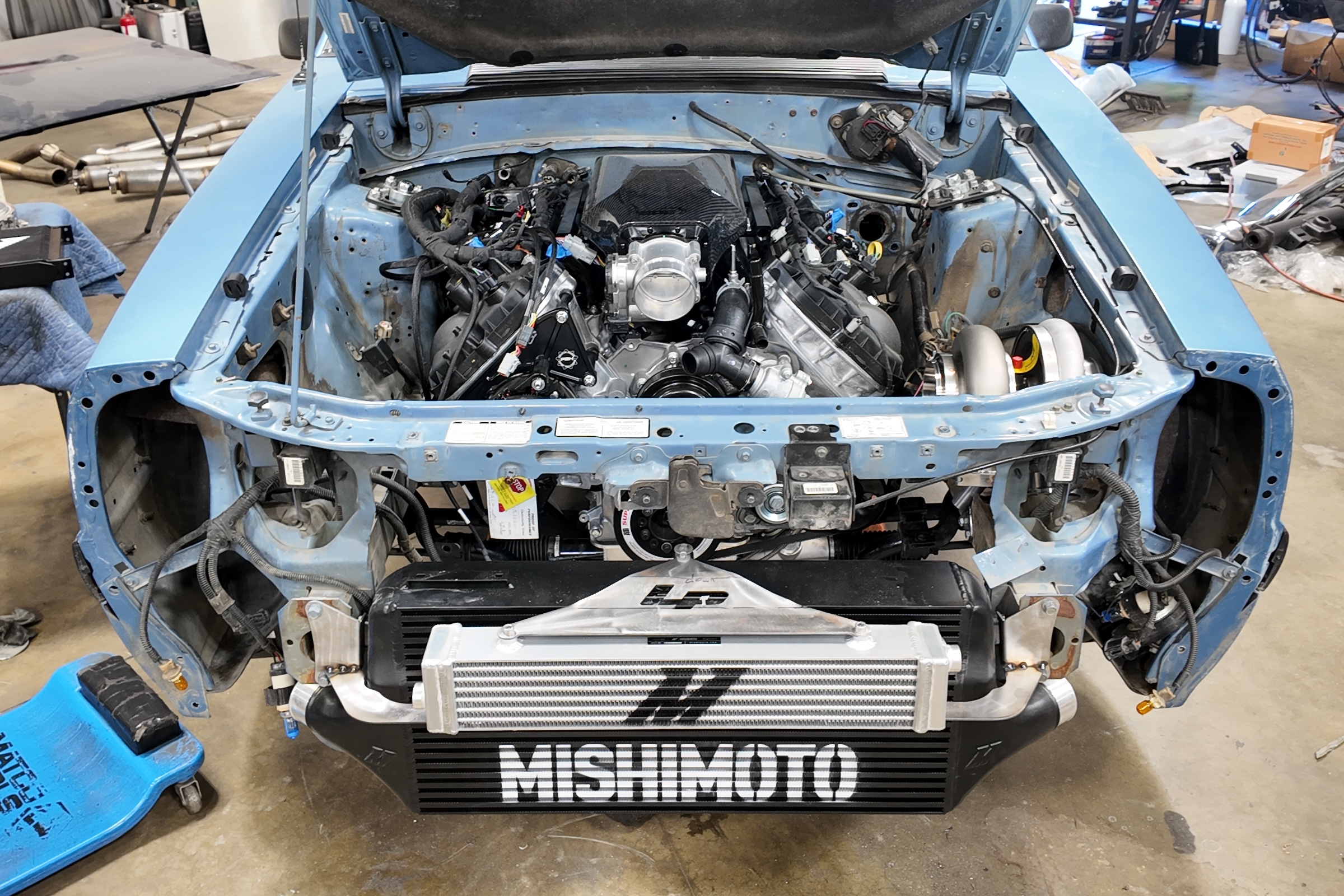
When we last caught up with the 1990 Mustang LX coupe drafted as the star of the latest Horsepower Wars installment, Fox v Ferrari, the crew at RPG Racing Engines constructed a 314-cube Gen 3 Coyote based on the vaunted Predator 5.2 engine block. That engine is designed to flourish with turbo boost, and the engine and the Fox returned to LP Racing for a custom single-turbo setup to provide that unnatural airflow.
The target is 800 to 900 rear-wheel horsepower, with room to push beyond 1,000 if the competition demands it. Getting there requires more than bolting on a big turbo. The exhaust, charge-air plumbing, and boost-control hardware must work together, all while fitting inside a Fox Mustang engine bay.
LP Racing tackled the job with purpose-built Coyote turbo headers, an HPT turbocharger, Mishimoto plumbing, and Turbosmart control hardware. Rather than adapting a universal kit, the LP Racing crew fabricated the system around this car and its mission.
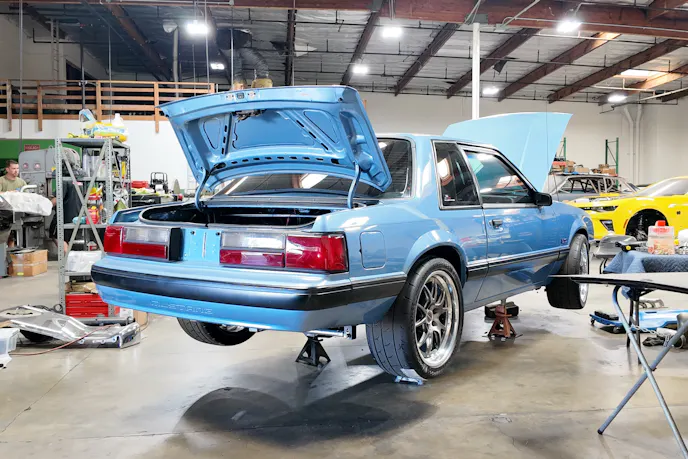
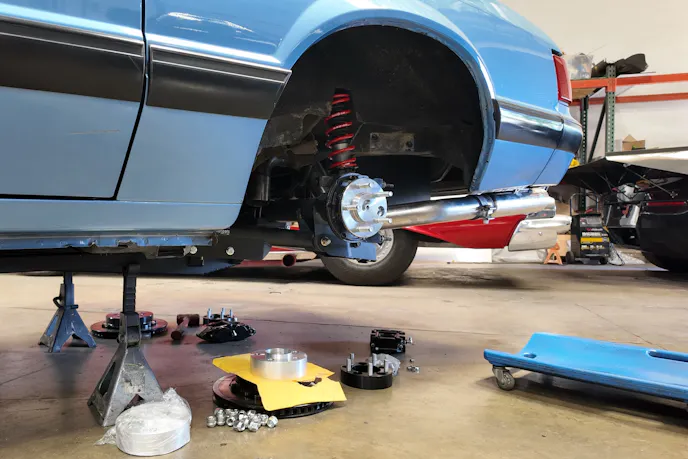
The Fox v Ferrari Mustang already has the chassis and suspension upgrades to support its ambitions. Full-length subframe connectors and a custom six-point-style roll cage reinforce the unibody, while a complete Maximum Motorsports suspension, Forgeline GA3 wheels, 275/35-18 Hoosier TrackAttack Pro tires, and Wilwood brakes prepare it for more than straight-line punishment.
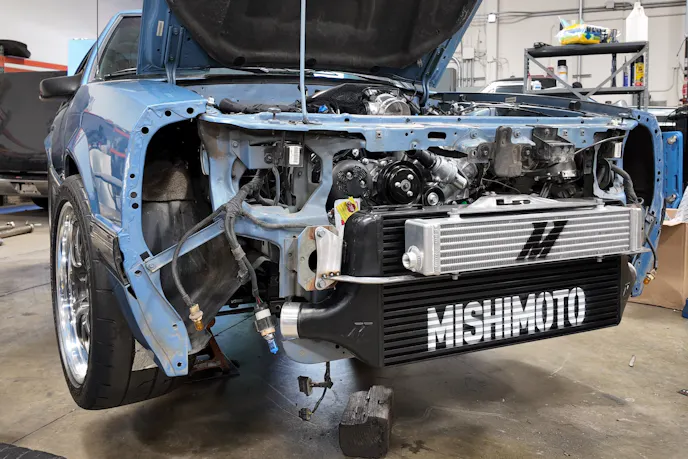
Under the hood, RPG Racing Engines built a 314-cubic-inch Gen 3 Coyote around the Ford Racing Predator 5.2-liter block. Now LP Racing is adding the airflow needed to turn that foundation into an exotic-challenging performer.
The objective isn’t just a big dyno number. The Mustang needs to deliver power with the response and consistency to make it count on the street, drag strip, and road course.
The Boostmaker
The centerpiece is an HPT F3 7675 turbocharger (P/N: F3-7675-96T4S; $2,655.95). It has a .96 A/R V-band turbine housing and HPT Quick Spool Technology, which are intended to balance airflow capacity with responsive boost delivery.
“The F3 7675 is a great fit for this combination because it’s capable of making serious power while still prioritizing turbo response. The V-band .96 A/R housing helps tailor the turbo to the engine and the car’s performance goals,” Tristan Kimpel, Sales and Technical Support Representative at HPT Turbochargers, said. “With a built Coyote, we want a turbo that can support the horsepower target without giving up the response needed to make the car competitive. It’s all about getting the combination right, not just chasing a big horsepower number.”
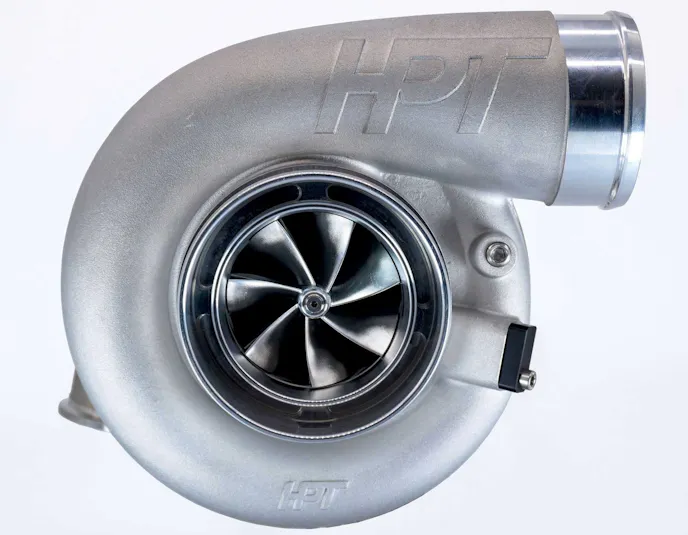
Key to helping this Fox power out of the corners and leap ahead in a roll race, HPT’s Quick Spool Technology helps the turbo build boost quickly when the driver’s right foot commands it.
“Quick Spool Technology is designed to help the turbo spool faster and improve throttle response. HPT achieves this through a combination of a lightweight rotating assembly, a low-friction dual ball-bearing system, and turbo aerodynamics designed to work together efficiently,” Kimpel explained. “For this Fox, that means the ability to build boost quickly while still having a turbo capable of supporting the car’s horsepower goals. When you’re racing against modern exotics, response matters. You want the power there when you need it, not waiting for the turbo to catch up.”
A single turbo also reduces the number of major components competing for space in the engine bay compared with a twin-turbo arrangement.
“A properly sized single turbo can be more efficient than a twin-turbo setup for this application. With the right turbo matched to the engine and horsepower goals, you can make the power you need without the added complexity and extra components of a twin-turbo system,” Kimpel said. “The key is choosing the right turbo for the combination to deliver the power and response this Fox-body needs to be competitive.”
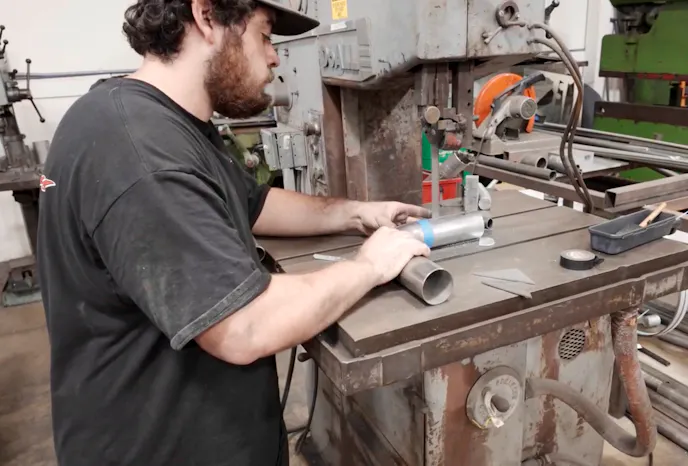
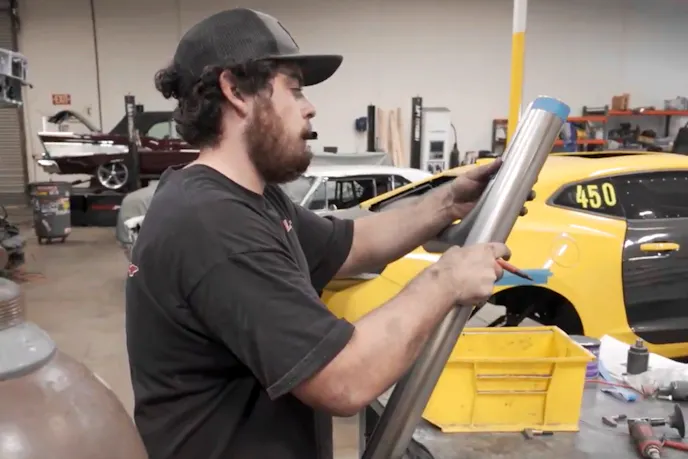
Boost control comes from a Turbosmart Gen-V HyperGate45 45mm external wastegate with a 7-psi spring (P/N: TS-0553-1002; $518.99). A Turbosmart Gen-V RacePort blow-off valve (P/N: TS-0204-1132; $355.99) releases pressurized air when the throttle closes, helping protect the compressor from surge. The final boost level and power output will depend on the complete combination, including the fuel system and calibration.
Custom Install
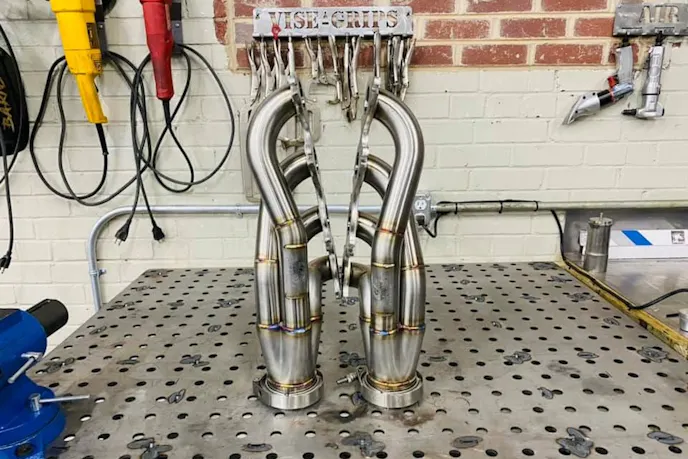
LP Racing began the hot-side fabrication with Fox/SN-95 Coyote Turbo Headers in race configuration from Barnbilt Speed and Fab (P/N: N/A; $1,657.85). Designed for Fox Mustang and SN-95 Coyote swaps, these forward-facing headers prioritize turbo clearance over retaining air conditioning.
The hand-built headers feature TIG-welded, back-purged 304 stainless-steel primary tubes and collectors, with 3/8-inch stainless-steel flanges. The standard configuration uses 1-3/4-inch primaries and 2-1/2-inch collectors.
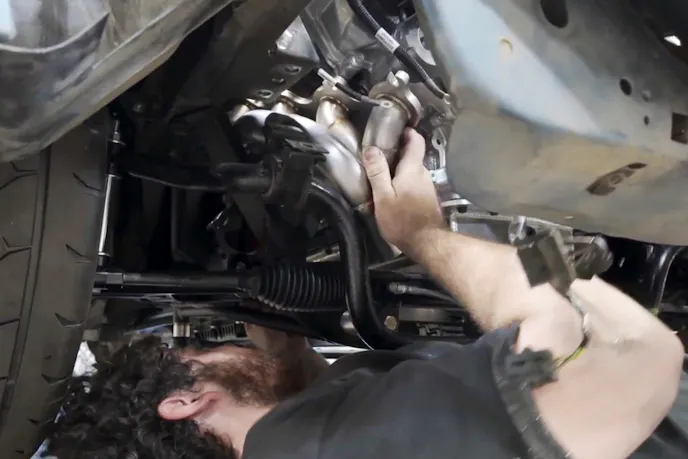
With the headers fitted, the next challenge was routing the exhaust into the turbo while preserving room for the downpipe, wastegate, and existing exhaust system.
“That part of the setup is finished, so now these headers fit. I guess the idea is to keep the hot side somewhat tight, but we have to leave a big enough opening for the exhaust pipe to pass through underneath and tie into the off-the-shelf exhaust,” Lang Paciulli, of LP Racing, said. “It’ll be 2-1/2-inch pipes merging, leaving enough room for a downpipe. The downpipe will come out at 4 inches, and we’ll probably have to neck it down to 3 inches. Then, underneath, it can go back up to 3 inches. The wastegates will go wherever they fit.”
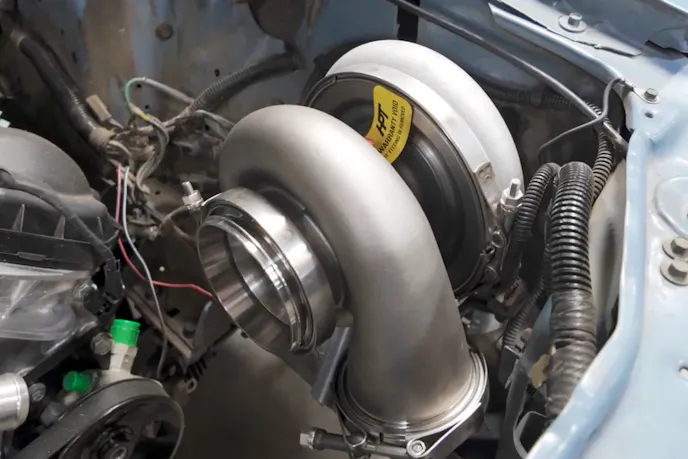
That layout dictates how the hot side fits beneath the car. LP Racing modified Mishimoto stainless-steel exhaust piping to accommodate the merge and downpipe while working around the available space. It is the kind of detail that separates a properly packaged custom system from a collection of parts that merely bolt together.
The cold side presented fewer complications. LP Racing installed a Mishimoto M-Line universal intercooler (P/N: MMINT-UMB; $330.95), featuring an aluminum core measuring 23.5 inches long, 11.75 inches tall, and 3 inches thick. The 3-inch inlet and outlet connections accommodate the charge-air plumbing.
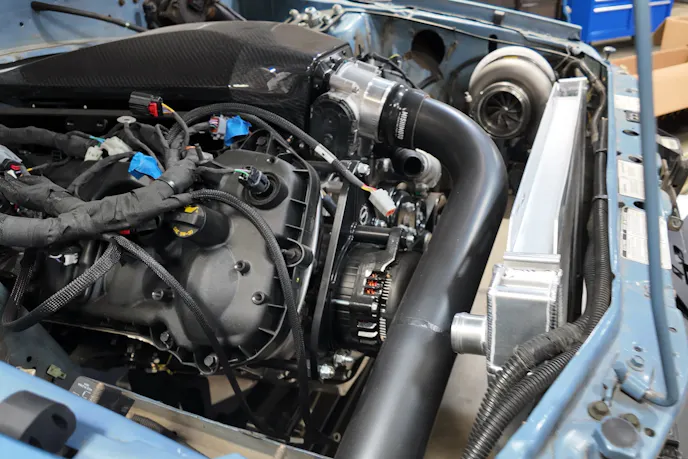
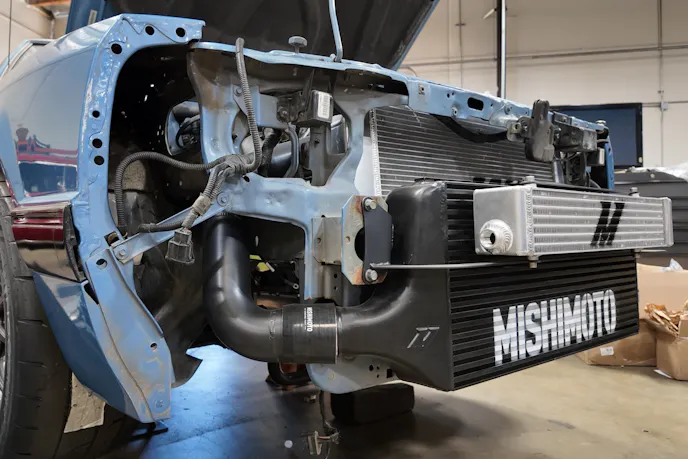
The intercooler sits between the turbocharger and throttle body, cooling the compressed air before it enters the engine. LP Racing adapted Mishimoto stainless-steel piping to connect the components and route the charge air through the available space.
“This is one of the simplest jobs ever when it comes to cold-side plumbing, aside from the intercooler. It’s literally just a tube path,” Paciulli said. “We made some access holes in the fender walls, and that’s it. So, it’s probably one of the easiest cold-side setups on a car.”
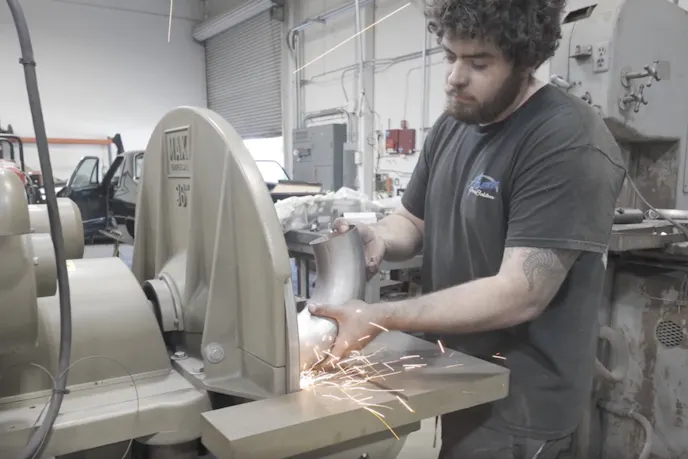
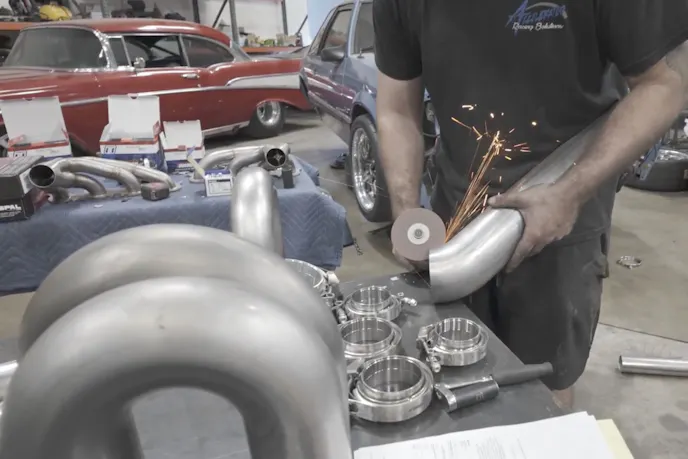
With those access points established, the LP Racing crew trimmed the inlet tubing to fit the compressor and routed the intercooler discharge toward the throttle body. The inlet supplies fresh air to the turbo; the discharge side carries pressurized air through the intercooler and into the engine. Both paths must remain secure and unrestricted enough to support the intended airflow.
The assembled system brings the HPT turbocharger, Barnbilt headers, Mishimoto intercooler and piping, and Turbosmart control hardware together in one package to meet the car’s projected horsepower goals.
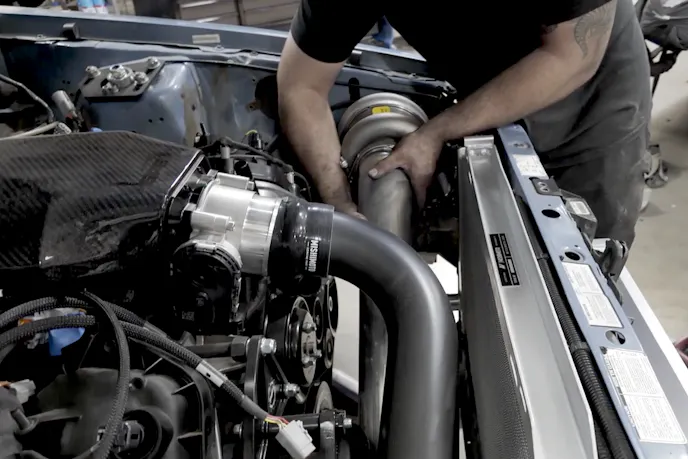
“The F3 7675 has the potential to support the 800-900 rear-wheel horsepower goal, but the final result depends on the entire combination. The engine, fuel system, boost level, exhaust setup, and tuning all play a role,” Kimpel said. “With the right supporting components and a solid tune, that’s a realistic target to work toward. We want to make sure the turbo and the rest of the combination work together to deliver the power and response this car needs.”
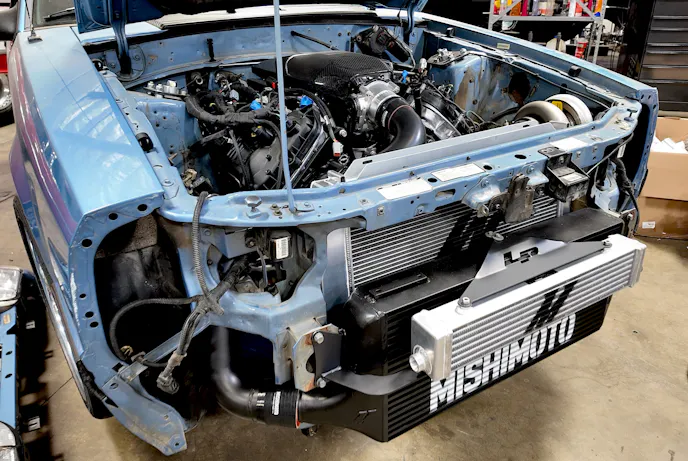
Next, the project heads to Papini’s Garage for the installation of the fuel system. With that work and tuning still ahead, the Fox v Ferrari project hasn’t yet delivered its final numbers. But the turbo system is taking shape, bringing this classic Mustang closer to its next challenge of putting modern exotic performance in its rearview mirror.
Horsepower Wars would like to thank its sponsors for making this show happen, including (in no particular order): Old World Industries/PEAK, VP Racing, COMP Cams, ARP, ATI Performance Products, JE Pistons, Boostline Connecting Rods, Total Seal, Cometic Gasket, Moroso, Hoosier Racing Tire, ECU Master USA, HP Turbo, Pure Drivetrain Solutions, SPE Motorsport, Moser Engineering, Delta ABS, Forgeline Motorsports, and Maximum Motorsports.
You might also like
This 1987 Saleen Mustang Came Back Home From The Ashes
A fire nearly finished this 1987 Saleen Mustang. See how a 331 stroker, Vortech boost, and Griggs suspension brought it back.