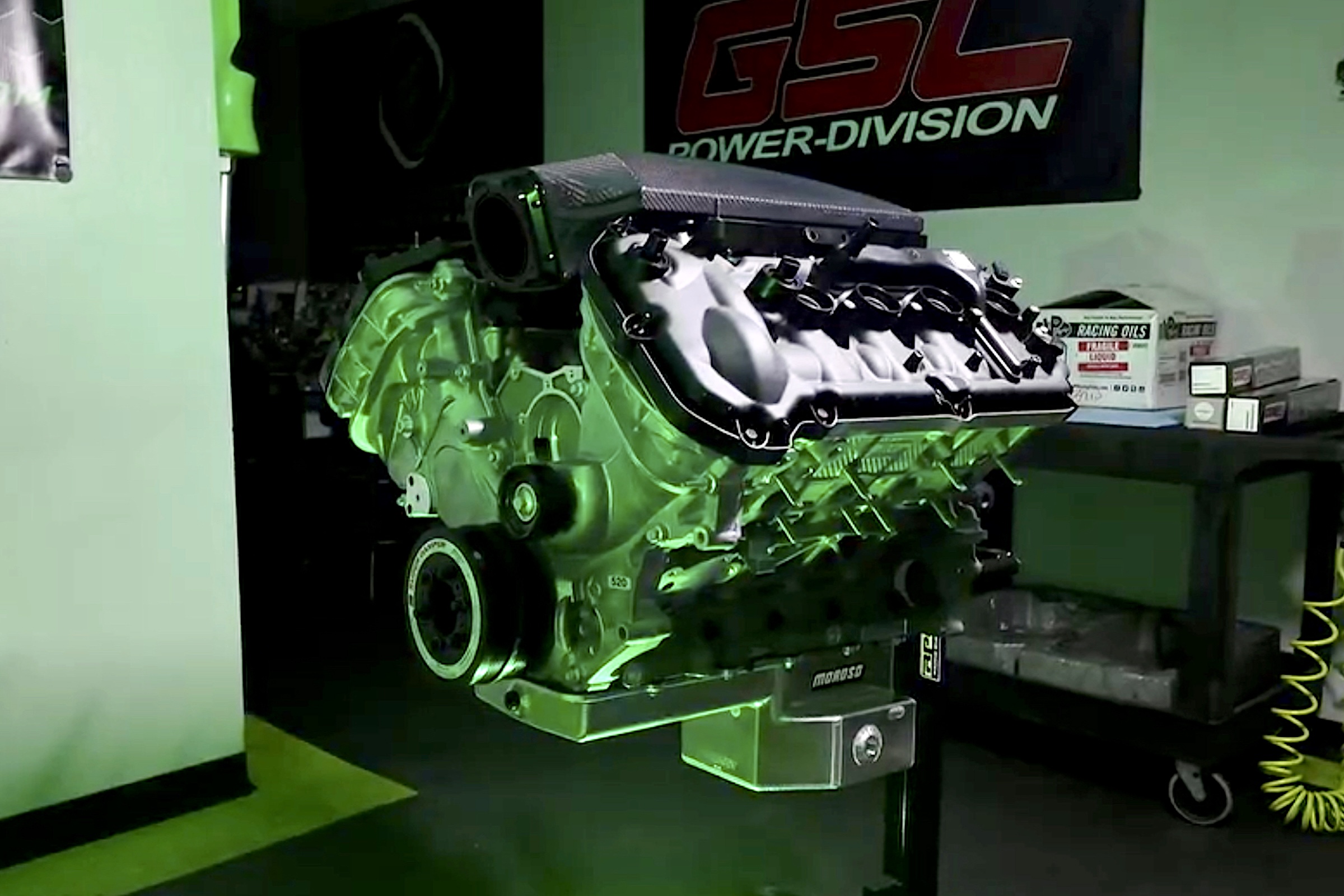
For those following the progression of the 1990 Mustang LX coupe charged with taking on exotics in this season of Horsepower Wars: Fox v Ferrari, you know this project is making progress. Now it is time to build an engine capable of fulfilling its mission, so RPG Racing Engines got the call to create a robust Gen 3 Coyote based on the vaunted Predator 5.2-liter block created for the S550 GT500.
The plan calls for serious power, but this Fox has more to do than blast down a drag strip. It needs an engine capable of supporting road-course sessions, hard acceleration, and everyday driving, with enough headroom to turn up the wick when the time comes.


RPG Racing Engines owner Will Rollins and his crew built the 5.2-liter engine based on that mission, combining the Predator block with upgraded internals, a custom camshaft package, and supporting hardware selected for the planned single-turbo setup. The initial target is 800 to 900 horsepower on low boost and conservative tuning, with the potential to push beyond 1,000 horsepower if necessary.
Ford-Bred
Enlisting RPG was a natural fit for the project as Rollins’ engine-building roots run deep. He was essentially born into a mechanical path in life and followed it into a successful business.
“My dad and high school shop teacher provided amazing early instruction on basic engine fundamentals and operation, which I built upon through accredited trade schools before venturing out on my own,” Will Rollins, owner of RPG Racing Engines, said. “RPG started in 2004 with me building engines in the garage for friends, and one thing led to another, with now our 7,500-square-foot facility and one amazing team making it all happen!”

Ford power has been part of that journey from the beginning, thanks to a family history that spans several generations of Blue Oval engines.
“Specializing in Fords and the Coyote stems from my grandfather and father; both were through-and-through Ford guys, working with everything from early FE to Windsor engines,” Rollins explained. “That’s how I grew up, and it’s why we specialize in the Ford Coyote platform.”

For the Fox v Ferrari project, RPG began with the Ford Racing Predator 5.2-liter block as the foundation. Developed for the supercharged S550 Shelby GT500, the Predator block provides the structure to build a rugged and powerful engine. From there, RPG assembled a combination intended to handle the demands of turbocharging without losing sight of the car’s multi-purpose mission.
Internal Strength
The 314-cube short-block pairs the robust Predator foundation with King bearings, ARP main fasteners, Boostline connecting rods (P/N: FD5933-866; $1,349.99), JE pistons (P/N: JE 353905; $989.99), and Total Seal piston rings. These components form the core of the rotating assembly and support the goal of making substantial power while maintaining reliability.

ARP hardware — including an ARP Coyote Head Stud Kit (P/N: 256-4302), an ARP Cam Phaser Bolt Kit (P/N: 256-1003), and an ARP Coyote Balancer Bolt Kit (P/N: 156-2502) — secured the critical engine components. Meanwhile, VP Racing Fuels Engine Assembly Lube (P/N: 2251; $9.27) provided lubrication for components as they were installed.


RPG took a straightforward approach to construct the engine with the intended performance in mind. With the turbo system still to come, the short-block needs to provide a solid foundation for the performance and durability goals ahead.
Head Games
Topping the Predator block are Gen 3 Coyote cylinder heads that deliver plenty of airflow to the table, so they didn’t require extensive reworking to meet the performance goals of this build.
“The factory Gen 3 heads flow so well, they are essentially as-cast GT350 heads in regards to the ports,” Rollins explained. “So beyond a slight bowl area cleanup above the valve, no additional head work was needed.”

Instead, RPG concentrated on valvetrain components suited to the application. As such, they replaced the stock valves with Manley stainless steel intake and exhaust valves and upgraded the valve springs with COMP Cams.
“Knowing this was going to be a turbocharged application, we knew we needed to upgrade the valve springs to eliminate possible valve float issues and replace the stock valves with Manley stainless steel intake and exhaust valves to handle the heat and pressures of the turbocharged combo,” Rollins said.

Cometic MLS head gaskets (P/N: C15435-040; $147.49, right, and P/N: C15436-040; $147.49, left)and ARP head studs complete the cylinder-head team-up to ensure the turbo boost stays in the cylinders where it belongs.

Cammed For Boost
Camshaft selection was another important piece of the puzzle. COMP Cams supplied a billet camshaft set (P/N: 433420; $1,719.96) with an exhaust-biased profile intended to help the turbocharger reach its effective operating range quickly.
“COMP Cams has been crucial in grinding us amazing cams for so many of our builds, so it was only natural to have them grind us a nice, billet cam set for this combo that favors the exhaust to help the turbo get into its sweet spot quickly,” Rollins explained.

RPG also added supporting lubrication components, including a Melling oil pump, a Moroso road-race baffled aluminum oil pan (P/N: 20576; $723.99), and a Moroso pickup tube (P/N: 24578; $252.99). The baffled pan is important for this combination, which will prove its merit on the road course. Oil control is a crucial consideration when a car is asked to corner hard, making the pan and pickup part of the overall performance package.

To properly feed the cammed Coyote, it is topped by an SPE Motorsport carbon fiber intake manifold (P/N: SPE-C100193; $3,900), which has already proven highly effective on Project Airstrike.
Power To Spare
More than just laying down a big number on the dyno, this engine has to deliver performance on the track and driveability on the street. The goal is a combination that can perform across that range of conditions while still offering room for additional power.
“With this build, we wanted a reliable combination that could excel on all levels, from the road course, drag strip, and an everyday shopping trip, but can still be turned up well over 1,000 horsepower, and this 5.2-liter build accomplishes all that,” Rollins said.

The initial target is 800 to 900 horsepower on low boost and safe tuning. That would give the lightweight Fox Mustang a substantial powerplant, but the figures remain projections until the engine is tested with its completed turbo system and calibration.
“We are expecting to see 800 to 900 horsepower early on with low boost and safe tuning, then turn it up from there!” Rollins predicted.

The potential to exceed four-digit horsepower gives the combination room to grow, but it likely won’t need all that output to triumph in the competition, as putting the power to the pavement will be the biggest challenge.
“Power-wise and reliability-wise, without a doubt!” Rollins predicted the engine’s competition-winning capabilities. “We will have to see how the Fox handles the corners and braking, though.”

This Predator-based build has the hardware and ambitious power targets to make the Fox a serious contender, but its real-world performance will depend on how the completed combination performs. Stay tuned for the next installment of the Fox v Ferrari build as our humble Fox coupe and its new engine travel to LP Racing for a custom single-turbo system.

Horsepower Wars would like to thank its sponsors for making this show happen, including (in no particular order): Old World Industries/PEAK, VP Racing, COMP Cams, ARP, ATI Performance Products, JE Pistons, Boostline Connecting Rods, Total Seal, Cometic Gasket, Moroso, Hoosier Racing Tire, ECU Master USA, HP Turbo, Pure Drivetrain Solutions, SPE Motorsport, Moser Engineering, Delta ABS, Forgeline Motorsports, and Maximum Motorsports.
You might also like
Mustang Challenge Competition Goes Global With Championship Invitational
Ford Racing takes Mustang Challenge global in 2027. Three iconic circuits will crown a champion in an international Dark Horse R showdown.