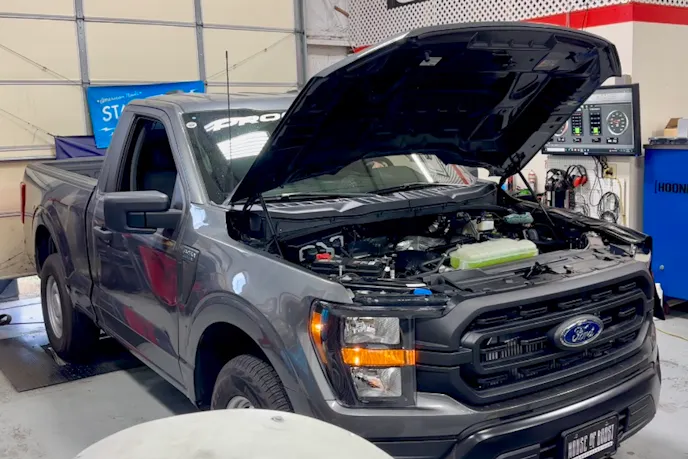
Whether you have been following along with Project Airstrike from the jump or you are just tuning in, the mission for this humble work truck is the same. We partnered with the team at House of Boost to turn our 2023 F-150 XL into a formidable street/strip performer with ProCharger boost, and so far, the results are impressive, but now it is time to turn the wick up with better breathing, elevated RPM, and higher octane.
Project Airstrike began life as a no-frills 2023 F-150 XL regular cab powered by Ford’s Gen 4 5.0-liter Coyote V8. In stock form, the truck delivered 364.88 horsepower and 412.10 lb-ft of torque at the rear wheels, but our goal was never to leave it that way. Working alongside the team at House of Boost, we set out to transform Ford’s humble work truck into a legitimate street/strip performer while documenting every step of the process.
“Last time we left off with our FordMuscle F-150, we were at the track running 11.70s, which is pretty impressive for a work truck…” Jordan Overstreet, of House of Boost, said. ”We’re installing a new fuel system, replacing both driveshafts with carbon fiber pieces, and then we’re going to start testing on fuel so we can really turn up the boost. This is where the project starts getting exciting.”
The first phase centered on adding a ProCharger Stage II system with a P-1X head unit, proving just how well the Gen 4 Coyote responds to boost. Stainless Works long-tube headers followed, along with progressively smaller blower pulleys as the calibration evolved. By the end of our last installment, Project Airstrike had laid down an impressive 752.19 horsepower and 578.46 lb-ft of torque on 93-octane pump gas. Those gains proved the stock long-block had plenty left to give, but they also exposed the next limitations in the combination. If we wanted to safely turn more RPM, support additional boost, and ultimately make the jump to E85, the supporting hardware needed to evolve as well.
Rather than immediately reaching for another pulley, the House of Boost team took a methodical approach. The next phase focused on strengthening the driveline, upgrading the fuel system, and improving airflow so every future horsepower increase would be supported by hardware capable of handling it. Individually, none of these upgrades were intended to produce a dramatic gain. Together, however, they transform how the truck performs
Ready To Rev
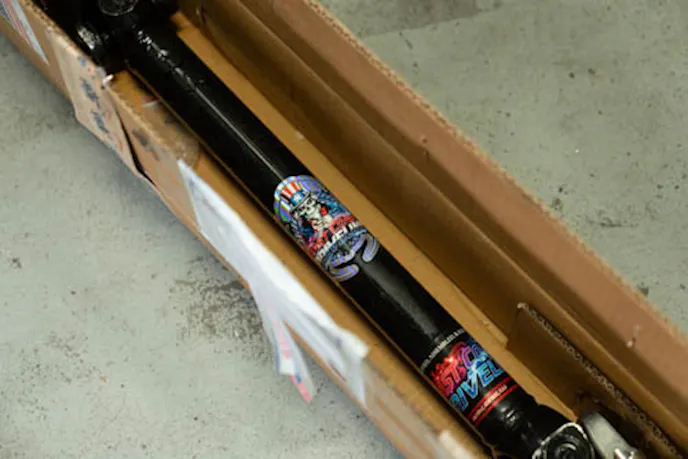
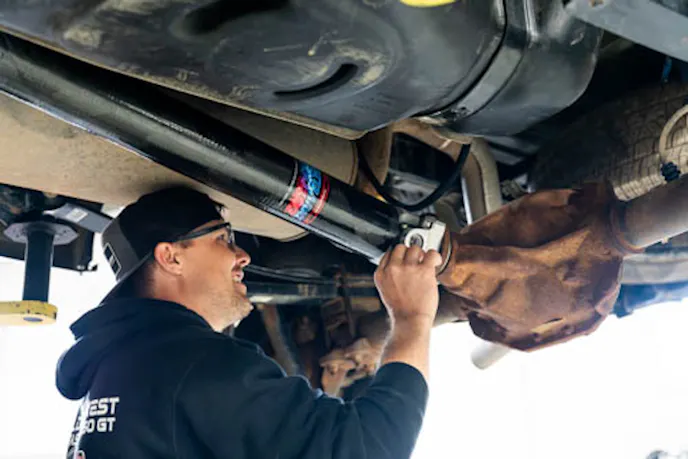
The first upgrade came in the form of an East Coast Driveline front driveshaft (P/N: ML3Z-4A376-B; $1,095) constructed from 2.0-inch by .120-inch-wall tubing and equipped with performance U-joints, a CV slip yoke at the transfer case, and a 1350-series connection at the differential. Replacing the factory constant velocity joints with larger, serviceable components significantly improves durability while easing future maintenance.
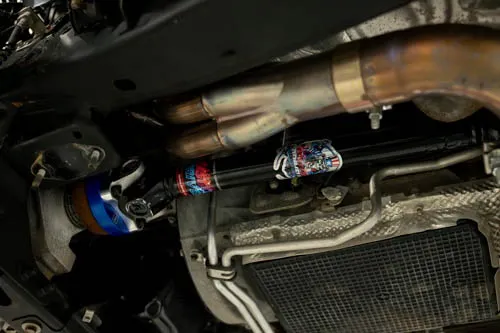
Out back, the factory shaft gave way to a purpose-built East Coast Driveline 1350-series assembly (P/N: ML3Z-4602-B; $2,395) utilizing heavy-wall tubing, Sonnax yokes and spline components, and upgraded Neapco performance U-joints. Designed specifically for the regular-cab short-bed F-150, the shaft bolts directly into the factory transmission and differential flanges without requiring adapters or fabrication.
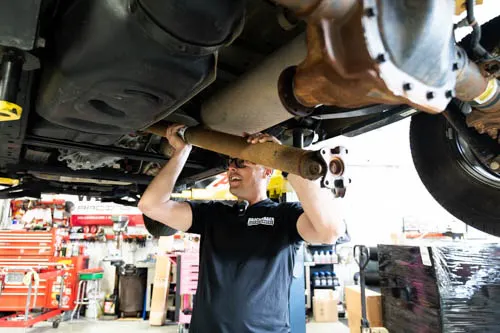
The stronger driveshafts weren’t installed just for durability. Instead, they removed an important limitation from the combination. With greater confidence in the driveline, House of Boost could safely spin the engine higher and perform dyno testing in the transmission’s direct-drive fifth gear. That allowed the team to evaluate the combination under conditions more representative of how the truck accelerates on the track while eliminating concerns about the factory shafts at elevated engine speed.
Fuel For The Fire
With the driveline sorted, Overstreet turned his attention to another area that would quickly become a limiting factor once boost and ethanol entered the equation.
Ford’s factory returnless fuel system performs remarkably well within its intended operating window, but supporting a ProCharged Coyote approaching four-digit horsepower requires switching to E85, which mandates substantially greater fuel volume. Before increasing boost or switching fuels, Project Airstrike needed a fuel system capable of feeding the engine ample ethanol-rich go juice.
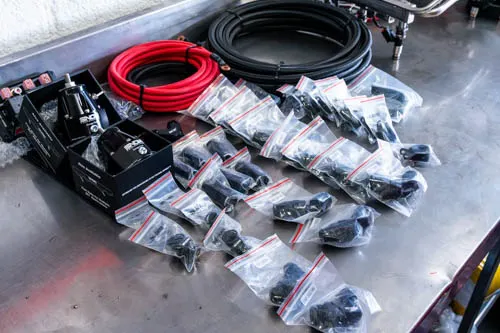
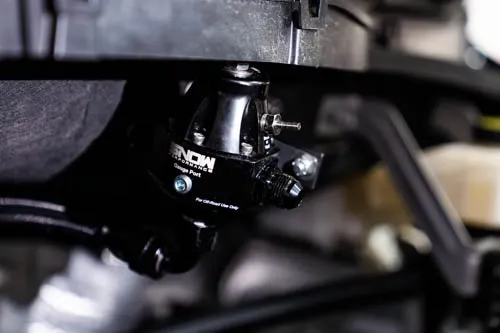
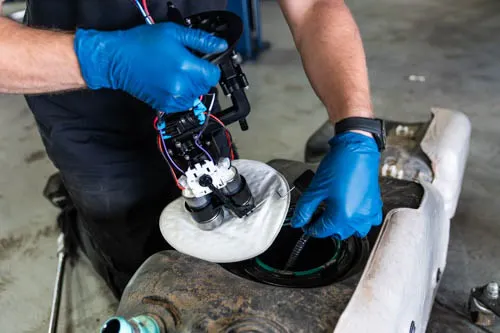
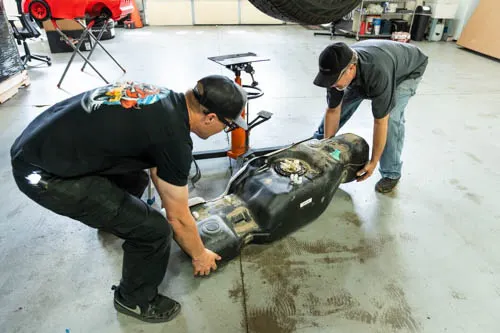
To accomplish that, he converted the truck to a return-style system centered around a Snow Performance billet triple-pump fuel hat (P/N: SNF-52800H; $1,195.43) fitted with three Hellcat pumps ready to feed 1,600-plus power on corn. Machined from billet 6061 aluminum and finished in black anodizing, the assembly replaces conventional hose-and-clamp plumbing with CNC-machined internal fuel passages, while utilizing Viton O-ring seals compatible with gasoline and ethanol blends.
Installation required lowering the fuel tank, transferring the factory fuel-level sender, reconnecting the EVAP plumbing, and wiring the truck for staged pump operation. Supporting hardware includes dual Snow Performance billet fuel-pressure regulators (P/N: SNF-11000; $206.75), a complete -8 AN braided plumbing package (P/N: SNF-60801B; $629.99), and the company’s multi-pump relay module (P/N: SNF-20004; $314.99) featuring three individually fused relay circuits that simplify wiring while ensuring reliable fuel delivery.
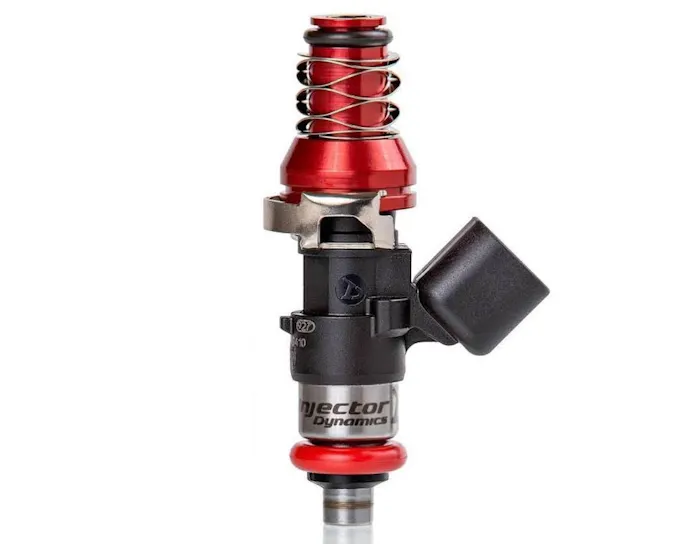
At the engine, fuel is delivered through Injector Dynamics ID1750-XDS injectors (P/N: 1750.60.14.14B.8; $2,725.80) capable of flowing 1,728 cc/min (165 lb/hr) at 43.5 psi. Despite their impressive capacity, the injectors retain excellent low-pulse-width control and street manners while providing the flexibility to support everything from premium pump gas to full E85.
Like the driveline upgrades before it, the return-style fuel system is a nicety now and a necessity as the project progresses. It was installed because the next phase of Project Airstrike would demand it tomorrow. With stable fuel delivery no longer a concern, House of Boost could finally turn its attention toward removing the remaining airflow restrictions from the boosted Gen 4 Coyote.
Carbon Fiber Breathing
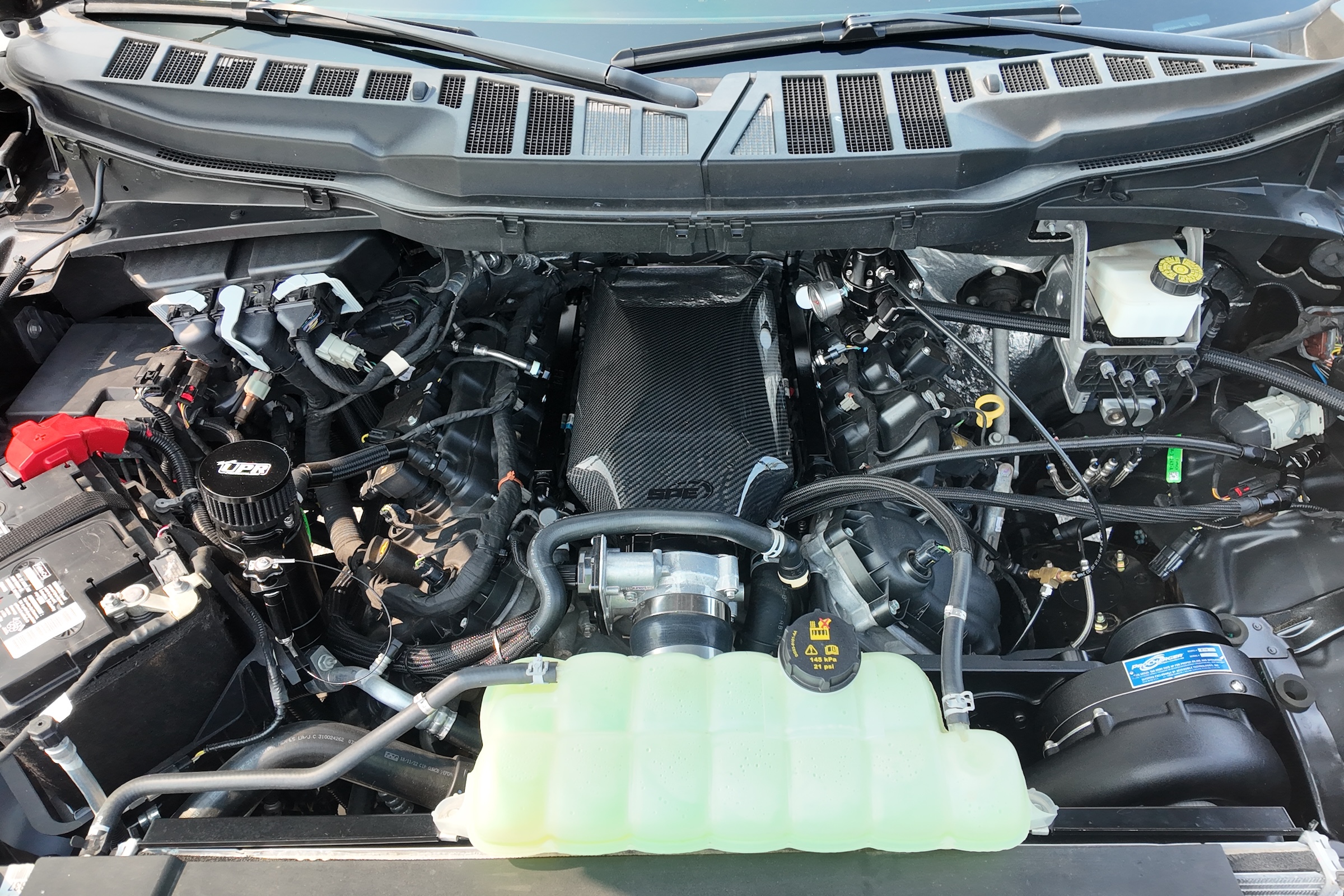
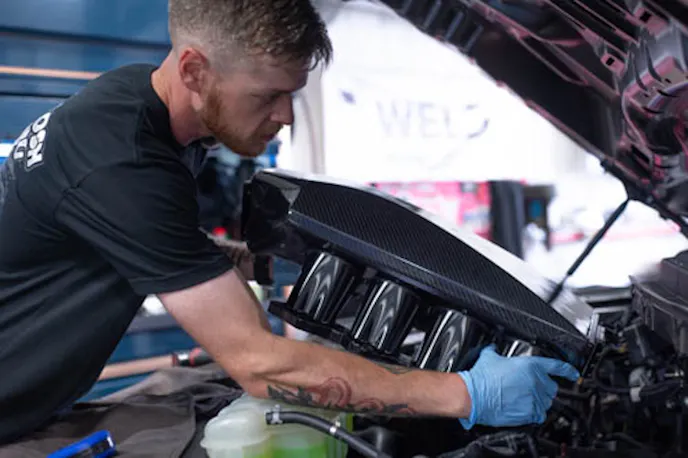
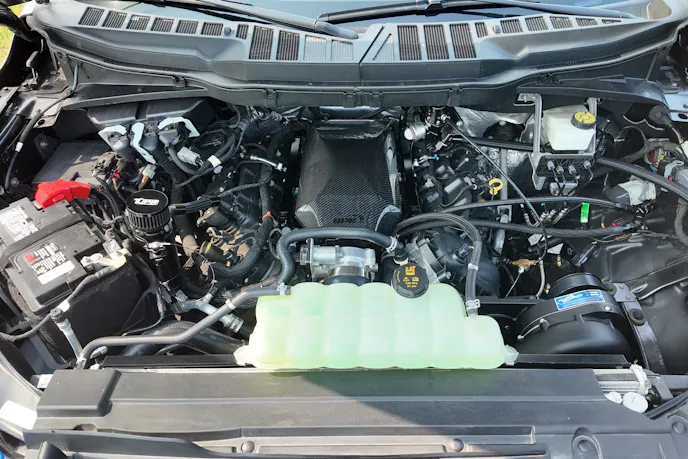
With the driveline and fuel system prepared for the next level, Overstreet shifted the installation duties to HOB tech Leam Wagenknecht, who removed one of the final bottlenecks limiting the boosted Coyote’s potential. Ford’s factory composite intake manifold is an excellent piece for a production truck, delivering broad torque and excellent drivability, but it was never designed to feed a centrifugal-supercharged engine spinning well beyond its factory operating range.
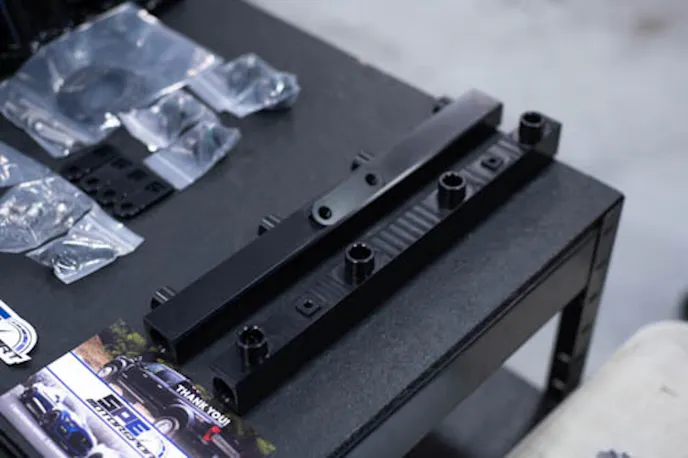
Replacing it is SPE Motorsport’s carbon fiber intake manifold (P/N: SPE-C100193; $3,900), a lightweight 15.5-pound assembly that combines a carbon mono-plenum with billet five-axis-CNC-machined runners in a modular package purpose-built for high-boost applications. Unlike many aftermarket composite manifolds that rely on permanently bonded construction, the SPE unit features a fully bolt-together design secured with custom Torx-drive titanium hardware. The modular architecture not only simplifies service but also delivers the strength required for a serious boost pressure.
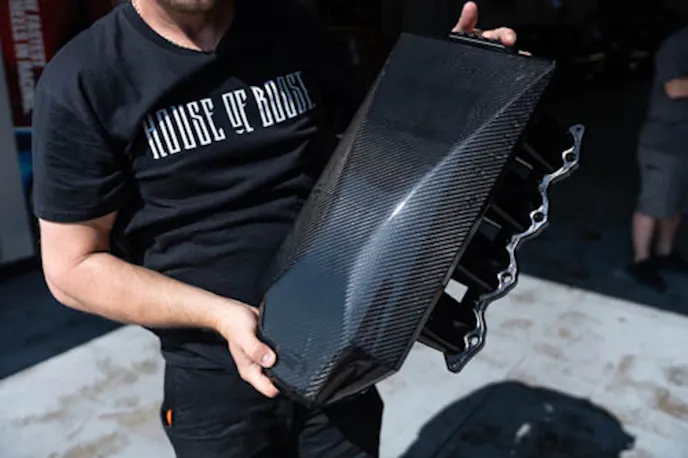
Engineering details abound throughout the manifold. Integrated O-ring seals ensure positive sealing under pressure, while carefully optimized plenum and runner geometry improve airflow distribution to each cylinder. A built-in burst panel adds another layer of protection, and the manifold’s 130-psi operating pressure rating offers a tremendous safety margin for combinations far more aggressive than Project Airstrike.
Perhaps more important than any specification on paper was what the manifold accomplished on the dyno. Freed from the airflow limitations of the factory intake, the ProCharged Gen 4 Coyote continued pulling cleanly to 8,000 rpm. Instead of watching power flatten as engine speed soared, the combination kept breathing, allowing House of Boost to fully exploit the compact centrifugal blower’s efficiency in the upper reaches of the tachometer.
Popping The Cork
There was still one restriction remaining. Although the truck wore Stainless Works long-tube headers, the factory cat-back exhaust remained in place while the team waited for the arrival of an after-cat exhaust system. Rather than allowing the stock exhaust to dictate the results of the next round of testing, Overstreet fabricated a temporary true-dual exhaust incorporating a Stainless Works X-pipe and turndowns behind the collectors.
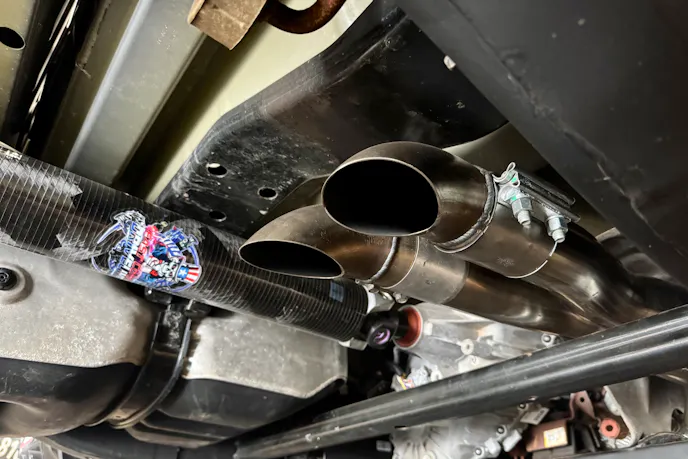
The fabricated system wasn’t intended to be the truck’s permanent exhaust, as we await a dedicated cat-back system. Its purpose was simply to uncork whatever backpressure remained in the factory cat-back so the team could accurately evaluate the combination as boost continued climbing. As it turned out, those temporary pipes would prove instrumental in Project Airstrike’s biggest milestone yet.
Delivering The Goods
With the supporting hardware in place and still running with the factory cat-back exhaust, it was finally time to see what the combination could accomplish. The stronger driveshafts gave House of Boost the confidence to safely perform dyno testing in the transmission’s direct-drive fifth gear while extending engine speed beyond previous limits. At the same time, the SPE Motorsport intake manifold eliminated the airflow restriction that had begun holding the engine back at higher RPM. Together, those upgrades and an ever-evolving custom calibration allowed the ProCharged Coyote to take full advantage of the additional airflow and fuel now available.
“The goal is four-digit horsepower on a stock engine with a ProCharger P-1X. We’ve been doing fourth-gear pulls all along because we had a stock driveshaft,” Larry Hamilton, of House of Boost, said. “So now we have carbon driveshafts in the truck, and that allows us to do higher-speed pulls on the dyno…”
Running in Fifth gear with approximately 15.5 pounds of boost, produced 761.04 horsepower and 536.47 lb-ft of torque at the rear wheels. The combination immediately demonstrated the benefits of E85’s ethanol-enhanced knock resistance and cooling effect while validating the new fuel system and induction upgrades.
Returning to the proven 4.25-inch ProCharger pulley and filling the tank with pump E85 fuel elevated output to an impressive 893.73 horsepower and 582.30 lb-ft of torque.
“It just made 890 wheel horsepower with a P-1X at roughly 15 pounds of boost on E85. Kind of mind-blowing, to be honest with you,” Hamilton reacted. “This thing will probably make over 900 on the 4.25[-inch pulley], and we still have a 4.0 and a 3.85 to test. I don’t think we’re gonna come short of joining the 1,000-wheel-horsepower club.”
Encouraged by those results, Overstreet installed a 4.0-inch pulley, increasing boost to approximately 17 psi and pushing Project Airstrike to 957.46 horsepower and 633.04 lb-ft of torque.
“Who would expect this pickup truck to make that kind of power?” Hamilton enthused. “You’d roll up next to this thing on the road, and it would blow your wig clean off!”
The next move showcased the efficiency of our ProCharged Coyote combo, as it got ever so close to achieving our goal for this phase of the project.
With a 3.85-inch pulley generating approximately 18.5 psi of boost, Project Airstrike produced a staggering 995.81 horsepower and 672.87 lb-ft of torque. Even more impressive, it accomplished that feat with the stock Gen 4 Coyote long-block, factory throttle body, and the restrictive factory cat-back exhaust still in place behind the long-tube headers. Few would have predicted a humble F-150 work truck would come within a handful of horsepower of the four-digit mark while retaining so much factory hardware.
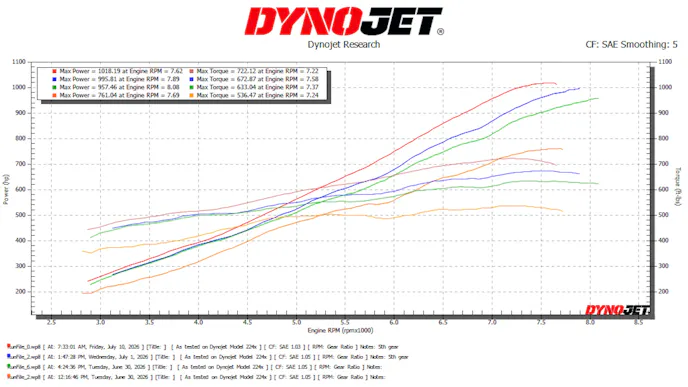
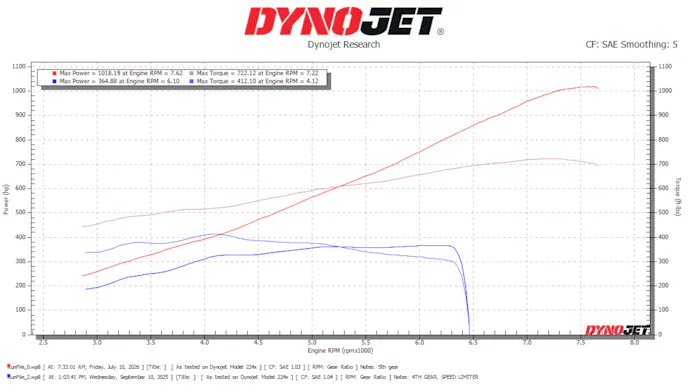
“The SPE intake is, honestly, awesome. We couldn’t make power past 7,000 rpm before, and now the curve is still just pulling. It’s not done making power,” Hamilton explained. “We’re still on a stock motor and a stock transmission, and we want to keep it somewhat safe.”
Knowing there was still power trapped behind the headers, Overstreet fabricated a true-dual exhaust with the aforementioned Stainless Works X-pipe and turndowns for one final test. The result was exactly what we had all hoped for.
As a result, Project Airstrike ripped off a four-digit dyno pull, producing 1,018.19 horsepower and 722.12 lb-ft of torque at approximately 18 pounds of boost. Crossing the 1,000-horsepower threshold is an accomplishment by itself, but the details make the achievement even more impressive. The engine remains a stock Gen 4 Coyote long-block. Boost comes from a street-oriented ProCharger Stage II system with a P-1X street blower rather than an all-out race combination.
“Now, that’s super-impressive, obviously, but for me, one of the things that’s more impressive is that the stock single exhaust made almost 1,000 wheel horsepower…” Hamilton enthused. “So Ford did a good job, but it does sound pretty wild right now.”
The supporting upgrades eliminated one restriction after another until the engine was finally able to deliver the performance potential lurking beneath its modest factory facade. Project Airstrike has evolved far beyond the modest work truck that first rolled into House of Boost, but the project is still far from finished.
With the supporting systems now proven at more than 1,000 rear-wheel horsepower, the saga will continue with a focus on putting that power to work and exploring just how much more performance remains in Ford’s latest Coyote-powered pickup. Next up, we’re upgrading the suspension, adding lighter Forgeline wheels, and wrapping them in sticky rubber to help plant all this newfound power, so stay tuned to see what this powerful pickup will run at the track.
You might also like
Stage 3 ProCharger Boost Propels A Bolt-On F-150 Pickup Into The Nines
ProCharger’s F-150 hits 9.863 at 144.76 mph after 17,000 street miles. E85 and a Stage 3 blower deliver single-digit performance.