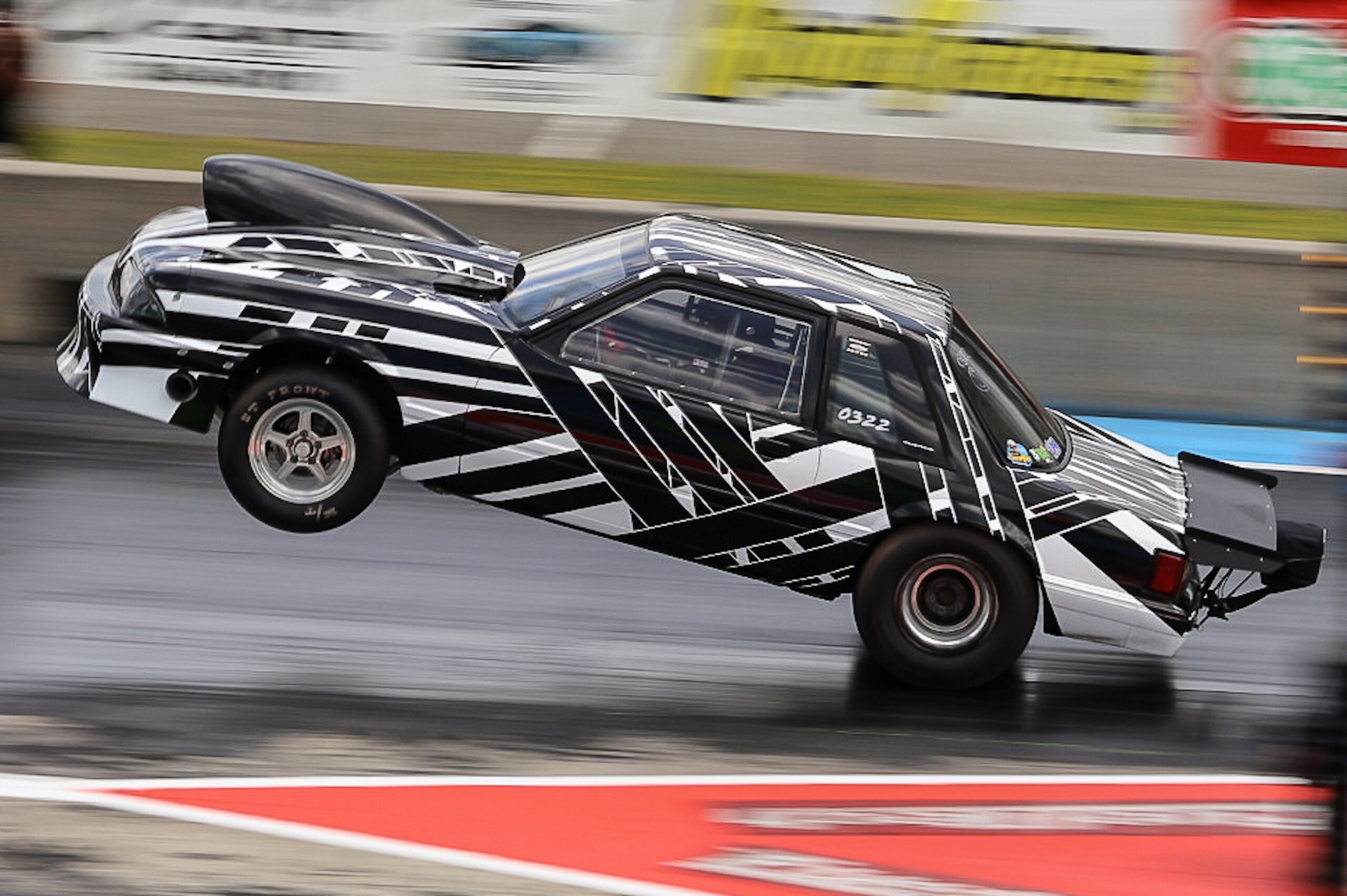
Building big power with Ford’s Coyote platform has become almost routine in the modern performance world. The 5.0-liter V8 responds incredibly well to boost, and supercharged and turbocharged combinations have pushed the architecture to horsepower levels that were once reserved for purpose-built race engines. Building a naturally aspirated Coyote capable of making serious power while surviving repeated 10,000-rpm shifts, however, requires a completely different approach.
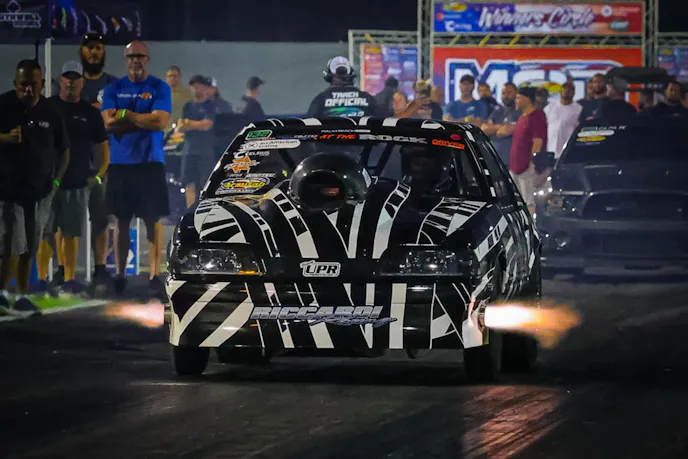
That was exactly the challenge Carlos Sobrino wanted to take on. The longtime Ford racer wasn’t interested in simply adding boost to his Fox Mustang and chasing an impressive dyno number. Instead, he wanted an unrestricted naturally aspirated combination built for a drag-racing class where displacement and engine speed were essentially open variables. The goal was straightforward but ambitious: create a naturally aspirated Coyote powerful enough to push his stick-shift Fox, known as “Joker 2.0H,” into the 7-second quarter-mile range.
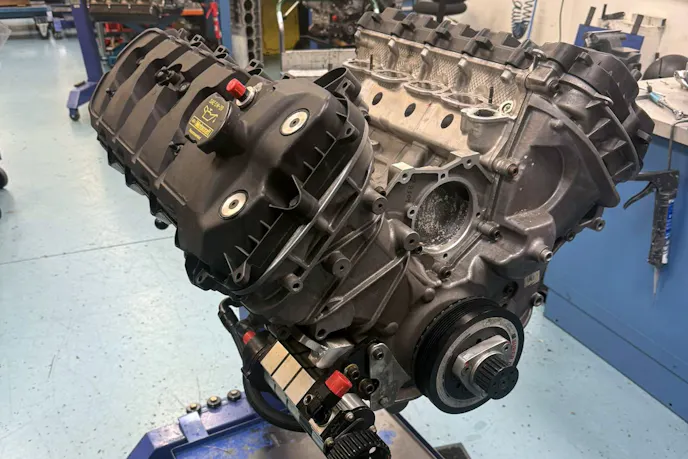
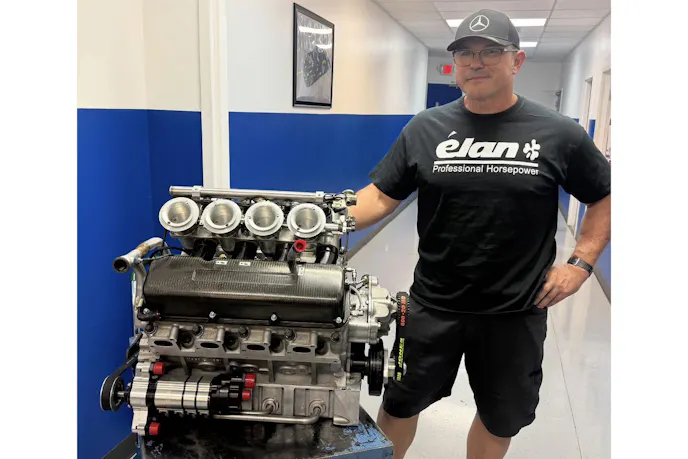
To accomplish that, Sobrino turned to Chris Smith and the team at Elan Power Products. While Smith had never built a Coyote before, that detail mattered far less than his decades of experience developing high-performance Ford engines and championship-winning racing combinations. The finished product is a 336-cubic-inch naturally aspirated Coyote that approaches the modern Ford V8 from a race-engine perspective, with every component selected to work together from the crankshaft to the intake manifold.
Racing Roots
The partnership between Sobrino and Smith was built long before this high-rpm Coyote project began. Around 2009 or 2010, Elan Power Products built the pushrod small-block Ford that carried Sobrino to two NMRA Factory Stock championships. That 309-cubic-inch combination operated within strict class limitations, yet it still delivered the kind of performance needed to run deep into the 10-second zone.
When Sobrino decided to move into a new class with far fewer restrictions, he knew the engine would need a completely different philosophy. Rather than modify an existing combination, he wanted an all-out naturally aspirated Coyote designed around the specific requirements of the car and class. The first step was finding a builder willing to take on the challenge.
“I wanted to build an all-out NA Coyote,” Sobrino recalled. “I asked him, ‘You want to do it?’ He goes, ‘Sure. I’ve never seen one, but I’ll do it.’”
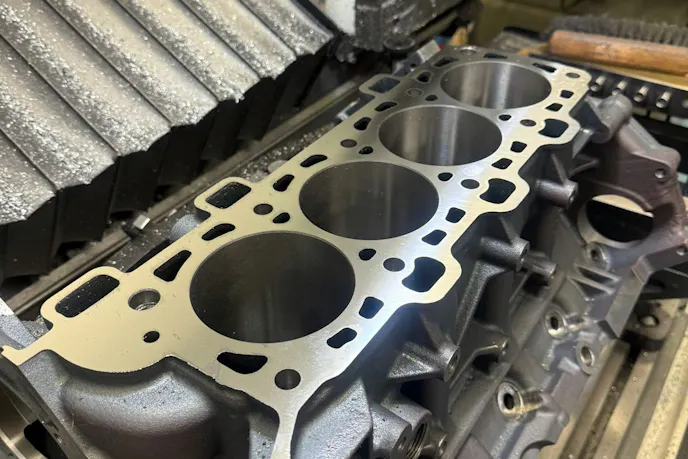
That confidence came from Smith’s background. Although the Coyote was a new architecture for Elan, overhead-cam Ford engines were not unfamiliar territory. Smith spent decades working with advanced racing engines, including four-cam designs, cylinder-head development, and endurance racing programs where reliability at extreme operating conditions is critical.
Elan Power Products was founded by Don Panoz in 1998 to develop and support engines for the Panoz Le Mans Prototype program. Smith joined the company in 2000, working in cylinder-head development and engine assembly before eventually moving into a leadership role. In 2020, Smith purchased the company from the Panoz family.
Over the years, Elan-powered programs accumulated victories and championships in endurance racing, road racing, rally competition, and drag racing, including class wins at Sebring and Le Mans. That racing background shaped Smith’s approach to Sobrino’s high-winding Coyote. Instead of focusing on a single impressive statistic, he treated the engine as a complete system, one in which airflow, compression, valvetrain control, and durability all had to complement each other.
The result is a Coyote that shares little in common with a typical street-performance build.
Building The Plan
The factory Coyote already provides an impressive foundation. Ford’s current Gen-4 crate engine uses an aluminum block, dual overhead camshafts, four valves per cylinder, and variable intake and exhaust cam timing to produce 480 horsepower at 7,150 rpm. For a naturally aspirated drag-racing application, however, Sobrino’s engine needed significantly more airflow, more displacement, and the ability to operate well beyond factory engine speeds.
“Every single project starts with a spreadsheet,” Smith said of his data-driven approach. “I have individual spreadsheets that I’ve made over the years, probably a hundred of them.”
Those calculations allowed Smith to determine what the engine needed to achieve the desired horsepower target, including airflow requirements, valve sizing, displacement, and other critical dimensions. Instead of selecting parts first and attempting to make them work together later, the combination was designed around the intended performance goal.
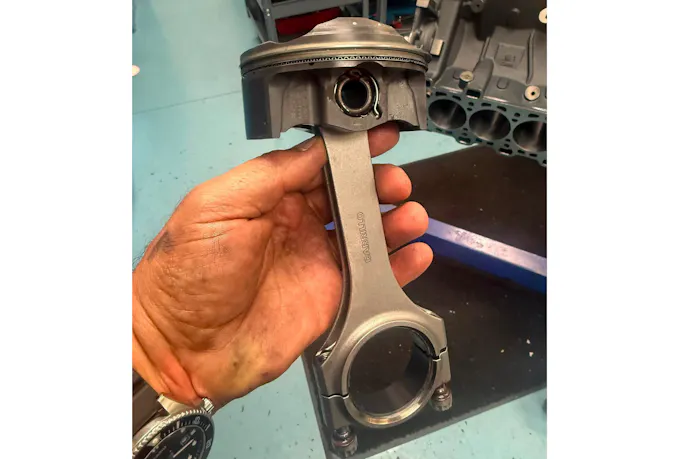
The first major decision was displacement. Smith wanted to maximize the available cubic inches while maintaining the high-rpm capability required for the project. The final combination uses an offset-ground crankshaft with a 3.900-inch stroke and 6.125-inch Carrillo connecting rods. Combined with a bore slightly larger than the
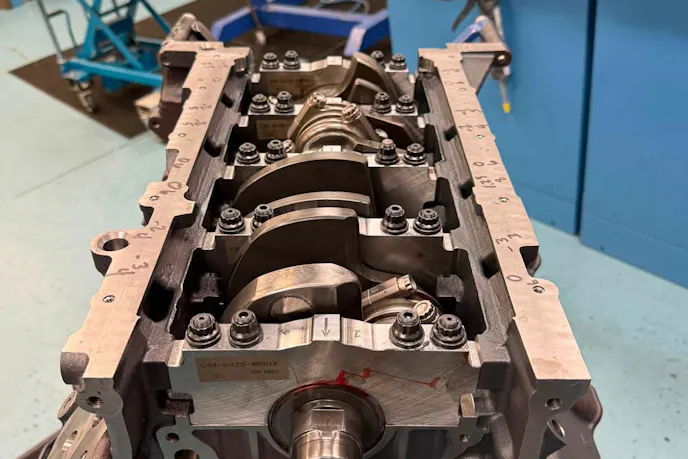
original 5.2-liter Voodoo dimension, the engine bulked up to 336.01 cubic inches. That increased displacement provided the foundation needed to make naturally aspirated power, but the engine’s ability to survive at extreme rpm required a more robust foundation.
The original version of the engine used an aluminum 5.2-liter block, but the latest iteration moved to a Ford Racing Parts cast-iron block bored to 3.705 inches. Although the iron block adds weight, Smith believes the improved dimensional stability is worth the tradeoff.
As an engine reaches extreme operating temperatures, aluminum expands significantly more than iron. That expansion can affect critical areas such as main bearing clearances and housing dimensions. The cast-iron block maintains those measurements more consistently, giving the rotating assembly a more stable foundation while also providing additional heat retention in the cylinders.
Sobrino addressed the additional weight elsewhere in the car, making chassis changes, especially up front, to remove pounds and maintain the Fox Mustang’s overall performance balance.
The need for increased rpm capability came from firsthand experience. With the previous combination installed in his stick-shift stallion, Sobrino found himself repeatedly missing shift points because the naturally aspirated engine accelerated through the rpm range in the blink of an eye. When he brought the engine back to Smith for development, the solution was simple.
“When I told Chris about that, he goes, ‘OK, so I’m going to build you a 10,000-rpm engine,’” Sobrino laughed. “‘We can’t fix you, so we’ll fix the engine.’”
Making Airflow Work
With the displacement strategy established, Smith turned his attention to the area that ultimately determines the potential of any naturally aspirated engine: airflow. While it would have been easy to chase the biggest possible flow numbers, that approach does not always translate into the kind of cylinder filling required for a high-rpm racing engine.
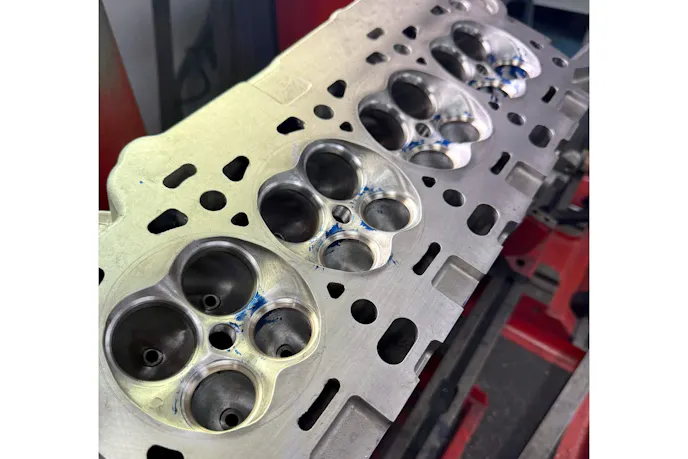
Smith retained the basic Voodoo cylinder-head architecture, including the factory valve angle and valve sizes, but focused on improving the efficiency of the ports rather than simply enlarging them. After roughly 35 years of developing cylinder heads, he knew that impressive flow-bench numbers often failed to convert that airflow into real-world power. The objective was creating a port that maintained velocity and delivered efficient airflow through the entire operating range.
“People get carried away with flow,” Smith says. “You’ve got to make sure that everything you do in there is contributing to efficient airflow.”
The intake ports were developed around the idea that the bowl area should represent the minimum cross-sectional area, with the remaining intake tract maintaining or slightly increasing in size as the air moves toward the valve. The goal was not simply moving more air, but moving it in a way that improved cylinder filling at the engine speeds where the Coyote would spend its time.
The exhaust side required more extensive development. Smith compared the factory exhaust port design to the architecture found in classic Cleveland cylinder heads, noting the steep short-side radius that forces airflow to make a sharp transition before exiting the chamber. For the revised combination, Elan lowered the short side, increased the radius, and opened the bowl area to improve high-lift flow and create a smoother path out of the cylinder.
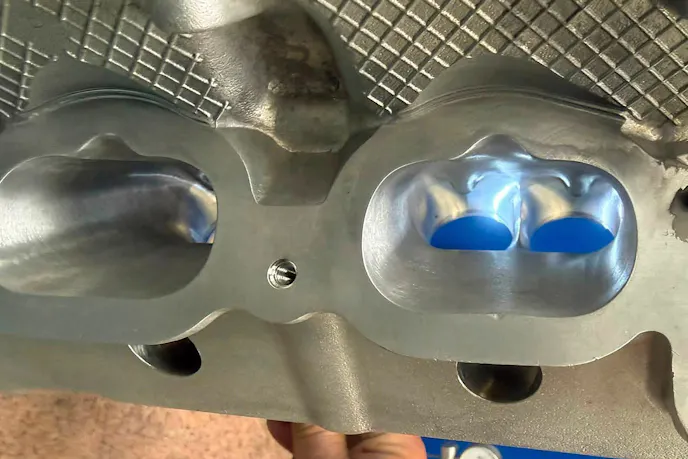
The cylinder heads also received custom-machined 45-degree valve seats using cutters designed by Smith himself. Titanium intake valves replaced the earlier stainless pieces, reducing valvetrain mass, while single-groove valve locks replaced the production-style multi-groove design to improve durability at extreme engine speeds.
At 10,000 rpm, reducing weight in the valvetrain is not about chasing a small performance gain. It is about controlling the components through thousands of additional cycles and preventing failures that can end an engine program instantly.
Camshaft Control
The next challenge was creating the valve motion required to take advantage of the improved airflow. Smith worked with Billy Godbold of Godbold Engineering, who currently consults with several racing programs, to develop custom camshaft profiles specifically for this combination.
Rather than adapting an existing camshaft profile, the pair designed lobes around the airflow characteristics, engine speed, and intended operating range of Sobrino’s Coyote.
The final profiles measure approximately 268 degrees of intake duration and 278 degrees of exhaust duration at 0.050-inch tappet lift. Smith chose not to disclose the total lift numbers, but the approach focused on controlling how quickly the valves moved rather than simply maximizing lift.
These cam profiles leave the seats relatively gently before becoming much more aggressive once the valve springs are fully engaged. That strategy helps balance airflow requirements with valvetrain reliability, an important consideration when an engine is expected to repeatedly operate near 10,000 rpm.
One of the more unusual aspects of the combination is that it retains a hydraulic valvetrain arrangement. For many racers, the idea of a hydraulic system surviving at those engine speeds seems unlikely, but Smith’s experience with overhead-cam endurance racing engines gave him confidence in the approach.
The previous version of the engine made peak power in the upper-8,000-to-low-9,000-rpm range and continued pulling beyond the peak. The challenge was that Sobrino could reach the shift point faster than expected, resulting in repeated trips to 10,000 rpm. That experience ultimately drove the decision to build an engine specifically designed for the way he piloted his pony car.
Compression Matters
For a naturally aspirated racing engine, compression ratio is one of the most effective tools available for increasing power. Without the assistance of boost pressure forcing additional air into the cylinders, every aspect of the combination must work together to maximize cylinder pressure.
That made piston design a critical part of the Coyote build. Smith selected custom MAHLE pistons featuring an unconventional two-ring package consisting of one compression ring and one oil ring. The design eliminates the traditional second compression ring, reducing internal friction while maintaining the oil control required for racing duty.
Smith had previous experience with similar ring strategies in endurance applications, making the choice a calculated engineering decision rather than an experiment.
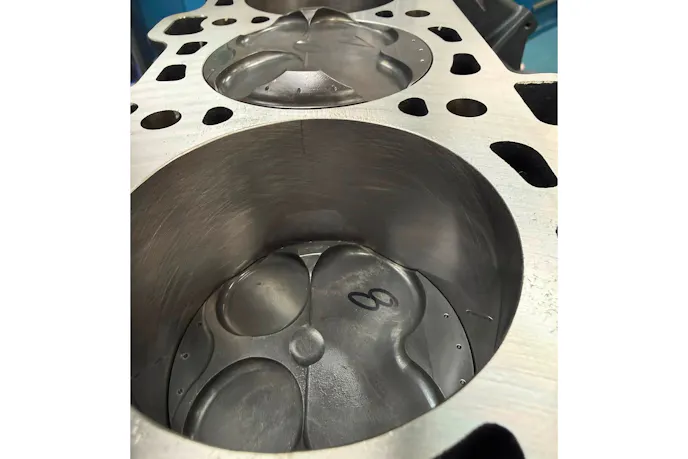
The original version used a 0.7mm Total Seal top ring, but the latest ethanol-fueled combination moves to a slightly thicker 0.8mm ring. The change was made because ethanol can be harder on engine oil, and the additional ring thickness provides improved protection.
The piston design itself is another example of the attention to detail throughout the project. With the Coyote’s shallow valve angle and large valves, creating compression requires carefully shaping the piston dome around the valve pockets. Every area of the piston crown that is not required for valve clearance becomes an opportunity to increase compression.
The MAHLE pistons use vertical gas ports and feature an 11cc dome. Piston-to-valve clearance remains in the approximate 0.060-to-0.090-inch range, and Smith installed the pistons 0.005 inch above the deck at top dead center to achieve a final compression ratio of 13.92:1.
That compression level works in conjunction with the chamber design, camshaft timing, and fuel strategy. Smith approaches those areas as one system because changing one variable affects the others.
The piston, ring package, combustion chamber, valve motion, and cam timing all have to work together if the engine is going to produce power efficiently while surviving the demands of high-rpm naturally aspirated drag racing.
A Purpose-Built Foundation
Supporting a 10,000-rpm naturally aspirated combination requires more than a strong rotating assembly. Every system attached to the engine has to support the same objective, including lubrication.
The engine uses a modified Armstrong dry-sump pan combined with a Dailey Engineering pump. Smith intentionally selected an oil pump with more than enough capacity because it gives the team room to adjust oil pressure and scavenging characteristics without changing the external system.
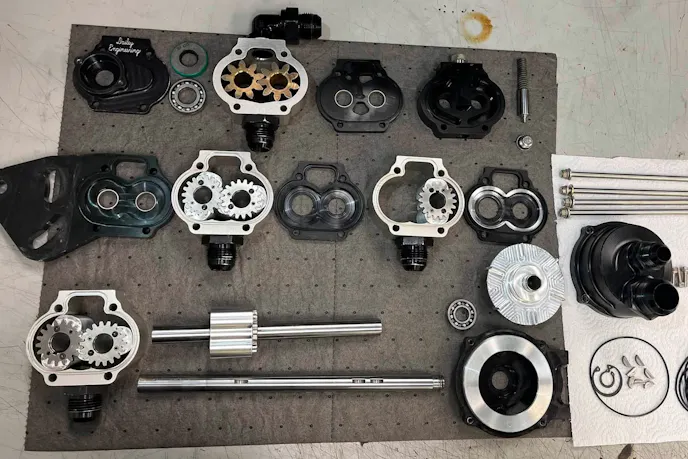
By altering gear widths and internal spacers, Elan can fine-tune oil delivery while keeping the same pump housing, mounts, and plumbing. That flexibility allows the team to optimize crankcase vacuum and oil control as additional track testing reveals more about the combination.
The attention to detail extends throughout the engine, from the rotating assembly to the lubrication system. Every component was selected based on the singular goal of creating a naturally aspirated Coyote capable of generating four-digit power and surviving repeated trips to engine speeds that rival those of a Lamborghini Temerario V8.
Reimagined Runners
The intake manifold is often where a naturally aspirated racing engine reveals just how far the builder is willing to go. On a boosted combination, forced induction can help compensate for some compromises in airflow design. On a naturally aspirated engine expected to make nearly 1,000 horsepower at the crankshaft, every inch of the intake tract matters.
For Sobrino’s Coyote, the intake started life as a Holley manifold, but little of the original design remains. Smith was not satisfied with the as-delivered runner configuration or injector placement, so Elan treated the intake as another opportunity to optimize the entire combination.
The team digitized the flange and mounting angles before cutting the manifold apart. The runners were removed, the injector location was revised, and the design evolved into what is effectively a custom sheet-metal intake that retains only portions of the original Holley casting.
“That thing is a Frankenstein,” Sobrino said. “The only thing that’s left from the Holley are the sides, right above the runners.”
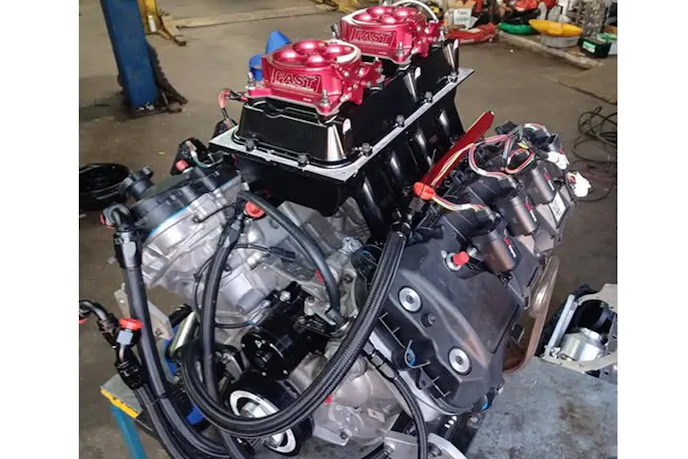
The finished intake was developed around calculated runner length and taper, with the goal of maximizing cylinder filling in the engine’s operating range. Dual FAST throttle bodies feed the plenum, while the revised injector location was developed after an early dyno incident damaged the first upper section of the manifold.
The engine management system remains Holley-based because that is the platform preferred by Sobrino’s tuner. While the intake may look unconventional, the design philosophy matches the rest of the engine where every component works to achieve the same 10,000-rpm goal.
The same approach applies to the cam drive and harmonic control. The combination uses an MMR heavy-duty cam drive and ATI damper to maintain timing stability at engine speeds where small inconsistencies can quickly become major problems.
Numbers Game
The first 336-cubic-inch version of the engine went to the engine dyno for break-in and initial validation. Running on VP Racing Fuels Q16 fuel, the naturally aspirated Coyote produced 800 horsepower at 8,600 rpm during that first session.
However, the goal of the test was not to chase a maximum number. Instead, Smith and the team focused on seating the rings, establishing a safe wide-open-throttle calibration, and gathering information about how the combination behaved.
The next phase of testing was cut short when chassis dyno testing ended after the dual 7-inch clutch failed. From there, Ken Bjonnes of Palm Beach Dyno refined the Holley calibration using data collected from track testing.
Based on elapsed times and trap speed, Sobrino estimates that the earlier combination produced approximately 750 horsepower at the rear wheels. That power level, combined with the lightweight Fox Mustang chassis and the challenge of managing a naturally aspirated stick-shift combination, was already enough to deliver impressive results.
Sobrino recorded a best quarter-mile elapsed time of 8.25 seconds with the previous combination. That was the quickest and fastest naturally aspirated Coyote-powered pass at the time.
The achievement is particularly notable because naturally aspirated drag racing requires a different approach than a typical high-horsepower build. There is no boost pressure to mask mistakes, no additional airflow waiting to be unlocked by a larger turbocharger or blower pulley change. Every precious pony must come from making the engine move more air, compress the mixture more effectively, and operate efficiently at extreme engine speeds.
7-Second Target
The latest version of the engine was built with an even more ambitious objective. Smith believes the combination will need to produce somewhere near 1,000 horsepower at the crankshaft to move the Fox Mustang into the 7-second range. That represents roughly three horsepower per cubic inch from the naturally aspirated 336-cubic-inch engine, a serious benchmark for any all-natural engine combination.
There is still additional tuning and track development ahead, so whether the engine reaches that target remains to be seen. However, the foundation is there. The Ford Performance iron block provides stability, the revised cylinder heads improve airflow efficiency, the titanium intake valves reduce valvetrain mass, the updated ring package improves durability with ethanol fuel, and the custom camshaft design allows the Coyote to operate in a range far beyond its factory mission.
Achieving that goal required contributions from several specialists and suppliers, and Smith credits those relationships as one of the most important parts of building successful racing engines.
“The most important thing you can do in this business is make relationships with people that are great at their job,” Smith said. “There are great people out there. You’ve got to get them on your team. That’s what we do.”
Creating a 10,000-rpm Coyote designed to deliver 7-second time slips is an impressive engineering exercise in its own right. However, it is also another example of just how much potential is lurking within the factory 5.0-liter design. While boosted Coyotes have long been fast friends, this engine shows that they can breathe deeply without any external assistance and still deliver impressive performance.
You might also like
Add More Stopping Power With Wilwood’s XRS Brake Calipers
XRS Calipers from Wilwood cut corner weight by 15 percent. The direct-fit radial mounting of these units simplifies DIY brake swaps.