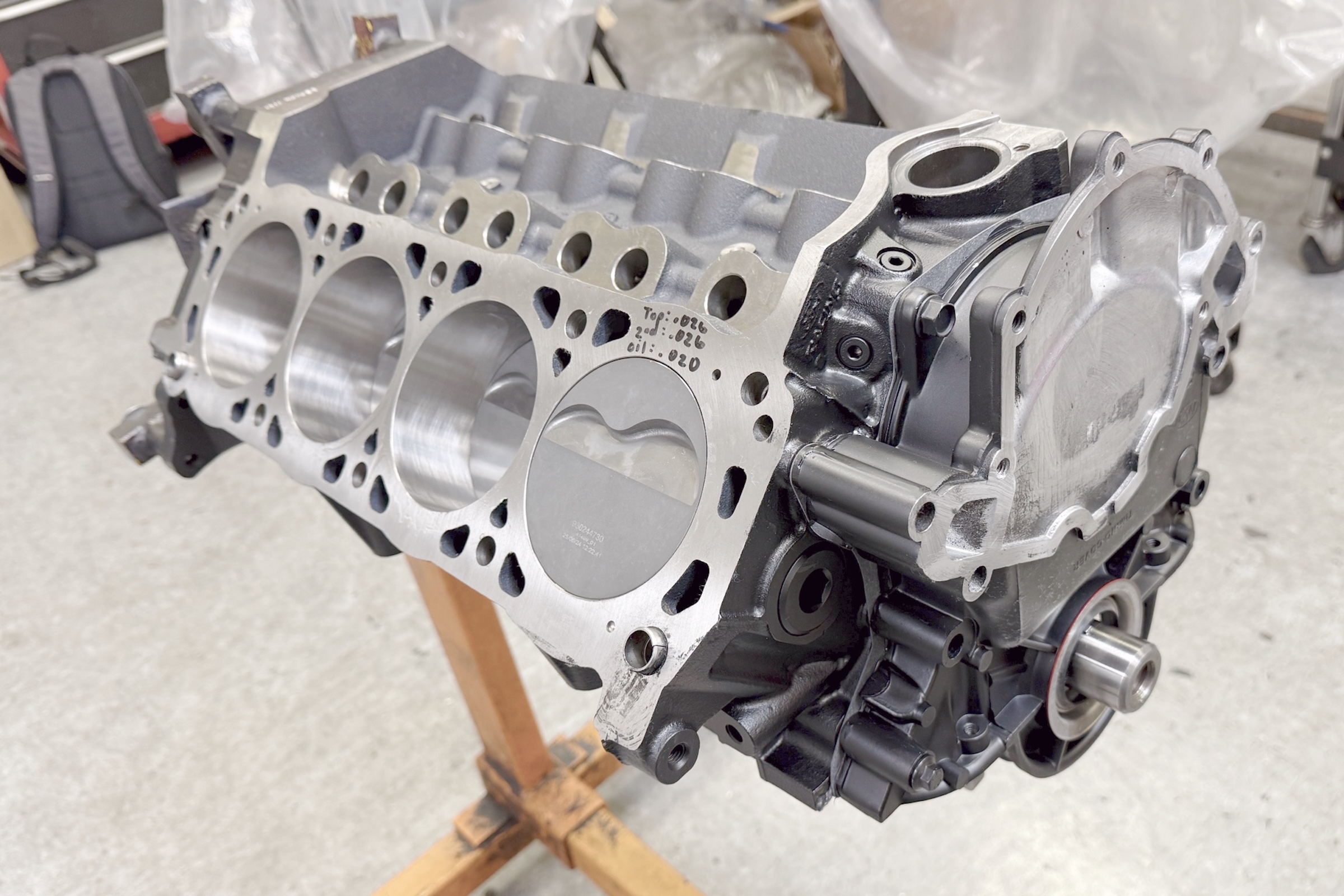
If you’ve been following the progress of Project Fox Dreams, you know that Melissa Lawrence’s dream car, a limited-edition 1993 Mustang LX Convertible, has come a long way. Thus far, we have freshened the fluids, upgraded the transmission, suspension, brakes, wheels, tires, interior, and exterior. Now, it’s time to get serious about performance, so our friends at EngineLabs turned to the team at JBA Speed Shop to build a robust 347 stroker ready to receive plenty of Vortech boost.
There’s a reason the 347 cubic-inch small-block Ford is a staple of the Fox Mustang performance scene for decades. Take a 302 block, add 0.400 inches of stroke, and open the bores by 0.030 inches, and you gain 45 cubic inches of displacement, or roughly 15 percent. It’s a simple formula, but one that has proven itself repeatedly on the street and at the track, and there’s no reason to reinvent it for Fox Dreams.
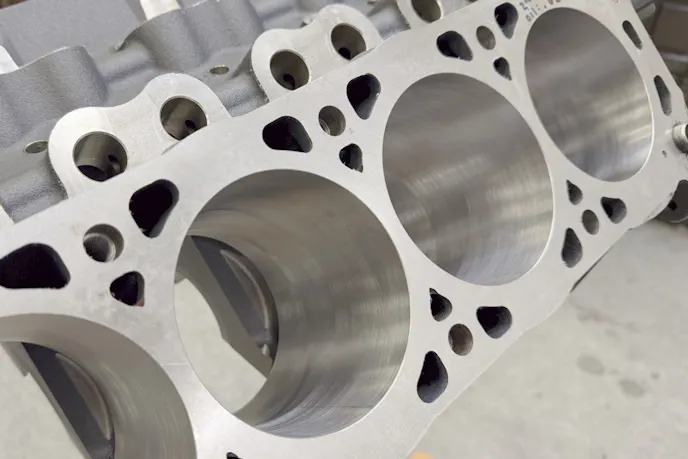
For this build, the goal isn’t simply to build a nostalgic 347. The engine needs to deliver the street manners Lawrence wants from her dream convertible while providing the strength and airflow needed for the project’s 600-plus-horsepower target, so JBA Speed Shop built the short-block and valvetrain with the forthcoming Vortech V-3 Ti-Trim supercharger in mind.
Who’s The BOSS?
The original 5.0-liter block is great, but it has its limitations. With reliability and a safety margin for somewhere around 700 horsepower in mind, JBA Speed Shop stepped up to Ford Racing Parts’ BOSS 302 performance block (P/N: M-6010-BOSS302). This 8.2-inch-deck casting can accommodate a 4.125-inch bore, but Fox Dreams sticks with the traditional 4.030-inch bore to retain plenty of cylinder-wall material.
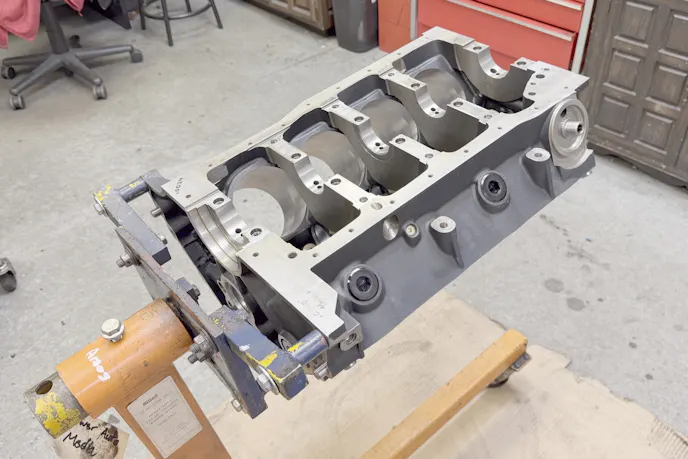
The BOSS casting brings considerably more hardware to the party than a production 302, with splayed four-bolt main caps on Nos. 2, 3, and 4 and two-bolt caps at cylinders 1 and 5. It also gets larger head-bolt holes for 1/2-inch fasteners, revised oil routing, Siamesed cylinder bores, and improved internal coolant routing.
Another important detail for a stroker build is the lower cylinder design. The BOSS block provides additional clearance for the longer-stroke rotating assembly, eliminating the need to start grinding on the block to make the crank and rods fit. That’s the kind of aftermarket engineering that makes a serious small-block Ford easier to build without giving up OE-style fit and finish.
Strong Stroker
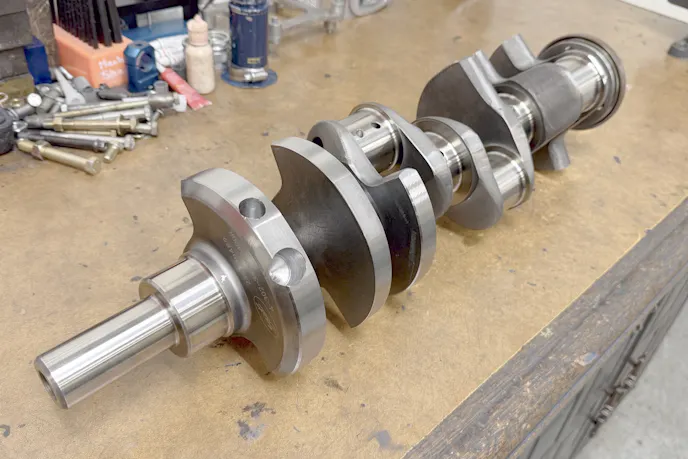
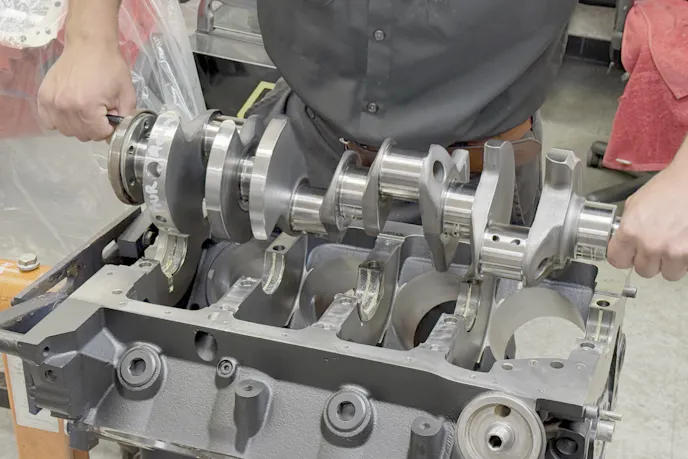
Since the aftermarket worked out the details of the 347 combination for decades, gear like SCAT’s 347 rotating assembly is available off the shelf. The complete package (P/N: 1-45310) brings together the forged rotating assembly, bearings, rings, harmonic balancer, and flexplate, with a 3.400-inch-stroke standard-weight crank providing the foundation.
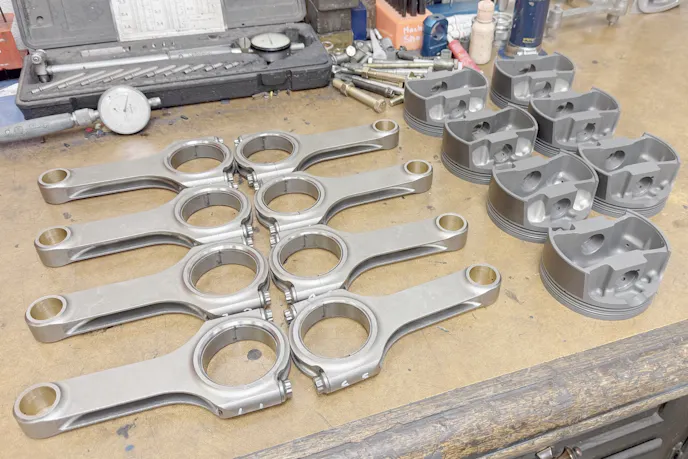
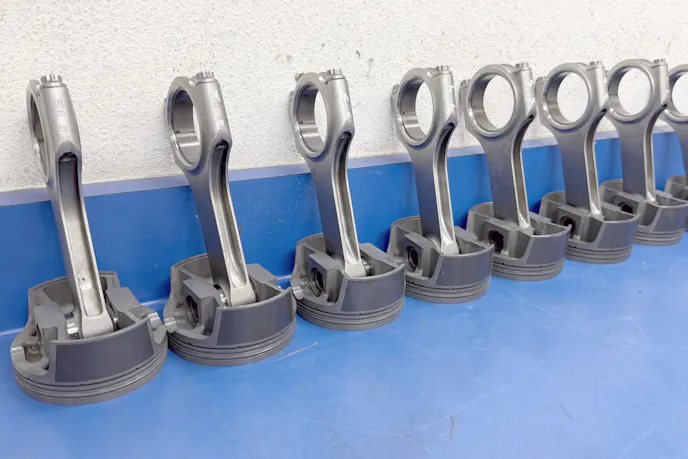
The connecting rods are SCAT’s forged 5.400-inch H-beam pieces (P/N: 2-302-5400-2123-927), forged from 4340 steel with doweled caps, stroker-friendly clearance, and 7/16-inch ARP 8740 12-point rod bolts. Their small ends are bushed for free-floating 0.927-inch wrist pins.
Those rods connect to MAHLE PowerPak forged flat-top pistons (P/N: SBF090030F06). The 4032 aluminum pistons are phosphate-coated and use MAHLE’s Grafal anti-friction skirt coating, while hard anodizing on the top ring land adds durability under elevated cylinder pressure.
The piston package also includes heavy-duty 0.927-inch wrist pins and pin locks, along with 1.5mm, 1.5mm, and 3.0mm rings. The top ring uses ductile iron with a plasma-moly coating; the second is a cast-iron reverse-taper design, and the 3.0mm oil ring provides oil control without adding unnecessary drag.
Built Bottom End
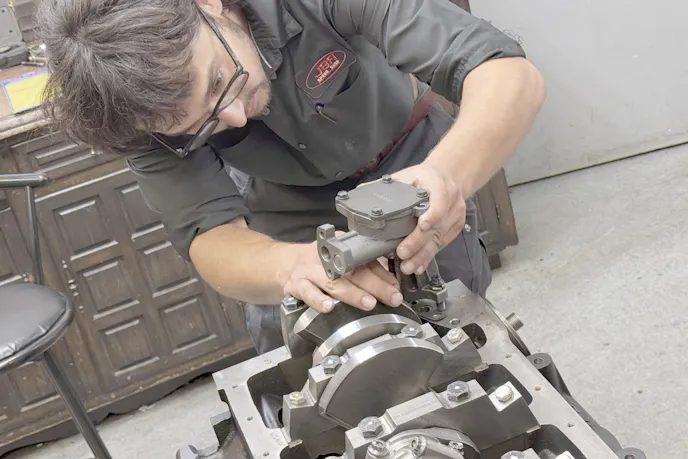
SCAT also supplies the Clevite main and rod bearings, along with its 28-ounce SFI-certified harmonic balancer and 157-tooth flexplate. JBA paired the rotating assembly with a standard-volume Melling M68 oil pump and a Canton oil-pump pickup designed specifically for the rear-sump Mustang oil pan, a combination chosen to provide the needed oil supply without putting unnecessary load on the drive system.
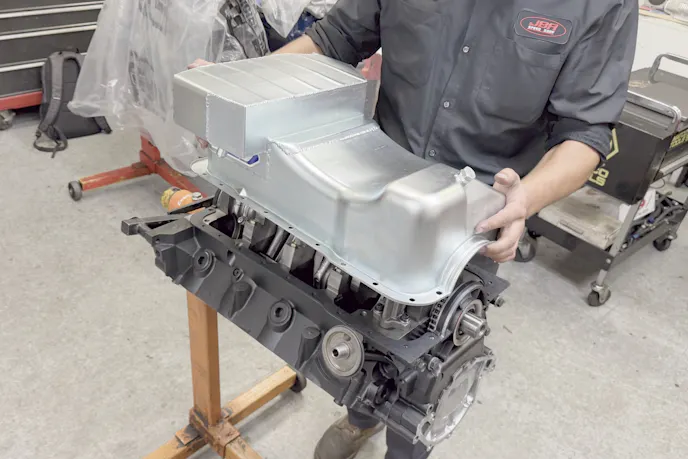
The Canton T-sump oil pan expands the rear sump laterally to increase capacity to seven quarts without making the pan deeper. Inside, a crank scraper helps manage windage while the slosh baffles keep the pickup covered during hard launches and cornering.
A Howards Cams double-roller timing set rounds out the short-block assembly, with a three-way adjustable lower sprocket allowing four degrees of crankshaft advance or retard. A reproduction Fox Mustang front timing cover completes the package.
Renegade Heads
With 347 cubic inches and a supercharger waiting in the wings, cylinder-head selection is critical. JBA turned to Air Flow Research’s Renegade 195cc cylinder heads (P/N: 1383-716), which feature fully CNC-machined ports and 72cc combustion chambers to help keep compression in check for California pump gas.
The Renegade heads use 2.050-inch stainless steel intake valves and 1.600-inch stainless steel exhaust valves, while AFR’s upgraded valve springs (P/N: 8019) use chrome-silicon steel and provide 155 pounds of seat pressure with a maximum valve-lift capability of 0.650 inches.
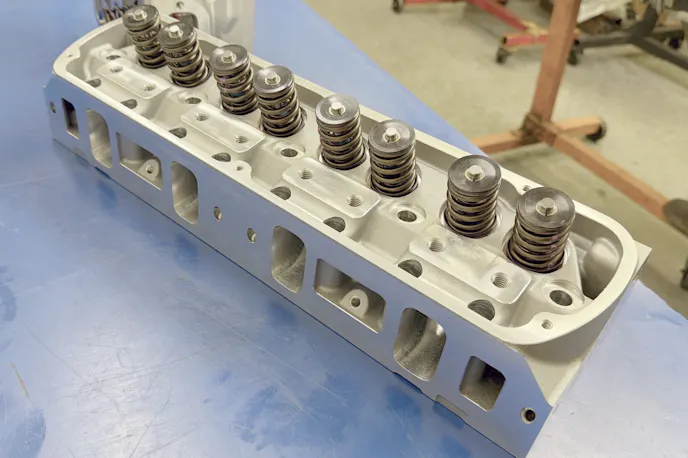
The airflow numbers are equally important, with the intake ports flowing 298 cfm and the exhaust ports moving 231 cfm at 0.650 inches of lift. That gives the 347 plenty of headroom while establishing the airflow foundation for the eventual Vortech system.
Keeping all that cylinder pressure inside the engine requires serious clamping force, so JBA used a 1/2-inch-diameter ARP head stud kit. Because of the additional depth of the BOSS block’s blind bolt holes, an FE head stud kit provides the extra length needed on the short studs.
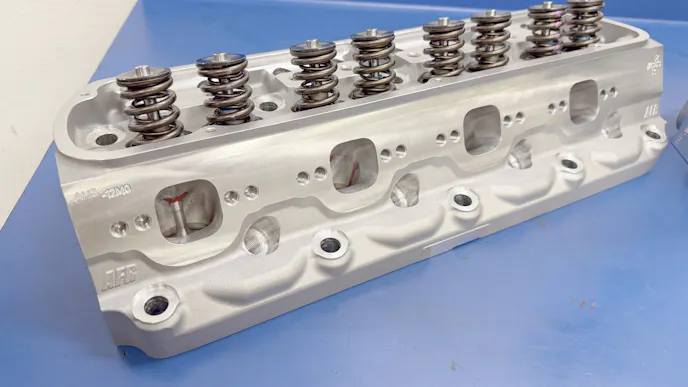
Cometic MLS head gaskets (P/N: C5961-040) provide a 0.040-inch compressed thickness, and the head studs are torqued to 110 lb-ft. The BOSS block, MLS gaskets, and ARP hardware give the heads the clamping force needed to keep the boost in the cylinders where it belongs.
Boost-Friendly Bumpstick
The camshaft is another critical piece of the puzzle. Andrews built a custom grind for the 700-horsepower street-engine target, with 0.595 inches of lift on both sides, 236 degrees of duration at 0.050 inches, and a 114-degree lobe separation angle, while Howards Cams Street Series hydraulic-roller retrofit lifters (P/N: 91168) ride on those lobes.
The lifters push Howards 6.250-inch chrome-moly pushrods measuring 5/16 inches in diameter with 0.080-inch wall thickness, while Howards billet aluminum rocker arms (P/N: 90081) ride on the AFR heads’ upgraded 7/16-inch rocker studs.
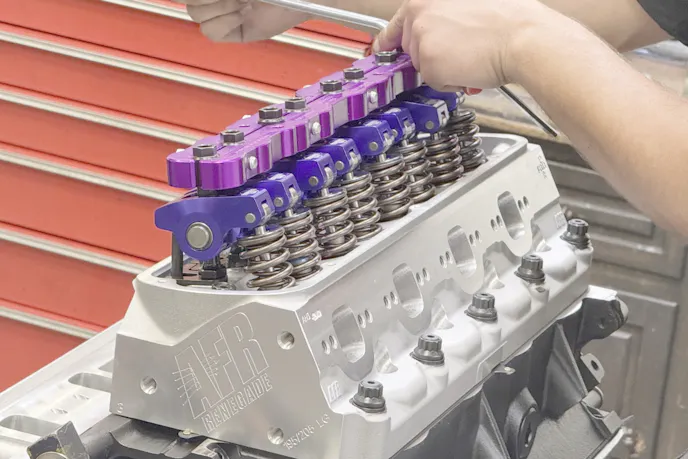
These rockers use roller tips and needle-bearing trunnions to reduce friction, and their construction is designed to withstand as much as 800 pounds of spring force. That’s more valvetrain capability than Fox Dreams needs today, but it provides useful headroom as boost and cylinder pressure increase.
JBA also added Howards Maximum Effort stud girdles (P/N: 90201). By tying the rocker studs together with a rigid billet bar, the girdles help control valvetrain movement and keep the camshaft’s commanded lift at the valves.
Single-Plane Flow
The intake manifold is where Fox Dreams’ 347 takes a turn from the usual Fox Mustang formula. Instead of a traditional EFI intake, the engine uses a Holley 4150-flange single-plane manifold (P/N: 300-276) configured for fuel injectors, with a 90-degree throttle-body elbow (P/N: 300-240) directing the inlet toward the passenger side.
At the end of that elbow sits a 102mm Sniper EFI LS-style throttle body (P/N: 860002-1). Despite the unusual combination, the 90-degree elbow puts the throttle-body inlet relatively close to the factory location, giving the engine a distinctive induction setup without creating a packaging headache.
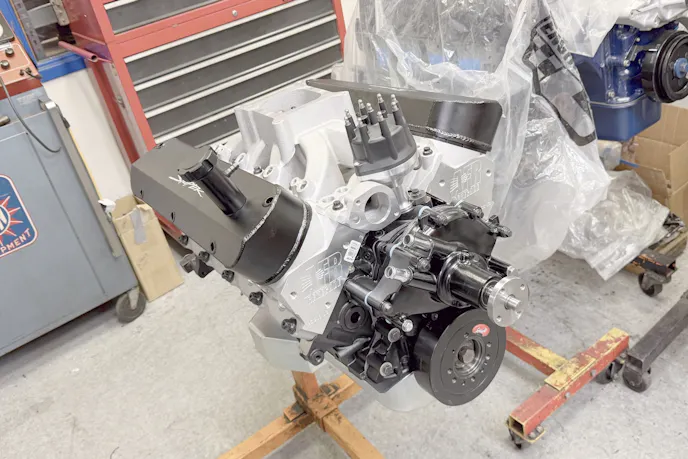
That wraps the first phase of Fox Dreams’ engine build, but the fun part is still ahead. The Holley fuel system is in the works, followed by the Vortech V-3 Ti-Trim supercharger, which will fundamentally change the personality of this stroker small-block.
Once it is installed, boosted, and properly fueled, the completed engine will then head to the dyno so we can see exactly what this combination can do before it goes into Fox Dreams. With a forged 347, BOSS 302 block, CNC-ported AFR heads, a boost-friendly camshaft, and a valvetrain built for stability under pressure, Fox Dreams will have the hardware onboard to hit its streetable 600-plus-horsepower target.
You might also like
Mustang Challenge Competition Goes Global With Championship Invitational
Ford Racing takes Mustang Challenge global in 2027. Three iconic circuits will crown a champion in an international Dark Horse R showdown.