Daniel Hookham’s ride came on our radar as the quickest and fastest Coyote-powered car in Australia. Given how seriously performance is taken Down Under, that was impressive enough. But when we realized his twin-turbo machine was a Holden powered by a modern Ford V8, it became even more noteworthy. The Ford-versus-Holden rivalry is every bit as fierce as the Mustang-versus-Camaro grudge match. Still, no matter how seriously you take brand loyalty, a 6-second, Coyote-powered street car commands respect.
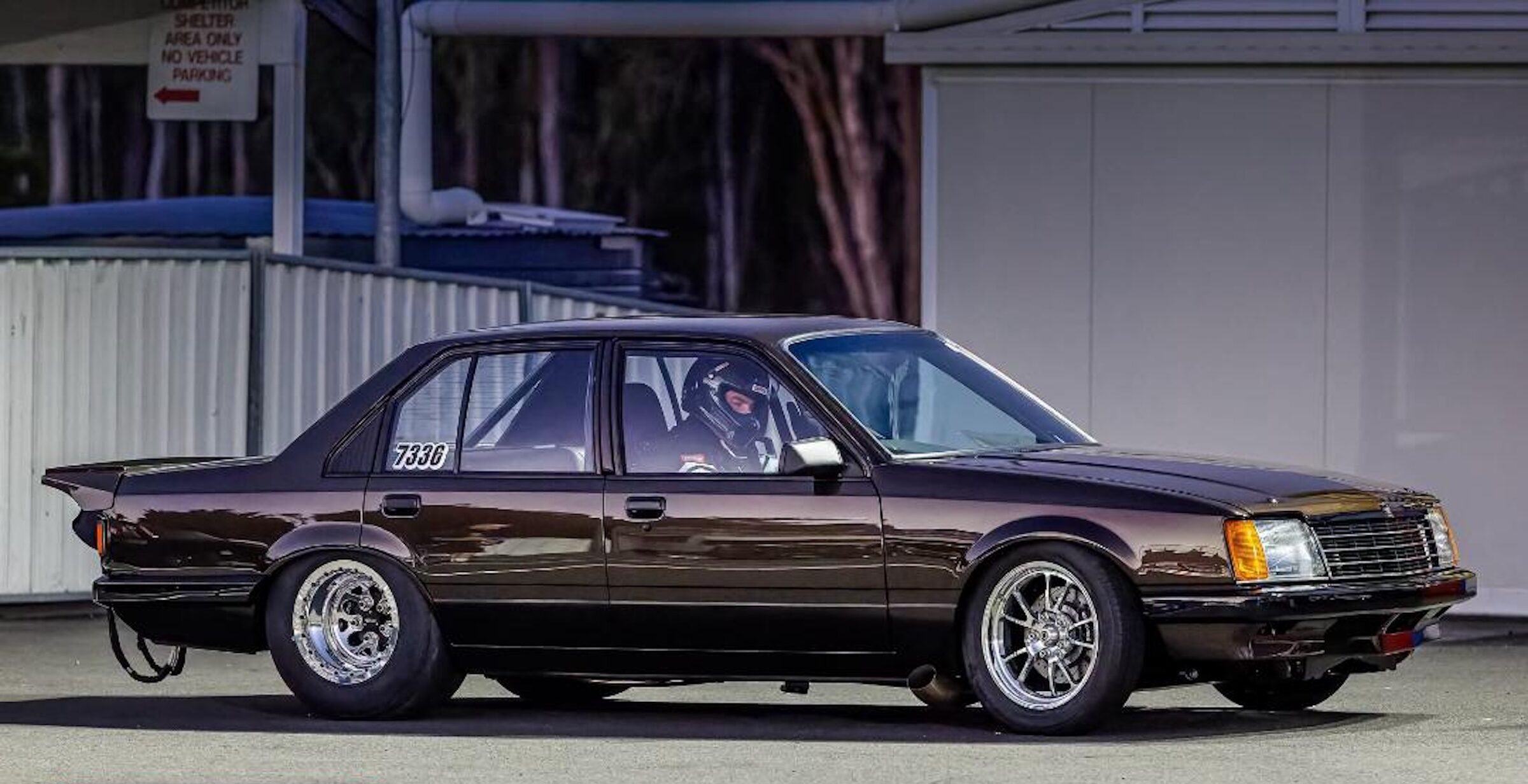
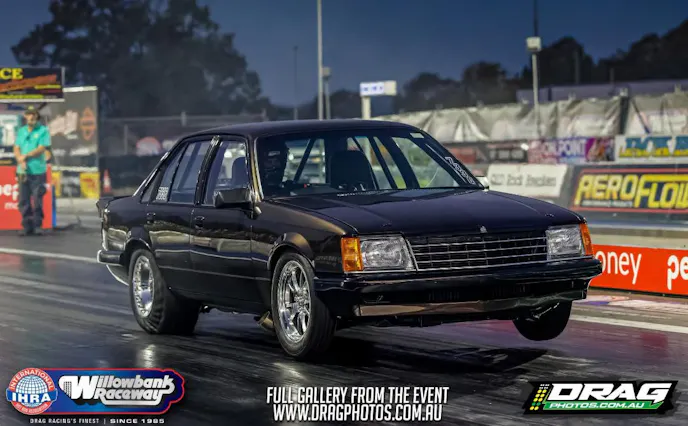
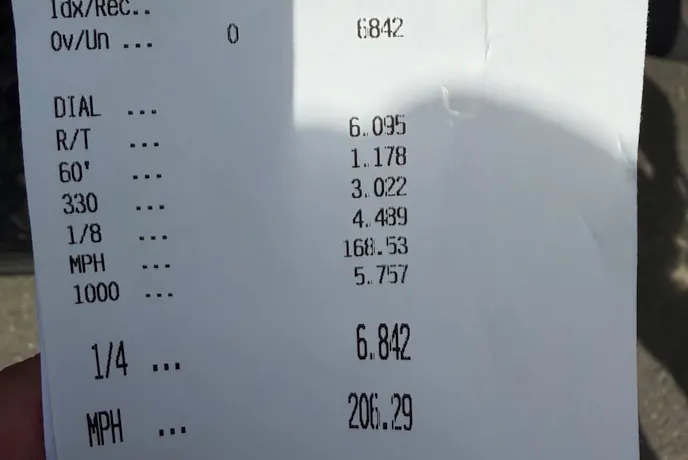
Hookham’s 1979 VB SL/E Commodore is more than a controversial engine swap. It is a fully finished street machine that earned a Top 60 Elite invitation and the Top Retrotech award at Street Machine Summernats before heading to the drag strip and proving its performance credentials. With a Fast Forward Race Engines-built Coyote making well in excess of 2,000 horsepower, the Holden has now recorded a 6.84-second quarter-mile pass at 206.29 mph while retaining the features that make it a legitimate street car.
It still wears steel body panels, full glass, electric windows, and a complete interior. That blend of presentation and performance is what separates this Commodore from a typical high-horsepower build.
Choosing Coyote
The original plan was to swap from LS power to Ford’s 7.3-liter Godzilla V8, but the performance of Bret LaSala’s Coyote-powered Snot Rocket altered Hookham’s direction. The capabilities of Ford’s modern multi-cam architecture proved too compelling, leading him toward a Coyote combination built specifically for extreme street and drag-strip use.
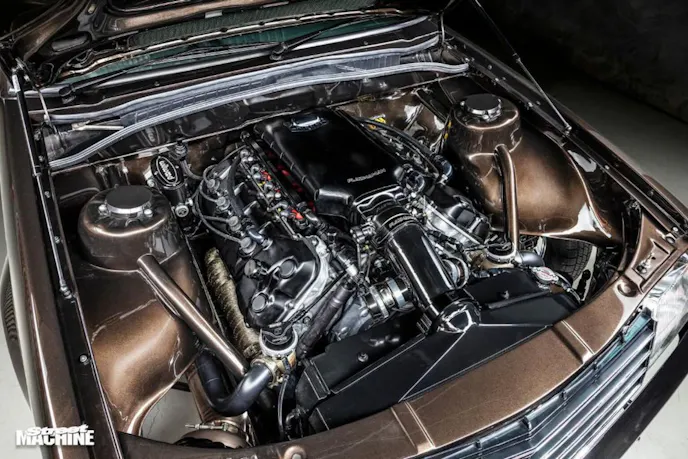
Fast Forward Race Engines built the engine on the foundation of a sleeved Ford Racing 5.2-liter Predator block and filled it with Manley rods, a billet crankshaft, and FFRE-spec Manley pistons with a 10:1 compression ratio. The robust Coyote is topped with FFRE-ported Gen 3 Coyote cylinder heads and a quartet of FFRE custom cams. A dry-sump oiling system handles lubrication, while methanol is delivered through a Plazmaman billet 16-injector manifold and a Kinsler fuel pump. Twin Garrett G42 turbochargers supply as much as 50 pounds of boost, with Haltech ignition coils and a Haltech Nexus R5 ECU managing the combination.
“Those guys had runs on the board. No one in Australia is at this level with the Coyote, so it was a no-brainer,” Hookham said. “And I stand by that decision. The team at FFRE has been amazing.”
Packaging that combination inside an early Commodore was one of the project’s biggest challenges. The VB engine bay was never designed for a modern quad-cam Ford V8, much less one equipped with twin turbos, intercooler plumbing, and dry-sump oiling.
“The width of the Coyote worried us, but luckily it fits within the standard bay without having to cut and move the strut towers,” Hookham explained.
Power Down Under
Putting well over 2,000 horsepower between those strut towers is one challenge. Getting that power to the track is another entirely. The Commodore uses an M&M TH400 transmission with a ProTorque bolt-together torque converter. A sheetmetal Ford 9-inch rearend with 41-spline axles and 3.50:1 gears handles the abuse, while Spot On Performance supplied the four-link suspension and anti-roll bar.
Up front, Gazzard Brothers Santhuff struts help manage weight transfer, while Gazzard Brothers-valved AFCO adjustable rear shocks control the launch. Wilwood brakes handle stopping duties, and the wheel package combines Weld Full Throttle 17×5-inch front wheels with Weld Alpha 1 15×12-inch rear wheels. The tire combination on those wheels reflects the car’s dual-purpose mission. Up front are Nankang Cross Sport SP-9S 165/70R17 tires, while the rear relies on Mickey Thompson ET Street Radial Pro 275/60R15 rubber.
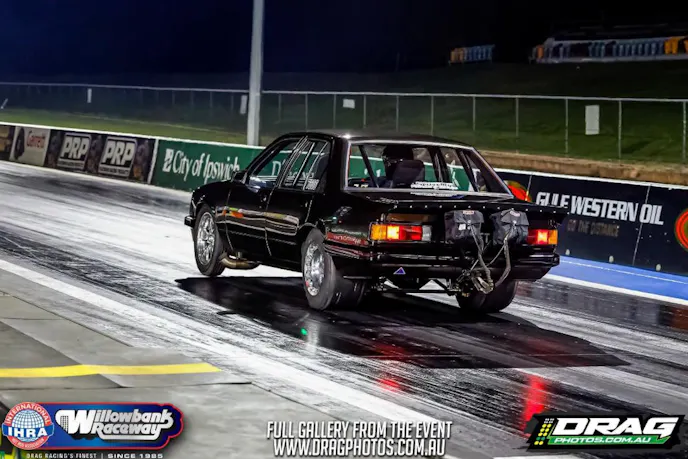
Early testing showed the engine had plenty of capability, but the chassis needed refinement before the Commodore could deliver consistent passes.
“The first two passes were a 7.7 and a 7.6. We called it a day after that, as we were just testing the car. The car fought us for the next dozen or so eighth-mile passes, and we just couldn’t make a clean pass,” Hookham said. “I ended up doing a front shock change, and now we’ve got the consistency we wanted. The first quarter-mile pass with the new struts went 7.0, and since then we’ve gone into the sixes.”
That suspension change unlocked the car’s potential. Once the front-end behavior was corrected, the Commodore moved from a promising combination into legitimate 6-second territory.
The payoff was a 6.84-second quarter-mile pass at 206.29 mph. Those numbers are impressive in any car, but they are even more significant considering what this Commodore still is. It is not a lightweight drag chassis wearing Holden panels. It is a complete street car that can cruise on the road, show at events, and then make a 200-mph pass at the strip.
Holden Heretic
Australia’s Ford-versus-Holden rivalry is a passionate one, so dropping a Ford engine into a Holden is guaranteed to get attention. But Hookham’s build is less about upsetting brand loyalists and more about using the best combination available.
The result is a Commodore that combines show-quality craftsmanship with modern Ford performance technology. Plenty of Holden builds have LS swaps, and plenty of Ford vehicles have been upgraded with Coyotes, but a nicely turned-out VB Commodore with a twin-turbo Coyote running 6.84 at 206.29 mph is a rare piece of engineering.
Even with its current performance, Hookham knows the car’s biggest limitation is weight. The full interior and street-car amenities that make the Commodore unique also keep it from reaching its ultimate potential.
“I need to be honest with myself. The car is too heavy to do what I want. It has full glass, electric windows, etc. It’s as much of a street car as you can get. I have plans to build a 2.0 version, same style, same look, just much, much lighter. And maybe I’ll send this car to the States to compete in a drag-and-drive event. That would be a real dream of mine!”
For now, Daniel Hookham’s VB SL/E Commodore remains an unusual high-performance machine. It combines a Ford Coyote engine, Holden heritage, show-car presentation, and 6-second drag-strip capability into one package. We can’t wait to see how much quicker a lighter version can run.
You might also like
Fabulous Fords Forever Is Back: A New Chapter Begins In Southern California
Fabulous Fords Forever returns to southern California with the addition of Mustang Week West to create a Ford Festival you won't want to miss!