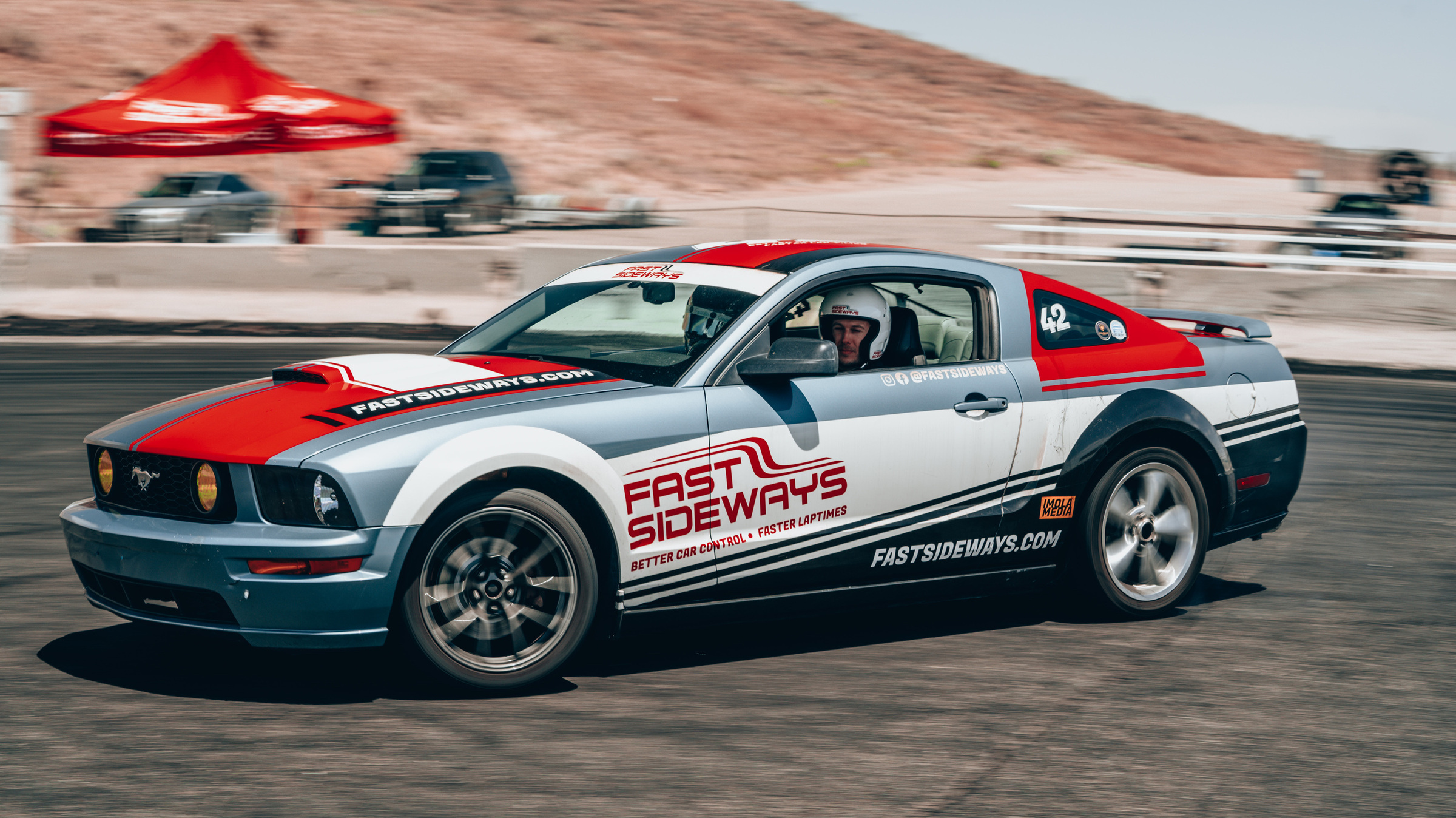
Practicality might be the mother of diversion. Nik Romano’s search for a versatile track car began shortly after launching his car-control clinic, Fast Sideways, and as he would have to use it mainly for instruction and promotion, it had to meet a wider range of criteria. His NA Miata and SA22 RX-7 were both entertaining machines, but neither was particularly well-suited to demonstrating how to slide a car safely, consistently, and repeatedly. They could certainly get sideways, but repeatability matters when students are watching and learning.
“If someone didn’t have a rental car to use with us, we wanted something accessible for them,” Romano explained. “Our first drift taxi was an IS250 with a six-speed manual.”
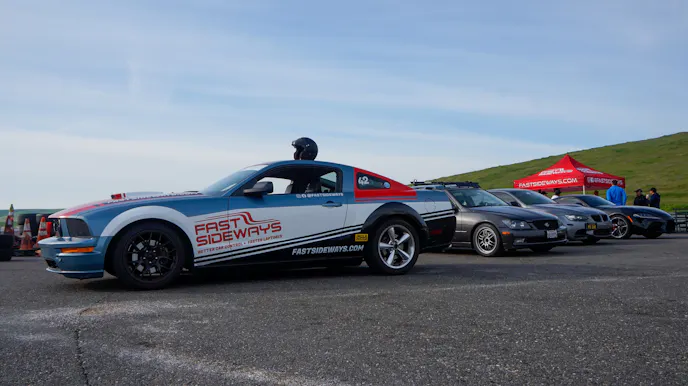
The Lexus checked some of the right boxes, but long-term ownership exposed several shortcomings. A combination of widebody modifications, spacers, and aggressive wheel fitment created geometry issues that accelerated tire wear, while the high-mileage, direct-injected V6 raised concerns about reliability. Since the car was a business asset as much as a toy, it needed to be dependable as well as entertaining.
“It chewed through front tires, and I got tired of changing them constantly,” Romano said. “The 4GR was Toyota’s first attempt at direct injection, and those engines burn valves. Since it had 200,000 miles on the clock, I didn’t want to be hunting for another motor when it finally gave up.”
Practical Choice
Romano’s replacement needed to be simple, durable, affordable, and capable of hauling everything required to support a track-day business. Among the candidates were an E46 BMW, Mazda RX-8, Pontiac GTO, Infiniti G35, and Ford’s S197 Mustang GT.
“It had to be large enough to carry my tent, canopy, cooler, and all my gear. It needed a manual transmission, predictable handling, and low operating costs,” he explained.
The Mustang’s combination of purchase price, parts availability, and operating costs quickly made it a front-runner. Unlike many enthusiast platforms, replacement parts were readily available and inexpensive.
“Everything you need for this car is available at AutoZone, and it’s all cheap,” Romano said. “The replacement aluminum radiator cost about $237, if memory serves.”
Sub2 Or Bust Considerations
The Sub2 Or Bust Challenge is built around a simple idea: How little money does it take to build a car capable of running a sub-two-minute lap at Buttonwillow Raceway Park’s 13CW configuration? To keep competitors on the same playing field, Romano established a straightforward ruleset.
Tracking Budget
- A common spreadsheet is used so every participant calculates costs the same way.
Everything that goes into the car must be included in the total budget, including maintenance, modifications, dyno time, tires, and consumable components. - Vehicle purchase price must reflect realistic market value. If a competitor acquires a car significantly below market value, an independent third party determines a fair value for budgeting purposes.
- If multiple combinations are tested during development, only the final combination used to achieve the qualifying lap is counted toward the budget. For example, if a competitor starts with one tire package and later upgrades to another, only the final tire package is included in the total.
- Outsourced labor must be included in the budget. Home-fabricated components are allowed, but material costs must be tracked.
- If your budget calculation trips the BS meter, that’s on you.
- Complaining won’t help.
- You’re probably overthinking it.
- Seriously, stop overthinking it.
Chassis
- Any mass-produced road car is eligible, from a Pinto to a Pagani.
- Weight reduction is legal, but competitors must still drive the vehicle to and from events without attracting unwanted attention from law enforcement. Building an all-out race car for a challenge with no prize money is generally discouraged.
Tires
- Tires must carry a treadwear rating of 100 or higher.
Fluids
- Fluids are exempt from budget calculations. The goal is not to encourage competitors to save money on oil, brake fluid, or coolant and risk damaging equipment. Use quality fluids and focus spending elsewhere.
Other Considerations
- Vehicles must comply with normal track-day safety requirements, including fuel, safety equipment, and general mechanical condition.
- Used parts are valued at 50 percent of current retail pricing.
- And once again, if you’re still looking for loopholes, see the section about overthinking it.
Thanks to his wife Kristen’s connections within the dealer network, Romano found a largely stock 2007 Mustang GT for just $7,200. The Windveil Blue coupe came equipped with a limited-slip differential, a 4.6-liter Three-Valve V8, and a manual transmission. It was also capable of returning roughly 21 mpg on the highway, which isn’t bad for a car rated at 300 horsepower and 320 lb-ft of torque. Like many enthusiasts who turn their passion into a profession, Romano found that priorities shift once a hobby starts paying the bills.
“It was Kristen who said, ‘You’re not going to the track for fun much anymore, so why don’t you take this one to the track?'” Romano shared.
Curious about the Mustang’s potential, he loaded the trunk with tools and fluids and headed to Streets of Willow. Expectations were modest. After all, this was a relatively heavy street car purchased primarily because it was practical and inexpensive.
Pleasant Surprise
The Mustang’s weight—roughly 3,400 pounds—quickly exposed the limits of the stock brakes and tires, but the experience revealed strengths Romano wasn’t expecting.
“I figured it would cook the tires and brakes, but that was really its only weakness. It was more stable, more predictable, and quicker than I expected,” he explained. “It would let you sit on the rear axle and drive with a little slip angle. Even with moderate understeer and all-season tires, I managed a 2:09.4.”
That first outing planted a seed. The Mustang wasn’t especially sharp, but it was forgiving, communicative, and far more capable than its bargain-basement purchase price suggested. Because the car still served rental duty, Romano wasn’t interested in transforming it into a harsh, single-purpose track car. The question quickly became how much performance could be unlocked without spending serious money.
“I wanted to keep it simple enough for students to jump in and drive,” Romano said. “If I made it stiff and snappy, not everyone could use it.”
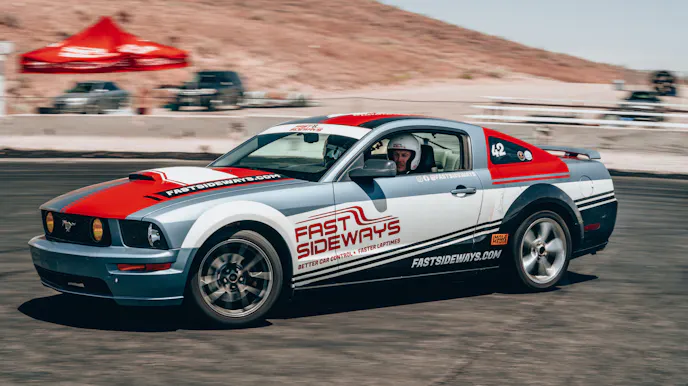
Fortunately, an affordable solution appeared. A fellow S197 owner upgrading to coilovers sold him a package consisting of Bilstein dampers, Ford Racing springs, Steeda sway bars, and an adjustable Panhard bar for just $500. Combined with a set of $45 camber bolts that provided roughly 1.7 degrees of negative camber, the Mustang’s handling improved dramatically for less than the cost of many track-day weekends.
“The adjustable bar was needed after lowering the car to maintain desirable geometry,” he added.
The results got Romano thinking beyond his own project. Years of watching Best Motoring videos had convinced him that affordable performance could be every bit as entertaining as exotic hardware. The Mustang seemed like proof.
Budget Speed
That train of thought eventually evolved into Sub2 Or Bust, a challenge designed to answer a simple question: How little money does it take to build a car capable of running a sub-two-minute lap at Buttonwillow Raceway Park‘s 13CW configuration?
The challenge wasn’t solely about outright speed. Cost mattered just as much. Participants would have to track expenses and demonstrate how efficiently they achieved performance.
Preparing for his first serious attempt, Romano upgraded to G-LOC R16 brake pads and mounted a set of 17×10-inch Apex EC-7 wheels wrapped in 275-wide Federal 595RS-R tires. The improvements immediately paid dividends. The Mustang clicked off a 2:02.21 lap. Not bad considering the only casualty was a rear axle seal.
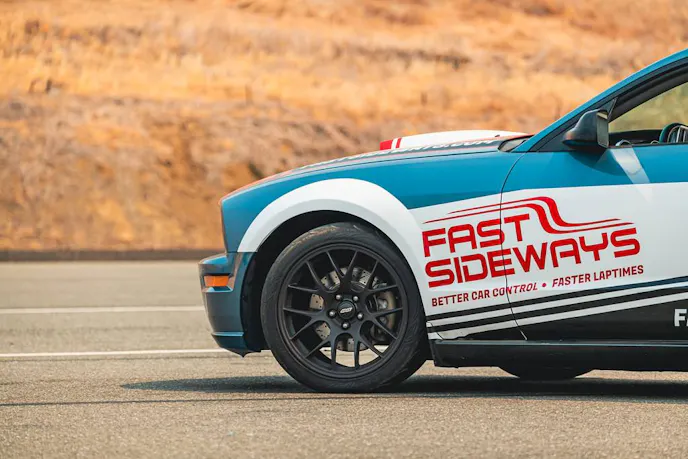
“After that performance, I figured all I needed were Yokohama A052s and a cold morning session to break into the one-minute range,” Romano said.
Before his next outing, the factory limited-slip differential gave way to an Eaton Detroit Truetrac. While not as aggressive as a clutch-type differential, the helical-gear unit offered simplicity, durability, and attractive pricing.
“It wasn’t as performance-oriented as a clutch-type differential, but it requires virtually no maintenance and only costs $560,” he added.
A set of discounted Maxxis RC-1 tires and Corbeau reclining seats followed, but the next attempt still came up short. Romano missed the goal by just .66 second.
Breaking Through
Rather than overhaul the combination, he focused on refining it. A set of forged Apex VS-5RS wheels joined the package, while Steeda X5 ball joints helped optimize front suspension geometry. A fresh set of Maxxis RC-1 tires completed the preparation.
Back at Buttonwillow, the Mustang felt more sorted than ever. It remained composed through the fast sections, responded well to steering input, and generated surprising grip despite its relatively simple setup. Certain curbs could still upset the chassis, particularly through the esses between Sweeper and Sunset, but the car’s balance inspired confidence.
“Honestly, for how compromised the car is, it’s quick into the corner. It’s a little front-heavy, but not by much. It honestly feels similar to a 350Z. In the tighter sections, you’re somewhat limited by the front end, but the overall grip level was much better than I expected. Once you reach the corner exit, it squats and absolutely digs itself out of the turn.”
Ironically, focusing on content creation may have helped him find speed. “Because I was concentrating on filming, cameras, and talking, I didn’t have time to obsess over the lap itself. It was one of those flow-state moments that don’t happen often enough,” Romano reflected.
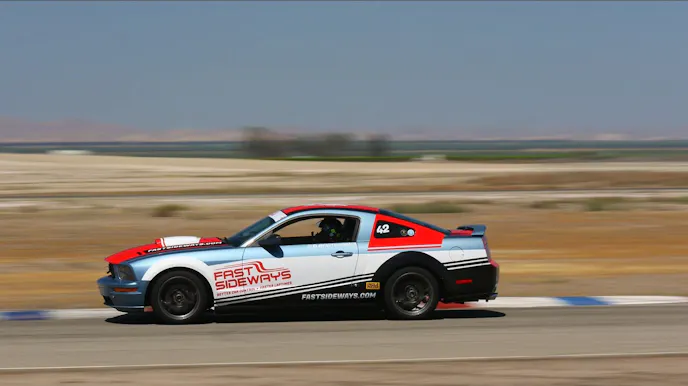
One detail from that lap remains particularly vivid.
“Even with the Corbeaus, I didn’t have a harness or CG Lock, so I slid the seat back, cinched the belt tight, and wedged myself into it,” he recalled. “I remember bracing myself against the dead pedal so hard that my leg was shaking through Sweeper.”
Chasing an RX-8 farther up the road, Romano crossed the finish line and glanced at the timer. After multiple attempts and countless calculations, the number he’d been chasing finally appeared on the screen.
The lap was a 1:59.15.
For less money than many enthusiasts spend on a rough Honda S2000, Romano had built a basic S197 Mustang capable of joining Buttonwillow’s sub-2-minute club — a benchmark that has challenged far more expensive machinery.
Diminishing Returns
Thanks to a handful of discounts, the project came together for $13,567.22. Using full retail pricing, the figure climbs to $14,593.16. Either way, the result is impressive. More importantly, the Mustang continued serving its original purpose. It remained a reliable instructional tool while proving that meaningful track performance doesn’t necessarily require a massive budget. With the challenge complete, Romano eventually installed a StopTech ST40 big-brake kit. Interestingly, the most expensive modification on the car delivered one of the least dramatic performance improvements.
“It didn’t make the car any faster, but it did extend pad and rotor life,” Romano said.
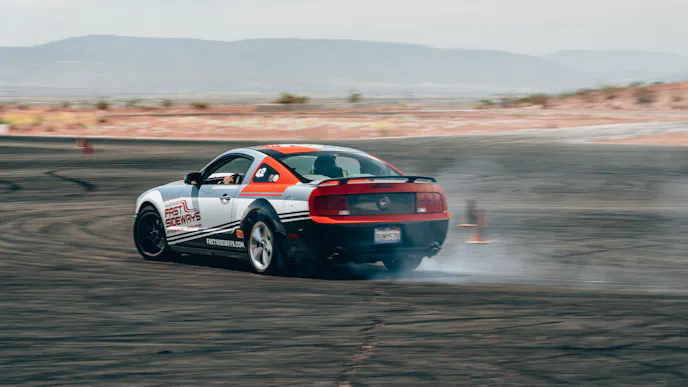
In many ways, that outcome reinforced the lesson behind the entire project. There is always another part to buy, another upgrade to install, and another tenth of a second to chase. Eventually, however, the return on investment begins to shrink.
For a relatively heavy V8-powered coupe purchased because it was cheap, practical, and easy to maintain, this S197 found that sweet spot sooner than most. That’s what makes Romano’s Mustang so compelling. It isn’t a purpose-built race car or an unlimited-budget track weapon. It’s proof that thoughtful modifications, realistic goals, and a clear understanding of value can still produce something genuinely quick.
You might also like
Ridetech’s Four-Link Rear Suspension Adds Formidable F-150 Traction
Ridetech created an F-150 four-link rear suspension upgrade. This system improves traction, geometry, and adjustability.