Finding a 2014 Mustang GT with under 4,000 miles is rare. VMP Performance recently brought one of these time capsules into the shop to prove that early Coyote engines still have plenty of potential. The plan involved a Predator supercharger swap to modernize the power output. This engineering exercise aimed to mate the massive Eaton TVS blower that tops the Predator 5.2-liter engine in the 2020-2022 Shelby GT500 or the Carnivore 5.2-liter engine that powers the 2023-and-newer Raptor R onto their Coyote 5.0-liter V8 cousin.
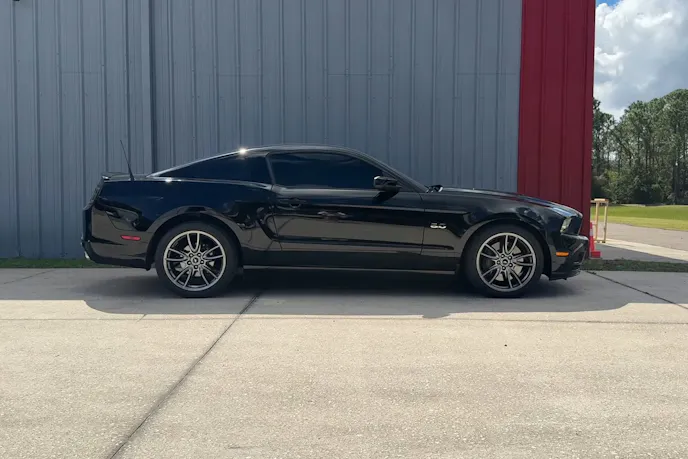
Jared Whitman, Content Creator at VMP Performance, introduced the vehicle, a race-spec example featuring cloth Recaros and Brembo brakes. Putting a Predator blower on a standard Coyote requires careful boost management. The factory pulley on these units targets a 5.2-liter engine built for extreme stress, not a standard compression 5.0-liter.
“That is 15 or 16 psi of boost, depending on the application, which is entirely too much boost for a stock Coyote, so you need to pick up our Apex Predator hub,” Whitman said of the danger of running the stock setup.
The VMP team swapped to a 3.4-inch pulley to drop the boost down to a manageable 9 to 11 psi. The intake system also needed work because Gen 1 electronics often reject the massive modern throttle bodies found on the Predator. A specialized adapter plate solved this by mating the stock 80mm throttle body to the supercharger’s 95mm inlet.
“There are not really any other options than a stock throttle body, so we are going to utilize our stock 80 mil to the 95 mil opening here,” Whitman said.
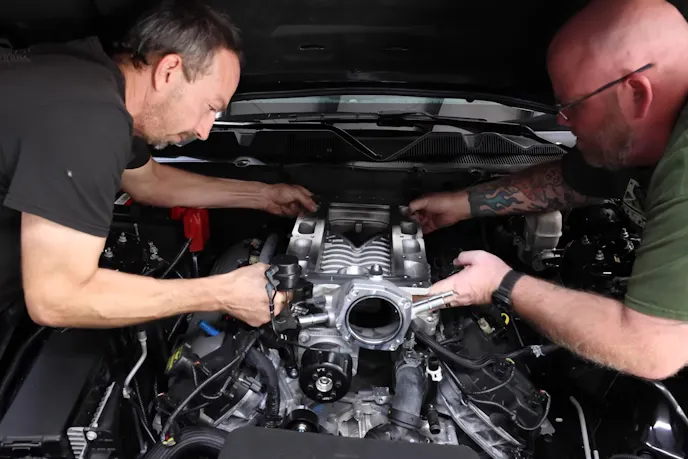
Custom solutions fixed the fuel system and cooling layouts. The Raptor R supercharger uses a different mounting geometry than the GT500 version, so VMP installed a specific set of fuel rails to handle the shorter bolt depth. Once the team sorted the mechanicals and the “boomerang” bracket for the belt drive, the car hit the rollers. It produced a healthy 615 rear-wheel horsepower.
“It delivers torque almost instantaneously and is very linear in the way that it delivers torque, and it just drives great,” Whitman said of the results.
You do not need a Shelby to enjoy this level of engineering. Careful selection of the pulley ratio and adapting the fuel systems make the Predator supercharger swap a viable option for Coyote owners. The result offers a clean, factory look under the hood with aggressive performance, and it keeps the car drivable on the street while providing massive torque on demand.
You might also like
A Collection Of Thoroughbred Pony Cars Heads To Auction In Florida
Mecum Auctions kicks off its ’26 schedule in Kissimmee, Florida. Among the groups of vehicles for sale is the Thoroughbred Mustang Collection.