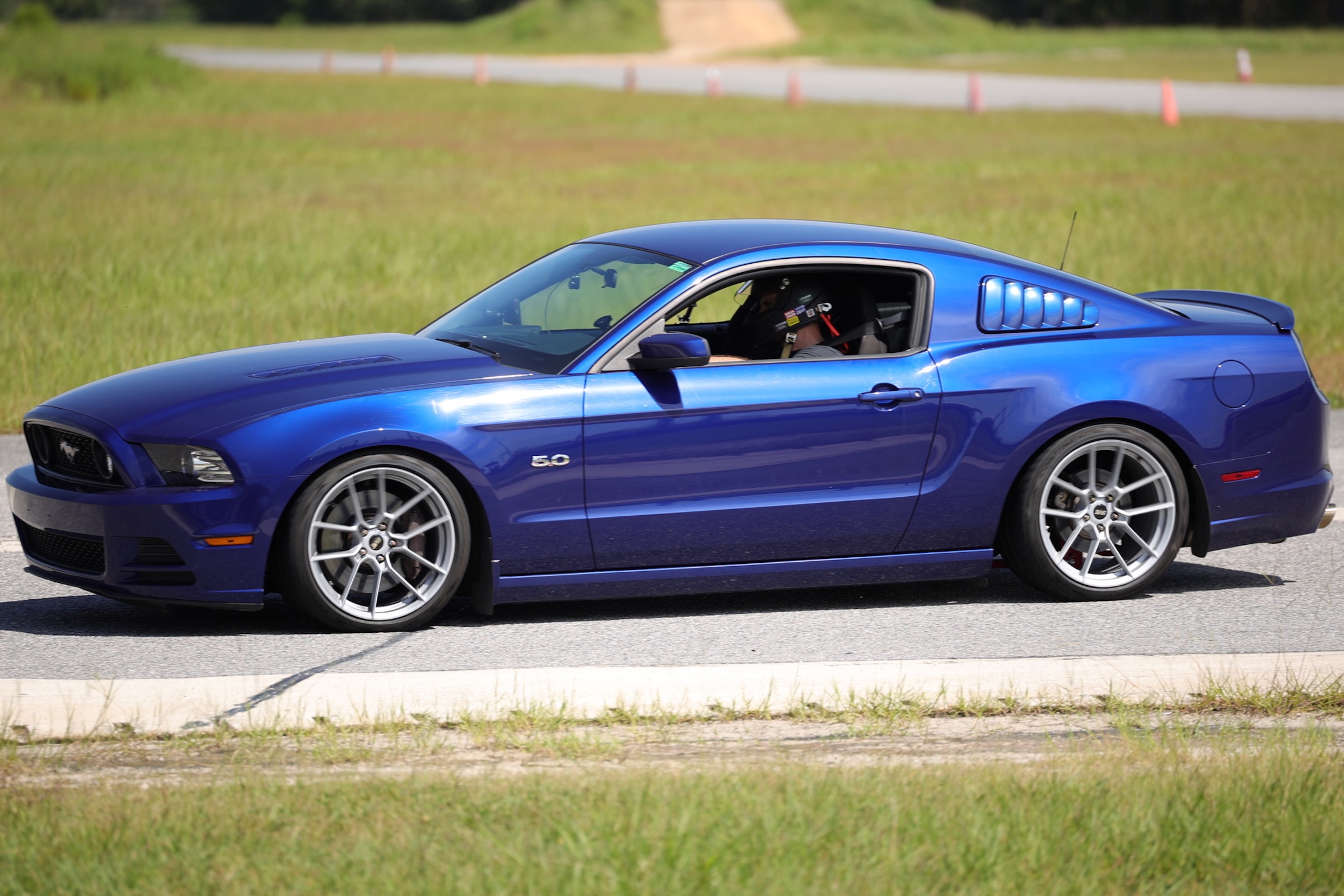
For those following along with Project Clubsport, our 2014 Mustang GT Track Package build, you know that we baselined the car after some sensible upgrades. Then we headed to BMR Suspension for a complete handling makeover, including Continental Tires and SVE Wheels from LMR. With those upgrades in place, we returned to the road course to see how our sharper S197 performed.
Our goal was straightforward. We wanted to improve the Mustang’s handling without turning it into a track-only machine. The suspension overhaul centered on KONI GTS coilovers (P/N: 1200-1009; $2,198.67), which provided adjustable ride height and damping. BMR Suspension complemented them with a comprehensive collection of front and rear components designed to correct the geometry changes that come with lowering the car, reduce unwanted deflection, and give us more control over chassis balance.

Up front, that meant adjustable tubular lower control arms with taller ball joints (P/N: AA757R; $699.95), an A-arm support brace (P/N: AAS001R; $69.95), a bump steer kit (P/N: BSK750; $129.95), and an adjustable sway bar (P/N: SB022R; $319.95) with upgraded end links and mounts. A tubular radiator support (P/N: RS003; $219.95) rounded out the front-end changes.
The rear received adjustable lower control arms (P/N: TCA021R; $319.95), relocation brackets (P/N: CAB005R; $139.95), an adjustable Panhard rod (P/N: PHR013R; $219.95), a larger sway bar (P/N: SB023R; $379.95), and a spherical bearing kit (P/N: BK079; $129.95). Together, those parts addressed axle location and suspension geometry while adding the adjustability needed to fine-tune the chassis.


We also ditched the factory staggered wheel-and-tire package in favor of a square setup. LMR’s 19×10-inch SVE DHP1 forged wheels (P/N: SVE-444903F; $549.99 each) wear Continental ExtremeContact Force 295/30R19 tires at all four corners. The 200-treadwear rubber brings a substantial increase in grip, while the square arrangement allows us to rotate tires between events.
The changes also trimmed weight. Project Clubsport dropped from 3,560 pounds to 3,532 pounds after the suspension work, then shed another 20 pounds with the wheel-and-tire swap. With a quarter tank of fuel, the Mustang now weighs 3,512 pounds—a total reduction of 48 pounds.


Back To The Track
Returning to the road course gave us the chance to evaluate the complete package, not just individual components. The results were encouraging, particularly because the second test took place in considerably hotter conditions. We conducted our baseline session at 80 degrees, while the return visit saw ambient temperatures climb to 97 degrees, with the track surface reaching 126 degrees.
Even with that heat working against the car, Project Clubsport recorded a quicker best lap. The baseline test produced a 59.16-second lap, while the modified Mustang turned a 58.47-second lap. That is a 0.69-second improvement on the stopwatch.
Our Garmin Catalyst Driving Performance Optimizer data also revealed more potential than the completed laps alone suggest. By combining the best individual sector times from each session, the system calculated an optimal lap of 57.96 seconds for the baseline configuration and 57.21 seconds after the upgrades. That 0.75-second difference indicates the Mustang has the pace to run in the 57-second range when we put it all together on a single lap. It is an estimate of potential, not a completed lap, but it gives us another useful way to evaluate the improvements.

Consistency improved, too. The variation among the three quickest laps dropped from 0.57 percent in the baseline test to 0.32 percent with the new suspension and tires. Looking at the five quickest laps, variation decreased from 1.06 percent to 0.78 percent. The smaller spread suggests the car was delivering more repeatable performance rather than relying on one particularly good lap.
“The car felt incredible, so precise. It really does what you ask it to do at this point. The front end was probably the biggest transformation,” the car’s owner, Ivan Korda, of POWER, said. “Under braking, it stayed composed and tracked straight. The shimmy I previously felt from the original front control arms was gone. Turn-in was excellent, and the steering wheel finally felt connected to the front tires.”
That improved driver confidence showed up in the segment data. The Mustang gained roughly 3/10 of a second in both segments four and seven, and about 2/10 in segment eight. In Segment four, Korda carried approximately 5.8 mph more speed into the corner, maintained a higher minimum speed, and exited roughly 4 mph faster. Segments seven and eight showed similar gains, with higher entry and minimum speeds helping the car carry more momentum through the turns.


Not every section improved. Segment 3 was approximately 2/10 slower, despite a similar or slightly higher entry speed. The data showed a lower minimum speed, followed by a substantially faster exit. Korda’s assessment was that he slowed the car more than necessary while rotating it, then got back into the throttle aggressively. Segment five was also fractionally slower, with entry speed up a couple of miles per hour but minimum and exit speeds essentially unchanged.
Those differences are useful because they show where the package is working and where more seat time can help. The car has more grip available, but the driver still has to learn how to use it consistently. That is part of the process when a familiar car gains a meaningful amount of capability.
Finding The Window
Tire pressure was one of the important variables during the return visit. We started around 30 psi cold and initially saw hot pressures climb into the 36.5- to 37-psi range. Korda felt some mid-corner oversteer when getting back into the throttle, but correcting the tire pressures improved that behavior. It was a reminder that a high-grip tire needs to operate in the right pressure window, especially when the track surface is baking in the sun.
“The rear initially had some mid-corner oversteer when I got back into the throttle. Once I got the tire pressure into the right range, that behavior went away. Turn-in and mid-corner grip were excellent, and I could apply more throttle and get into it earlier,” Korda explained. “The new rear suspension parts definitely create more bite out of the corner and make the solid rear axle much more predictable to drive. You still have to respect the throttle in the slow corners, but the car is much easier to manage.”


The braking system required attention as well. After the first session, the pedal traveled to the floor, so Korda flushed the brake fluid at the track. The car had also moved from Carbotech XP10 to XP12 pads before this event. With fresh fluid, the pedal returned, and the brakes delivered the smooth, strong bite expected from the newer pad compound.
During the final session, which lasted about 30 minutes, brake temperatures became a concern after roughly eight to 10 minutes of hard running. Korda mitigated the rising temps with some slower laps, doing so three times during that session. The engine and cooling system remained under control, but the experience made it clear that brake temperature management will be part of the next round of development.
“The pedal was going completely to the floor after the first session, so I flushed the brake fluid at the track. With fresh fluid in the system, the brakes felt brand new again, and the XP12 pads had really good, smooth bite,” he assessed. “During the next session, I could feel the brakes getting hot after about eight to 10 minutes of hard laps, so I backed off and completed cool-down laps. We made it through the final 30-minute session, but brake temperature is something we need to address before pushing the car harder.”
More temperature-resistant brake fluid and improved brake cooling are worth investigating before the Mustang spends longer sessions at the limit. The data also reinforces the value of getting the tire pressures right and giving the driver more time to adapt to the additional grip.
More In The Tank
The best part of this round of testing is that the Mustang made measurable progress without requiring a radical change in its character. The suspension package improved the car’s response, the wider square tire setup delivered more grip, and the lighter wheel-and-tire combination helped reduce mass. The lap times confirm that the work is paying off, while the consistency numbers show the gains are repeatable.
Cooler ambient and track temperatures, a more refined tire-pressure window, better brake temperature management, and additional seat time could all help the car move forward. Korda’s estimate is that another couple of seconds may be possible under more favorable conditions, though that remains a projection rather than a measured result.

“The biggest takeaway is how approachable the car has become. This S197 is now precise, predictable, and easy to drive. Someone could get in it, immediately feel connected to the car, and have a great time,” he added. “We made the car faster, but the transformation goes beyond the stopwatch. The front does exactly what I ask, the rear puts power down more effectively, and the entire car is easier to drive.”
Stay tuned as we continue building Project Clubsport into a Mustang that can deliver more speed, more confidence, and more fun every time it hits the track. The next installment will shift attention from the chassis to the engine. We’re heading to VMP Performance to explore naturally aspirated upgrades for the Gen 1 Coyote 5.0-liter V8.
You might also like
Ford Hushes The Haters With A Cobra Snake Attack In GT41 Hypercar Clip
Ford released a video hyping its return to Le Mans with the GT41. That clip also offered a first look at the badge on the next Mustang Cobra.