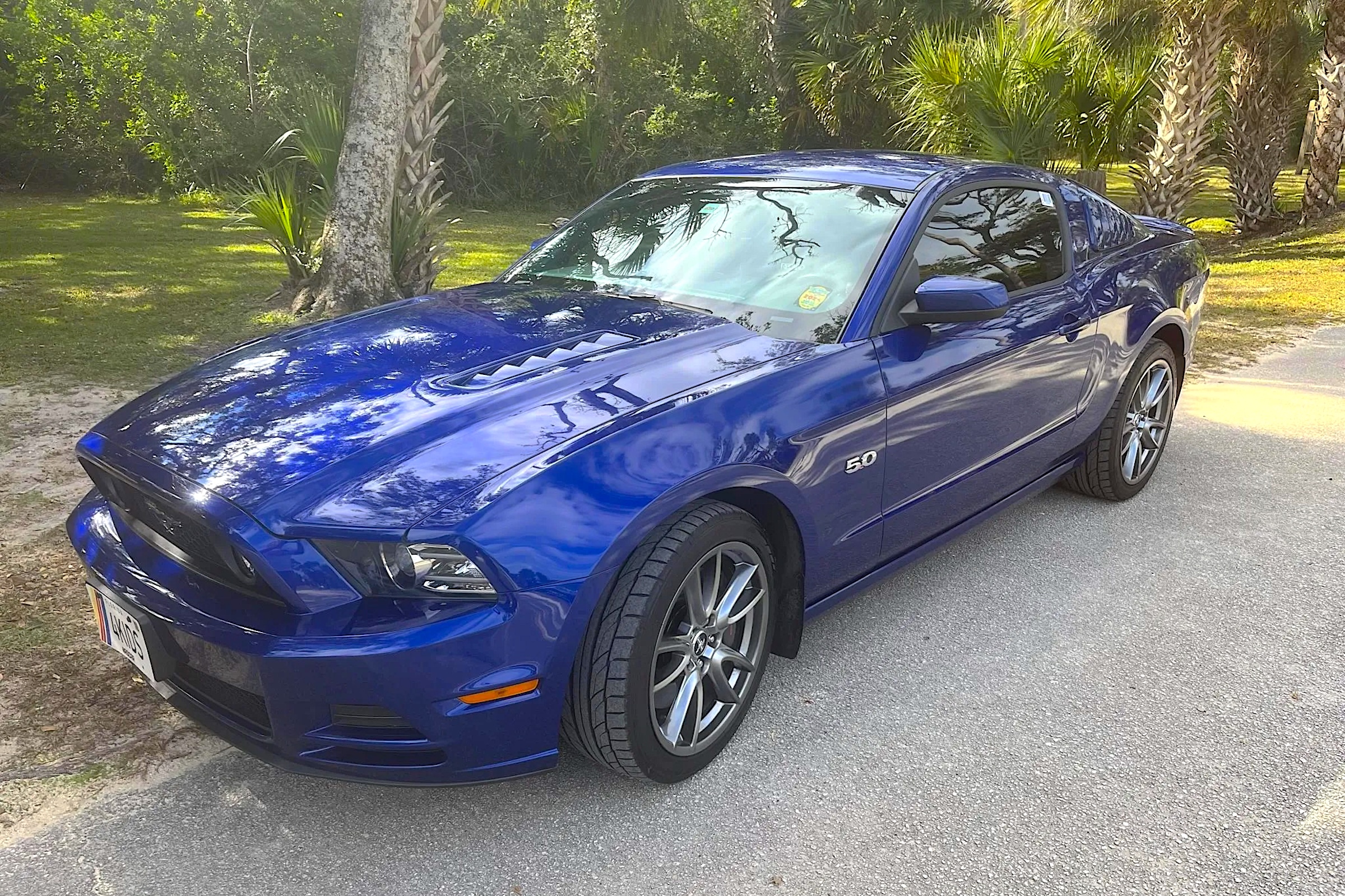
If you’ve been following our 2014 Mustang GT project car, owned by Ivan Korda, Director of Business Development at POWER, FordMuscle’s parent company, you know the goal is to enhance its performance so it can hang with modern corner carvers like the S550 Shelby GT350 and S650 Dark Horse for far less money. It’s a lofty goal, but Korda is ready to give it a shot and have some fun in the process. Before we pour on the mods, however, we need to add a few sensible ones and establish a baseline for Project Clubsport’s on-track performance.
A potential mistake when building a track car is modifying it before you truly understand it. It’s tempting to order suspension components, sticky tires, and more horsepower before ever turning a wheel on a road course. That approach makes it nearly impossible to know which upgrades genuinely improve the car and which simply put a Band-Aid on its shortcomings.
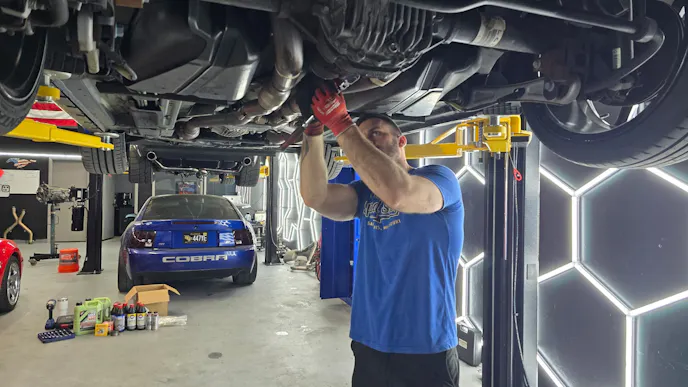
Korda’s philosophy for Project Clubsport is exactly the opposite. Before we change how the car behaves, we want to understand how Ford engineered it to perform. That means our first High Performance Driving Event wasn’t about chasing lap times or trying to build a race car overnight. It was about eliminating maintenance unknowns, improving reliability, protecting the drivetrain, increasing braking confidence, and learning exactly what the factory chassis has to offer before making modifications that change its personality.
Strong Start
At approximately 51,000 miles, our one-owner 2014 Mustang GT Track Pack already starts with a strong factory foundation. Ford built the Track Pack as a serious enthusiast package, and it shows. The Brembo front brake package brings more thermal capacity and braking consistency than a standard GT setup, while the Boss 302 radiator and engine oil cooler help manage heat during sustained high-load driving.
A 3.73 rear gear and Torsen limited-slip differential sharpen acceleration out of corners without the abrupt behavior that can come with a more aggressive locking setup, and the factory Recaro seats do an excellent job of keeping the driver planted when the lateral load starts building. That combination makes the Track Pack a jumping-off point for HPDE duty. It is still a street car, but it is one that was factory-engineered with track use in mind.
Even so, every used performance car comes with unanswered questions. Before asking this Mustang to spend an entire day at wide-open throttle, repeated threshold braking, and sustained cornering loads, we wanted to eliminate as many unknowns as possible.
“I didn’t want our first day at the track to be a troubleshooting exercise. We went through the car front to back with preventative maintenance so I could spend the day driving instead of wondering what might break,” Korda explained. “Outside of one minor cooling-system concern, the car completed the event without any major mechanical issues.”
Fresh Fluids
When you buy a used performance car, you never truly know its history. Maintenance records can provide some comfort, but they do not tell the whole story. Fresh fluids remove that uncertainty, and for track use, that peace of mind matters as much as any horsepower gain.
“When you buy a car, you never know what’s hiding underneath, so I like to start fresh. Even if the car’s maintenance history is good, fresh fluids remove any uncertainty about what’s lubricating the important systems of your new toy,” Korda said. “Track driving places significantly more heat into every drivetrain component than normal street driving, so I like to invest a few hundred dollars in fresh fluids to give me peace of mind.”
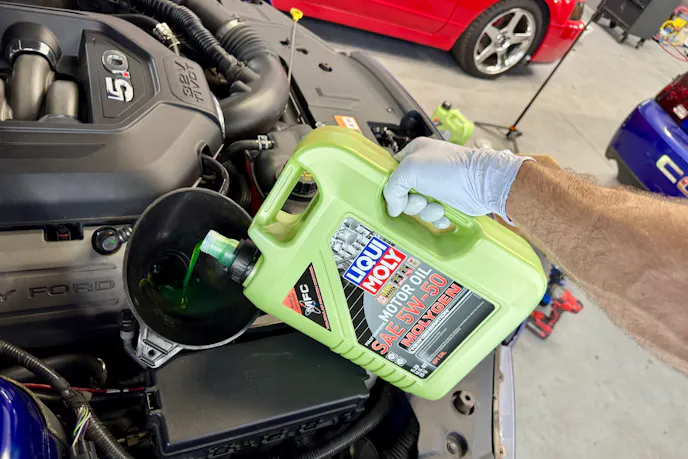
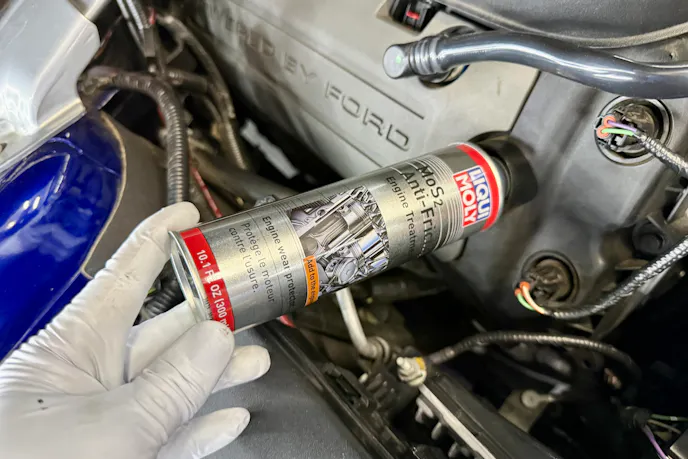
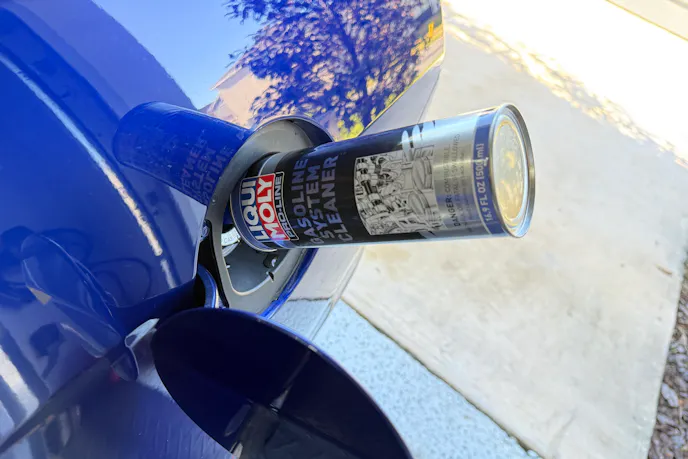
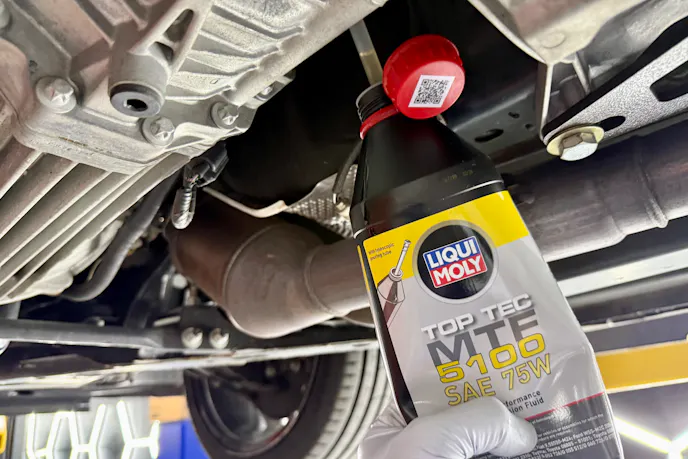
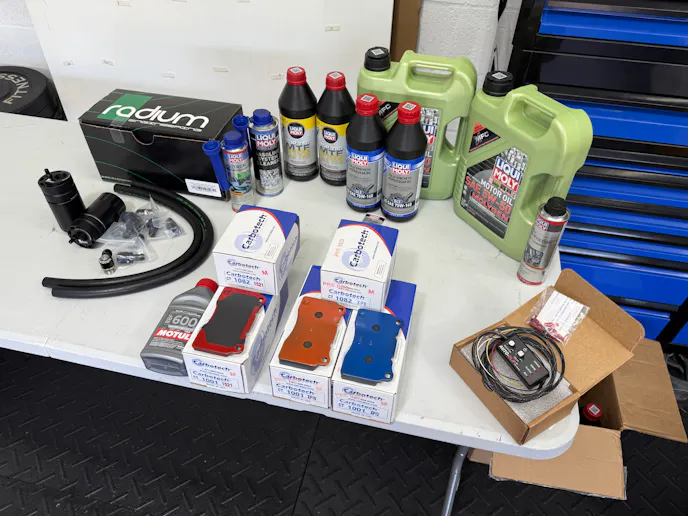
That mindset shaped the entire prep process. We had LIQUI MOLY product specialist guidance on the fluid selection, and the Mustang now runs Molygen 5W-50 (P/N: 20310; $86.95) engine oil with MoS2 Anti-Friction Engine Treatment (P/N: 2009; $17.95). The MT82 manual transmission received Top Tec MTF 5100 75W fluid (P/N: 20352; $17.95) with LIQUI MOLY’s MoS2 Anti-Friction for Gears (P/N: 2019; $21.95), and the rear axle was refilled with Hypoid Gear Oil 75W-140 (P/N: 20042; $42.95) and the correct friction modifier. We also treated the fuel system with Pro-Line Gasoline System Cleaner (P/N: 2030; $42.95), then followed that up with Fuel System Treatment (P/N: 8365) in the next tank to clean, lubricate, and protect the system.
Fresh fluids will not make the car faster in the traditional sense, but they remove a layer of doubt. When every critical system starts from a known baseline, it becomes much easier to judge what the car is telling you once the tires, brakes, and chassis start getting hot.
Before the car ever left the garage, we also completed a full nut-and-bolt inspection of the suspension, steering, brakes, cooling system, and driveline. On a used performance car, that kind of attention is not overkill. It is smart preparation.
Oil Control
Preventative maintenance also extended to the engine’s crankcase ventilation system. Gen 1 Coyote engines are known to pull oil vapor through the PCV system during sustained high-rpm operation, which makes an oil separator a worthwhile upgrade for any Mustang that sees regular track time.
To address that, we installed a Radium Engineering dual bolt-in catch can system (P/N: 20-0324-FL; $229.95). The Radium kit separates oil vapor from crankcase gases before they re-enter the intake tract, which helps reduce contamination, minimize carbon buildup, and keep the intake runners cleaner over the long haul. It will not add horsepower, but it helps preserve the horsepower the engine already has.
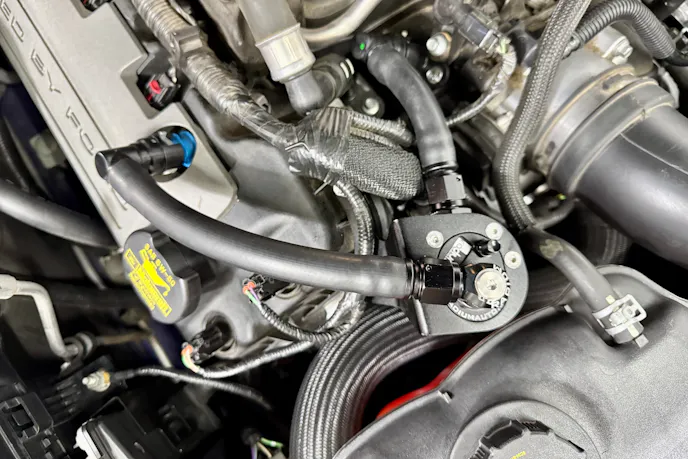
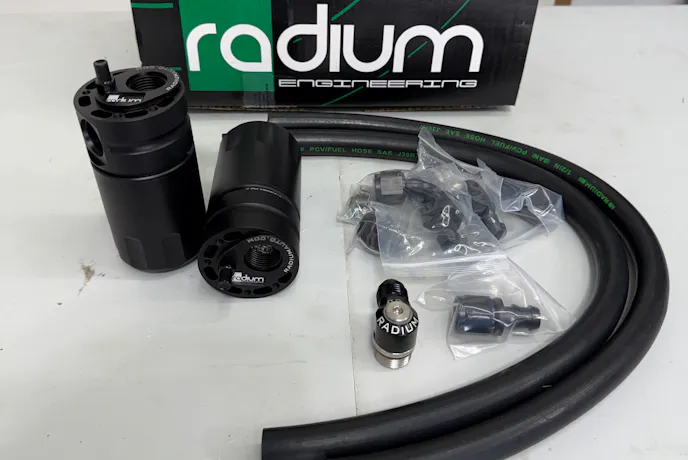
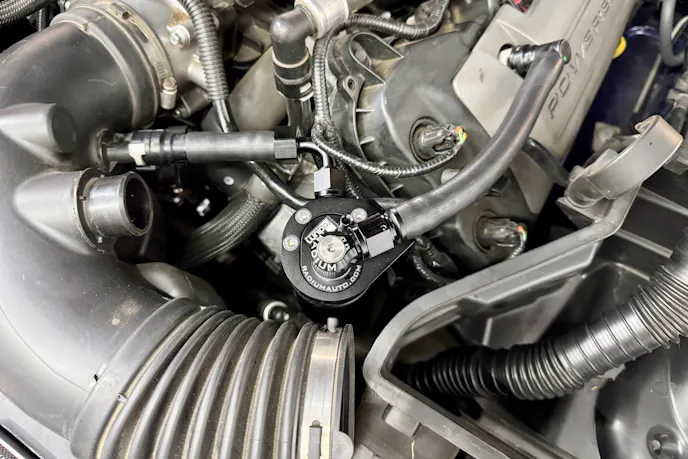
Korda chose the Radium system because it is engineered specifically for the S197 chassis and installs as a true bolt-on with factory-style fitment. The integrated dipstick also makes it quick and easy to inspect the amount of oil collected between sessions. That matters when you are trying to keep a track car dependable over the long run.
Rev Matching
Another smart addition to Project Clubsport is the Auto-Blip Rev Matching System ($395.00). This one is less about hardware and more about reducing distraction during the car’s maiden voyage on the road course.
“For this project, I decided to install the Auto-Blip Rev Matching System. While heel-toe downshifting is an important performance driving skill, it’s also one of the hardest to master consistently, especially for enthusiasts who only attend a handful of HPDE events each year,” Korda said. “It’s difficult to practice safely on public roads, and by the time the next track day comes around, those skills often need to be relearned. Many modern performance cars from manufacturers like Porsche, Chevrolet, BMW, Toyota, and Nissan now offer automatic rev matching from the factory, so I figured I’d embrace the ‘easy button’ and see how it performs on the S197.”
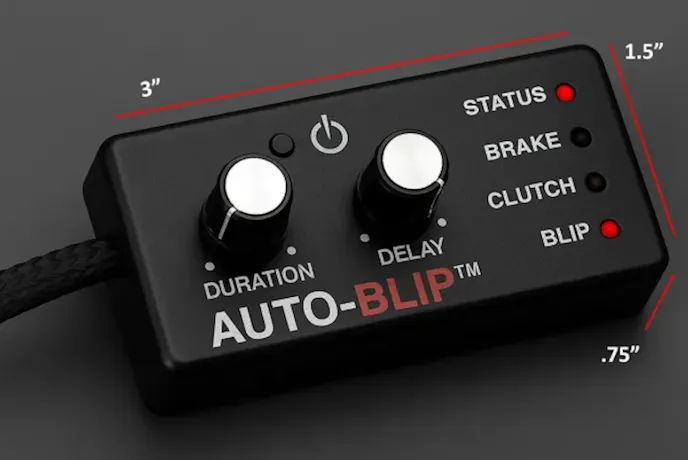
That approach makes a lot of sense for a first HPDE. Proper rev matching helps reduce drivetrain shock, smooths out downshifts, improves chassis stability under braking, and frees up mental bandwidth so the driver can focus on the bigger fundamentals, like braking points, vision, and line selection. The installation is also appealing because it uses dedicated connectors and requires no cutting or permanent modification to the factory wiring. The hardest part is climbing under the dash, not the electronics.
Brake Prep
If there is one system that matters more than horsepower before a track day, it is the brakes. Horsepower gets attention, but brakes determine whether you can repeat lap after lap with confidence.
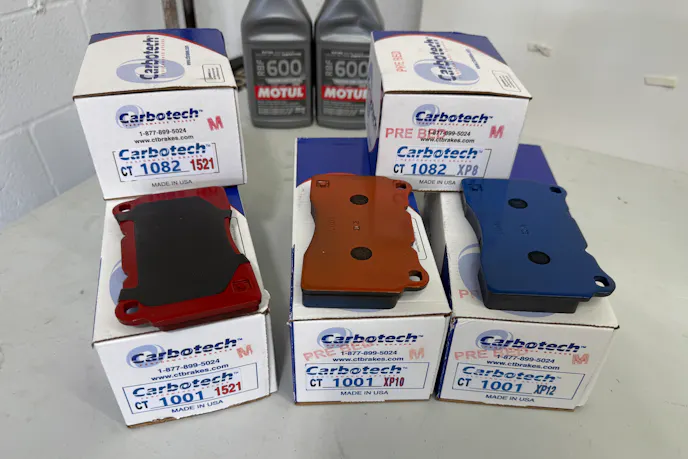
For Project Clubsport, we wanted the brake package to match the car and the driver rather than simply chasing the most aggressive combination available. On the street, the Mustang will run Carbotech 1521-compound pads (P/N: CT1001-1521), front, and P/N: CT1082-1521), which are known for quiet operation, low dust, and solid cold bite. That gives us the freedom to swap to a dedicated track compound for HPDE events without living with race-pad compromises in daily driving. For the track, we started with Carbotech XP10 (P/N: CT1001-XP10), front, and P/N: CT1082-XP10) pads because it is the least aggressive compound that could still handle the higher track temperatures.
“My philosophy is to begin with the least aggressive pad capable of handling the expected temperatures instead of immediately jumping to the highest-friction compound available. The XP10 has an excellent reputation as an entry- to intermediate-level HPDE pad, providing consistent braking performance while being easier on rotors than more aggressive compounds,” Korda said. “If I find that my pace increases, session lengths become longer, or I’m exceeding the thermal limits of the XP10, I’ll step up to the XP12 in future testing. This approach allows the brake package to evolve alongside the driver rather than overbuilding the car from day one.”
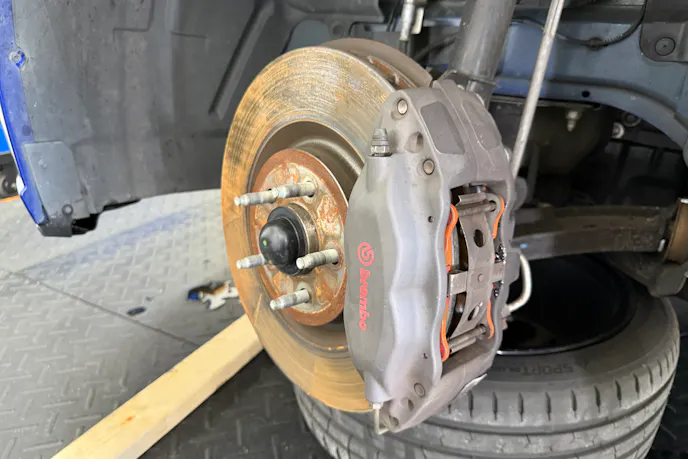
That plan is paired with a complete flush using Motul RBF 600 high-performance brake fluid (P/N: 100949; $26.20). Brake fluid is one of the most overlooked parts of track prep, and one of the most important. Once fluid boils, vapor forms in the hydraulic system, and vapor compresses. That is how a brake pedal goes soft, and confidence disappears. Even the best pads cannot compensate for old or overheated fluid, so starting with a fresh flush is one of the best low-cost upgrades any driver can make before venturing out on track.
Learning Laps
We took a similar approach with the tires. Rather than immediately bolting on a dedicated 200-treadwear track tire, we chose Continental ExtremeContact Sport 02 (P/N: PN 03125350000) 255/35/19 tires for the first event. That gives us a high-performance street baseline and makes it easier to understand how the car behaves in its current form.
“I wanted to understand the car before adding a lot more grip,” Korda explained.
A quality summer tire exposes the car’s natural balance, weight transfer, and chassis behavior, but it gives the driver a more forgiving platform to learn from. Once we know how the Mustang behaves in near-stock form, every future tire and suspension change becomes easier to measure. The Continental ExtremeContact Force 200TW tire is the next move, which will give us a useful comparison between a premium street tire and a true track tire on the same chassis.
Baseline First
Project ClubSport arrived at its first HPDE event in nearly as-delivered form. It was a used car, so it is not totally stock, but its existing mods are light, including a line-lock, a Ford Racing calibration, a Barton short-throw shifter, and a rear shock-tower brace.
Rather than masking any existing shortcomings, we set out to understand what this 2014 Mustang GT Track Pack does well, where it starts to run out of composure, and which changes will deliver the biggest return. The first track day is not about building the wildest Mustang in the paddock. It is about building the right Mustang for the job.
“This first track day wasn’t about proving how fast the car was. Instead, it was about learning what we had. I wanted a true baseline before changing anything, so every upgrade from here has a measurable purpose,” Korda added.
Solid Foundation
What stood out immediately was how complete the baseline chassis still feels when pushed in a controlled environment. Even with factory suspension geometry and rubber isolation still intact, the Mustang remained predictable at the limit and built pace in a progressive, readable way rather than falling off abruptly. The chassis was not razor sharp, but it was honest. It responded predictably to inputs and built confidence as the pace increased rather than eroding it.
“The biggest surprise was just how much fun this Mustang was in near-stock form,” Korda enthused. “It was far more responsive and confidence-inspiring than I expected, and it kept encouraging me to push a little harder every lap.”
From a dynamics standpoint, the S197 still carries a naturally balanced rear-drive character that allows rotation under trail braking without becoming unstable. Steering effort remains linear, and initial turn-in is more responsive than expected for a car of this weight class. The platform clearly benefits from its long wheelbase stability while still retaining enough compliance to communicate grip changes at the limit.
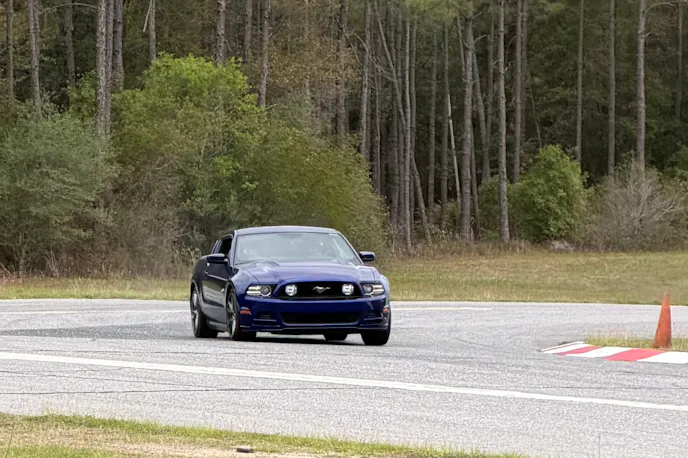
On paper, 420 horsepower does not sound excessive in a modern performance context. On track, in a relatively tight and technical environment like The Firm, it proved to be more than enough. The more meaningful discovery was not how much power the engine makes, but how often the chassis ran out of composure before the drivetrain ran out of breath.
“After a day on track, it’s obvious this car doesn’t need another horsepower right now. Four hundred and twenty horsepower is plenty on a road course,” Korda said. ”The engine already gives you everything you need — the chassis is what needs to catch up.”
The 5.0-liter Coyote continues to deliver strong midrange response and excellent throttle repeatability, particularly on corner exit, where modulation matters more than outright output. The limitation is not engine delivery, but the chassis’ ability to keep the rear tires consistently planted during weight transfer events.
Areas To Address
Where the S197 architecture begins to show its age is in transient control under repeated load cycling. The Track Pack suspension provides a competent baseline, but it is clearly tuned toward dual-use comfort rather than sustained lateral performance.
Under braking, weight transfer is pronounced enough to load the front end aggressively, which in turn requires early stabilization before turn-in. During direction changes, the chassis exhibits a noticeable delay between steering input and full body response due to bushing compliance and damper tuning. The result is a car that is fundamentally predictable but requires more steering correction than necessary at the limit.
“You can feel the chassis moving around underneath you,” Korda elaborated. “The grip is there, but the body roll, brake dive, and soft factory bushings make the car work a lot harder than it should.”
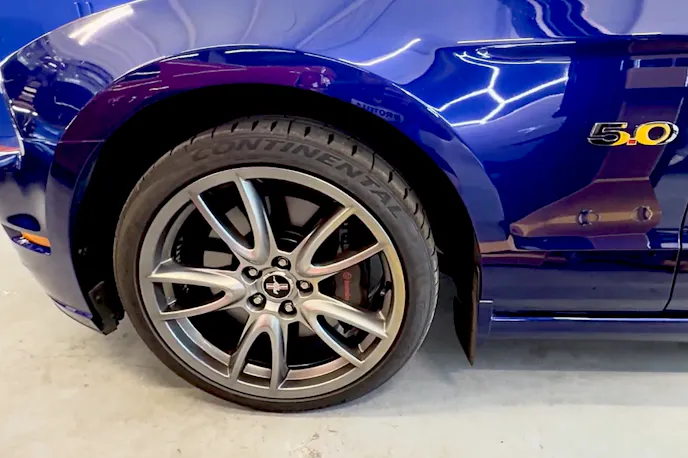
The Continental ExtremeContact Sport 02 tires were one of the strongest validation points of the entire baseline exercise. Despite its 340-treadwear rating, the tire maintained consistent grip across multiple sessions without significant thermal degradation. Braking and cornering behavior remained linear and predictable, with no abrupt loss of traction.
“I honestly came away more impressed with these tires than anything else on the car,” Korda said. “They stayed consistent all day, never got greasy, and gave me predictable grip every lap. If anything, the suspension was holding the tires back—not the other way around.”
One brief moment of concern occurred when coolant temperatures rose more quickly than expected during sustained running.
“Seeing the coolant temperature climb definitely got my attention, but once I turned the heater on, it came right back down and never became an issue again,” Korda said. It’s something we’ll keep an eye on, but I don’t think it’s a major concern at this point.”
Brake performance provided clear insight into thermal capacity limits. The Mustang ran Carbotech XP10 pads paired with Motul RBF 600 fluid. Early sessions delivered strong bite and a firm, consistent pedal with no signs of hydraulic fade. As the day progressed, braking distances increased even though pedal pressure remained unchanged. That points directly to pad compound temperature saturation rather than fluid breakdown. The next step is a move to Carbotech XP12 pads, along with a consultation to verify compound selection and a precautionary system bleed before the next track outing.
“Rather than guessing, we’re going to work with Carbotech and make sure we’ve got the right pad for this car and this style of driving,” Korda elaborated. “If we can gain more thermal capacity without giving up consistency, that’s exactly the direction we want to go.”
Clear Roadmap
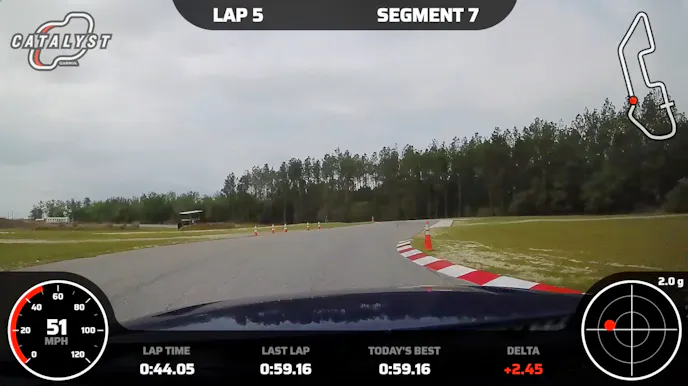
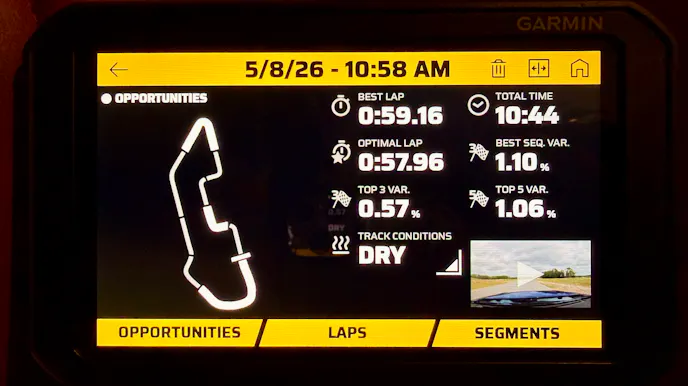
By the end of the day, Project Clubsport accomplished exactly what it was intended to do. It ran clean, delivered consistent feedback, and clearly defined the next phase of development as we look to improve upon its 59.16-second baseline lap around The Firm, which was not far off from the optimal 57.96-second lap predicted by our Garmin Catalyst Driving Performance Optimizer.
“The car’s biggest limitations are not power-related. Instead, they stem from chassis compliance, suspension movement, and braking heat management. Most importantly, the baseline test validated the direction of the project and provided a clear roadmap for future development.” Korda added. “This project isn’t about building the highest-horsepower Mustang — it’s about building a balanced car that’s predictable, responsive, and rewards you every time you take it to the track.”
We’re just getting started, but the bar is set pretty high for this car as it aims to hang with some of Ford’s most heralded factory corner carvers, like the S550 Shelby GT350 and S650 Mustang Dark Horse. Stay tuned for the next phase of Project Clubsport as we get more serious about the modifications. We’ll be taking the car to BMR Suspension for a complete upgrade that will fortify its foundation and sharpen its handling.
You might also like
An E85 Calibration Pushes A ProCharged Fox Past 800 Rear-Wheel Horsepower
A ProCharged Fox Mustang hit the hub dyno for a calibration. Kyle Morris dialed in the blown small-block Ford to surpass 800 horsepower.