When Ford added MagneRide to the Shelby GT350 back in the S550 era, the performance of Mustang suspensions changed forever. The system analyzed myriad factory sensor inputs to deliver suspension tuning changes in milliseconds, allowing the factory hardware to deliver a great balance of ride quality and performance. However, the OEM system was a walled garden that allowed no tuning beyond driving mode changes. That’s where DSC Sport entered the chat with a performance-tuned controller, and the company just debuted a new version for the modern S650 Mustang.
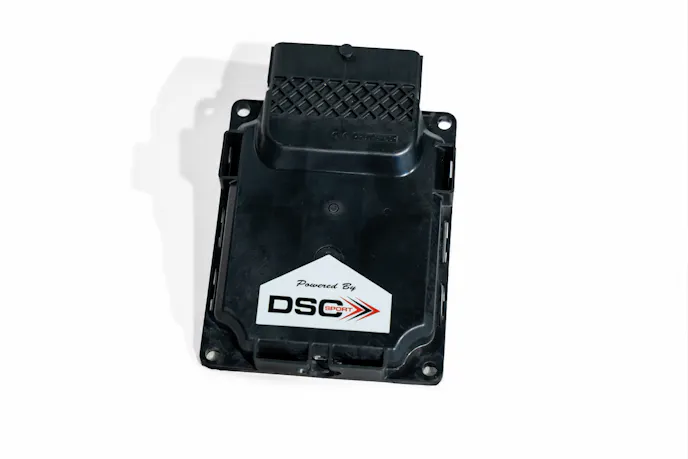
The new DSC Sport 2024-and-newer Mustang MagneRide Controller is a direct plug-and-play replacement for the factory suspension controller, retaining the factory electronic dampers while opening up a much wider range of calibration possibilities. The controller uses an upgraded logic board and communicates with a Windows laptop through USB, allowing owners to read and write calibration files, make damping adjustments, and datalog suspension operation.
Unlocking The Door
The 2024-and-newer Mustang S650 is already a seriously capable chassis. Add the Dark Horse Handling Package, with its unique MagneRide dampers and factory camber plates, and Ford gives enthusiasts a Mustang that can attack a road course at a serious pace without immediately demanding a pile of aftermarket suspension hardware. DSC Sport’s idea is to work inside that factory architecture rather than throw it away, using the controller to manipulate damper behavior according to the inputs the chassis is already generating.
“DSC Sport takes an approach that combines platform control with velocity-based offsets, much like you would use in a race car,” Michael Levitas, owner and founder of DSC Sport, said. “In essence, we’re combining Skyhook-style comfort with Groundhook-style chassis control.”
In practical terms, the calibration can account for throttle, braking, steering, vehicle speed, G-force, accelerometer data, pitch, yaw, and rate of change among other inputs. That allows the controller to change damping as the vehicle transitions from braking to turn-in, loads the outside tires in a corner, or begins transferring weight rearward under acceleration. The key is that the damper isn’t being treated as a fixed component with a handful of predetermined settings. Its response becomes another variable in the chassis equation, one that can be adjusted around how the car is actually being driven.
“For me, it’s about improving on an already amazing baseline and giving the driver the ability to customize the car around how they actually use it,” Chris Cervenka, owner of Modified Muscle Marketplace, said.
Factory Foundation
The MagneRide system itself isn’t the weak link, however. Ford’s latest magnetic damper system is another significant step in electronically controlled damping, and there is potential left to exploit.
“The latest MagneRide system is another big step forward in magnetic damper control, very similar to what we’ve seen with the C8 Corvette; CAN FD is awesome,” Levitas said. “Where I think Ford really separated the S550 and S650 from the C7 and C8 is in the actual damper.”
He says the shock-dyno behavior of the GT350 and GT500 dampers, particularly their ability to deliver low-speed control from roughly 0 to 2 inches per second while maintaining useful high-speed control from 3 to 10 inches per second. That makes a difference because low-speed shaft velocity is closely tied to body motions such as pitch and roll, while higher shaft velocities come into play as the damper responds to sharper road inputs and more abrupt wheel movement. The result is a hardware package with substantial control authority before any aftermarket calibration is applied.
As such, the DSC controller isn’t masking a weak link; it offers tuners access to a sophisticated adaptive damper that Ford otherwise keeps locked behind a factory calibration.
Track Tested
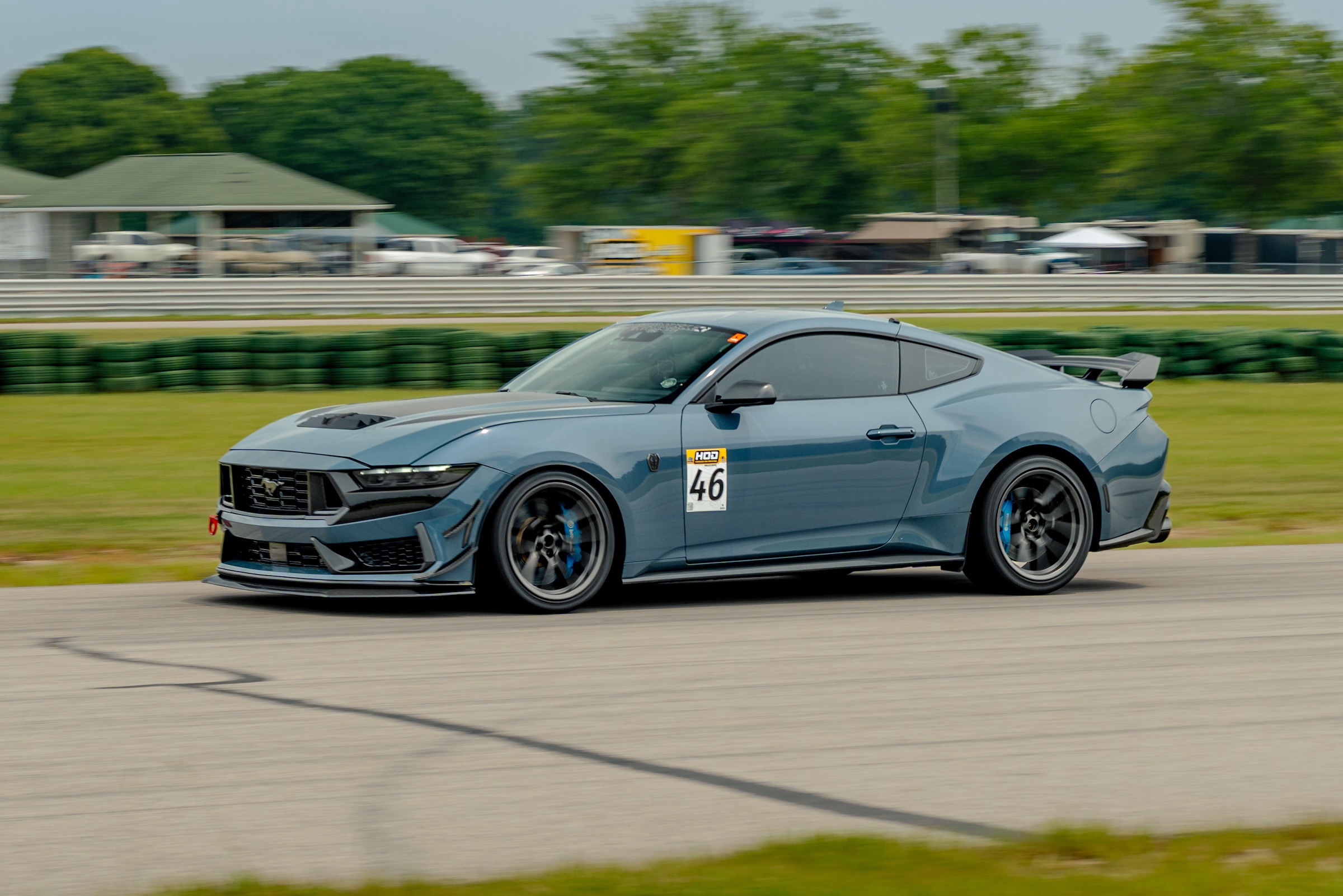
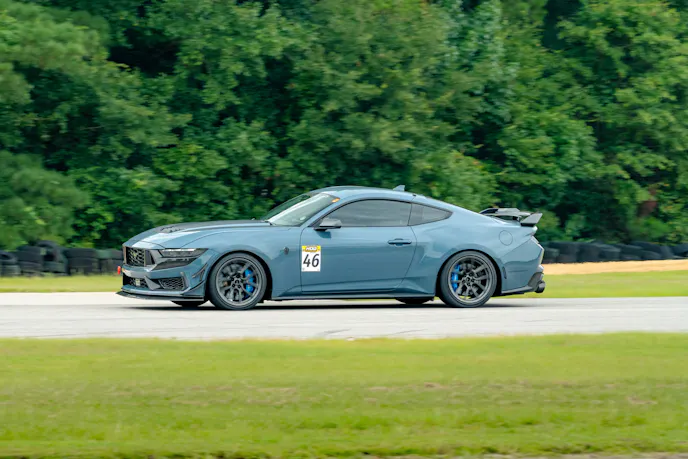
To demonstrate what that means in the real world, Cervenka, a longtime Mustang enthusiast with a decade of experience on the track, put the new controller through its paces at Carolina Motorsports Park with Hooked on Driving. His Dark Horse Premium was equipped with the Handling Package, and its suspension remained essentially stock, providing a useful test bed for evaluating how much could be accomplished through calibration alone.
The test car wasn’t completely untouched, however. It retained the factory Handling Package camber plates, with the lock nuts removed to establish a track-oriented alignment, while Baer EradiSpeed rotors and Carbotech XP20 front and XP12 rear pads handled braking duties. Up front, A.J. Hartman dive planes and Function Factory Performance carbon-fiber components added aerodynamic hardware. Meanwhile, an AWE 3-inch SwitchPath exhaust retained the active function and supplied the soundtrack on the straights.
With roughly three track days already on the Dark Horse’s Hoosier Track Attack Pro tires, Cervenka wasn’t chasing a record lap. Instead, the goal was to have consistency in the tires, evaluate the controller, make calibration changes, and determine what the Dark Horse could do with its factory suspension hardware.
The most telling result came in Turn 10, a fast kink at Carolina Motorsports Park. He estimated that he was carrying roughly 3 to 5 mph more speed through the section than he had earlier in the day, despite deteriorating conditions. While that’s more of a seat-of-the-pants evaluation rather than a precise metric, it illustrates the type of improvement the calibration was intended to produce. The controller gives the driver more confidence and delivers more predictable behavior when the car is run hard.
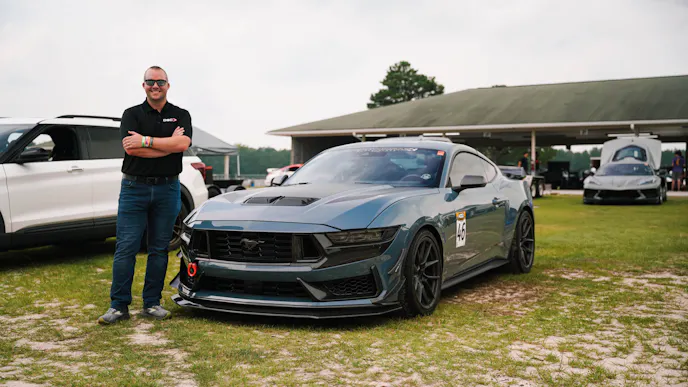
“The biggest thing I noticed with the S650 is just how composed the car is out of the box,” Cervenka said. “I’ve owned and driven a lot of Mustangs, and the S550 was already a massive step forward for the platform over the S197, but the S650 Dark Horse feels like Ford sent the S550 to college. It’s much more refined in so many areas.”
“There’s better body control, better confidence in transitions, and the car feels more settled when you’re asking a lot from it. Especially with the Handling Package, you can get in one of these cars, take it to a road course, and run at a pretty serious pace without immediately feeling like you need to start replacing suspension components as you may have in previous-generation Mustangs.”
Rather than masking a basic suspension deficiency, the MagneRide calibration concentrates on transient response, pitch and roll control, weight transfer, and compliance. The goal is to make the Dark Horse’s existing dampers respond more deliberately to the forces acting on the chassis, rather than just making them arbitrarily stiffer everywhere. That also creates room to improve ride quality because the controller can manage body motion and damper response without treating comfort and performance as mutually exclusive.
“You immediately gain ride comfort along with enhanced velocity control for performance,” Levitas said. “And this isn’t limited to Mustangs. What we’ve been able to do with the street and rally modes on the F-150 Raptor is ridiculous.”
Plug & Play
For the level of control it enables, installation of the DSC Controller is refreshingly simple. After disconnecting the negative battery terminal, the factory MagneRide controller is accessed in the trunk in the spare tire well. Remove the trunk cover and plastic trim panel, undo two 10mm nuts, disconnect the factory connector, and reverse the process to install the DSC unit. There is no rewiring required, and an extra-long USB cable can be used to make tuning adjustments from the driver’s seat while the controller remains installed in the car.
The Windows-compatible software allows the user to select the correct vehicle profile, pull the base calibration, make changes, write revised files, and datalog the suspension system. That last feature is key for anyone serious about dialing in a car to the driver’s liking, as it provides a way to correlate driver feedback with the inputs the controller monitors and the selected damper behavior. Instead of guessing whether a car needs more or less damping in a particular phase of a corner, the tuner has another source of information to guide the next calibration change.
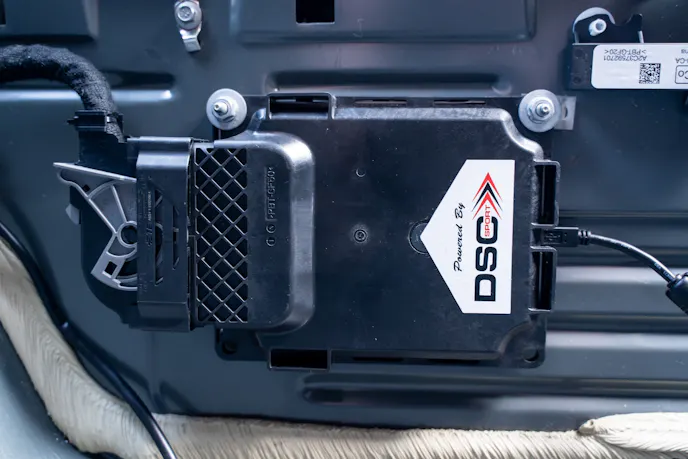
“Ford gives you an incredibly capable MagneRide system from the factory,” Cervenka enthused. “DSC takes that hardware and turns the volume up to 11.”
The controller ships with a final base calibration, ready to plug-and-play right out of the box. If you want to take it a step further, owners can tune around street use, sport, and track driving, different tire characteristics, and changes such as aftermarket springs or sway bars.
“It gives you another tuning tool that most enthusiasts historically haven’t had access to,” Cervenka said. “We spend a ton of time talking about alignment, spring rates, sway bars, tire pressures, and aero, but damping is a huge part of how the chassis actually responds to all of those things. Now you can start treating the MagneRide dampers as a fully integrated tunable part of the setup instead of a fixed component.”
Beyond Road Racing
While the S650 controller naturally lends itself to road-course work, DSC Sport sees considerably more potential in its ability to respond to inputs throughout a run rather than simply selecting one static damping level. The same hardware can be calibrated for highway compliance, back-road driving, road-course cornering, or drag launches.
“Oh, this is exactly what drag racers want, need, and have to have,” Levitas said. “You can do so much to control both the leave and what the car does down track.”
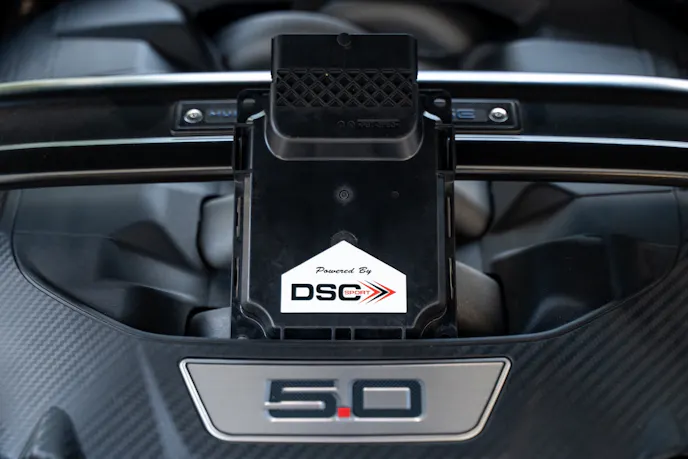
The system offers tuning throughout the launch and downtrack, including timer-based control, while allowing damper settings to be established before the car rolls out. For a high-powered Mustang, controlling how the chassis accepts and transfers load can be just as important as adding more power. That same philosophy applies on the street. The objective isn’t simply to make the S650 stiffer, but to increase body control under hard driving while preserving the compliance that makes MagneRide attractive.
“You can improve performance without necessarily making the car harsher everywhere else,” Levitas said. “Traditionally, we’ve accepted that making a car better on track means sacrificing something on the street. With an adaptive damper and the right calibration, those two things don’t have to be mutually exclusive.”
The Next Step
The DSC Sport controller changes the usual order of operations. Instead of immediately adding springs, sway bars, or dampers, enthusiasts can first tune the factory MagneRide hardware and then determine what, if any, mechanical changes are needed.
“For me, it’s about improving on an already amazing baseline and giving the driver the ability to customize the car around how they actually use it,” Cervenka said. “You’re not replacing what Ford engineered. You’re unlocking another level of control from hardware that’s already on the car.”
“I think the bigger story here is how much Mustang suspension tuning has evolved,” he added. “For years, modifying a Mustang meant physically replacing parts. Now we’re at a point where software and calibration can fundamentally change how the chassis behaves while using the same incredibly sophisticated hardware Ford installed at the factory.”
The DSC Sport controller doesn’t replace the fundamentals of a serious track setup, including alignment, tires, brakes, springs, sway bars, and aero. It adds another layer of control, giving MagneRide-equipped S650 owners more tuning range before and after reaching for the parts catalog.
DSC Sport opened the pre-order page today for the S650 controller, with product shipments currently slated for early 2027. If you are looking to unlock more capability from Ford’s most capable naturally aspirated 5.0-liter Mustang thus far, race on over to DSC Sport’s website for more details.
You might also like
Haltech’s Latest Nexus ECUs Control Cable-Throttle Engine Swaps
Haltech's Nexus T1 and T2 deliver cable-throttle engine management with high-speed wireless diagnostics and more.