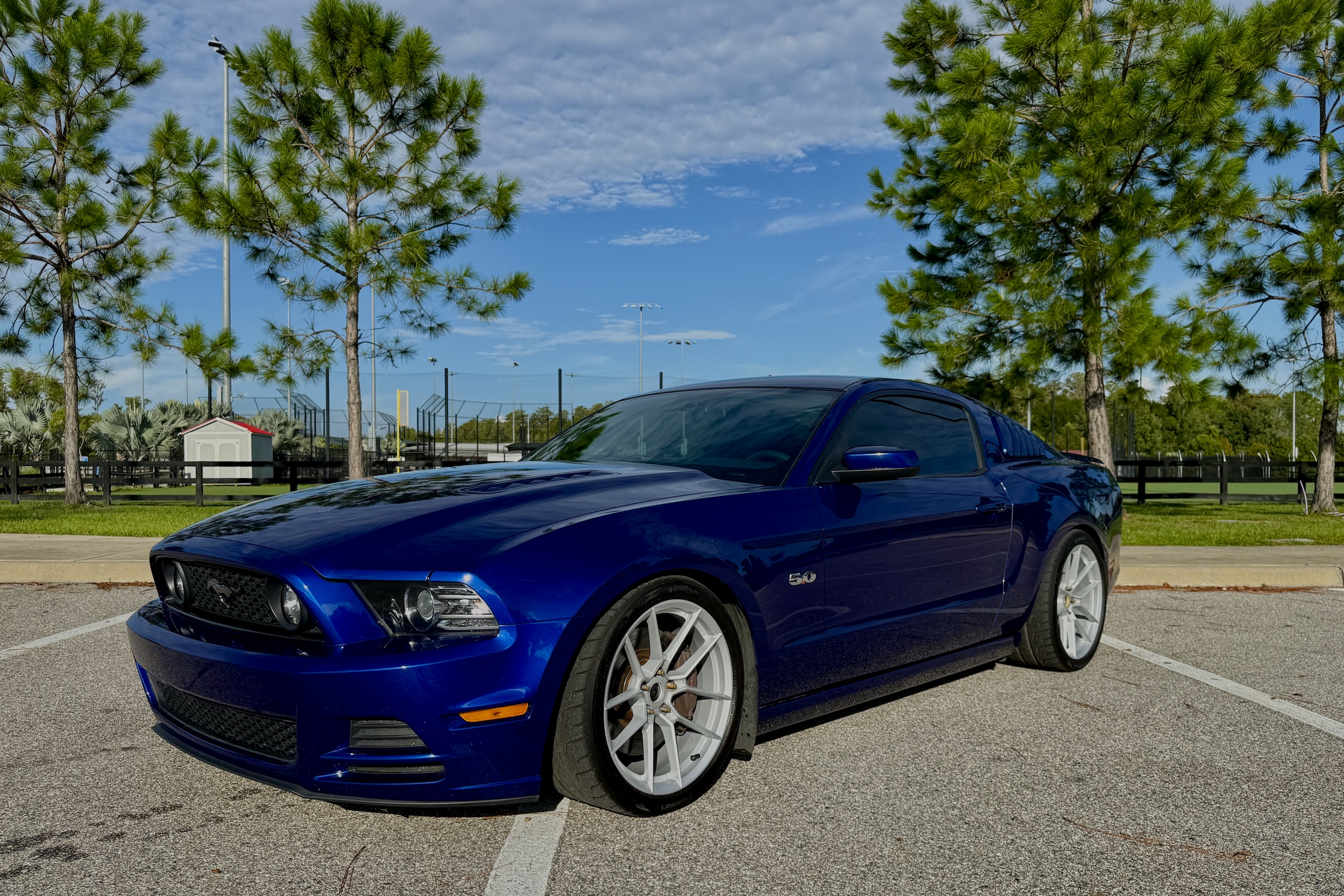
If you are a fan of our latest S197 build, known as Project ClubSport, this 2013 Mustang GT with the Performance Pack option has its sights set on competing with Ford’s modern factory corner carvers, like the Shelby GT350, Mach 1, and Dark Horse. The idea is to build something far more affordable that can hang with those formidable performers on the racetrack.
In our last installment, we made a few sensible mods before heading to the road course to establish a baseline. With that in mind, it’s time to transform this Mustang, and the logical place to build that foundation is with a comprehensive suite of chassis and suspension upgrades. As such, we turned to BMR Suspension to sharpen our S197’s handling.
There is no shortage of suspension parts available for the S197 Mustang platform. From simple lowering springs to complete track-focused systems, enthusiasts have plenty of options when it comes time to improve handling. The challenge is not finding parts. The challenge is choosing the right combination of parts that work together.

That was the philosophy behind Project ClubSport from the beginning. This build was never about bolting on every available upgrade or creating a Mustang that only works at the track. The goal was to build a balanced performance machine that could carve corners on a road course, attack an autocross course, and remain enjoyable during a weekend drive.
“…We took a completely stock S197 Mustang and worked with the engineers at BMR Suspension to build a complete suspension package that can compete with much newer performance Mustangs,” Ivan Korda, Director of Business Development at POWER, FordMuscle’s parent company, said.

Balanced Approach
The factory S197 chassis is a capable platform, but it was engineered around a broader mission. Ford needed the Mustang to deliver comfort, durability, and refinement for a wide range of customers. Those priorities meant compliance was built into the suspension through rubber bushings and components designed to absorb noise and vibration.
“The factory suspension isn’t ‘bad.’ It was designed for a mass-market customer. Ford uses large compliant rubber bushings throughout the suspension to isolate NVH, especially because the S197 uses a solid rear axle,” Korda said. “The downside is that all of those soft bushings allow suspension movement when you really start loading the chassis. Modern sticky tires expose those weaknesses even more. The stamped control arms flex. The bushings flex. Geometry changes once you lower the car. Eventually, everything adds up to a car that feels less precise than it could.”


That is where BMR Suspension’s approach came into play. Rather than selecting parts individually from a catalog, the team focused on how each component influenced the overall chassis.
“The first thing I ask is, ‘What is the vehicle going to be used for?’ So, when he said he was going to go street-drive it and take it on track days, I knew we were going to need to have a range of tuning and adjustment, strength to deal with the additional force the suspension was going to see, and maintain streetability,” Brandon Canny, Design Engineer at BMR Suspension, explained. “That balance guided every decision, from the control arms and sway bars to the bushings and alignment hardware. The result is a suspension system designed around performance without sacrificing the personality that makes a Mustang enjoyable on the street.”
That philosophy also dictated the order of modifications. Rather than selecting springs first or adding isolated suspension components, the team chose to build the chassis around Koni’s new GTS coilover system. The adjustable dampers establish the Mustang’s ride height and provide the tuning range needed for both street and track use, but they also alter the suspension geometry. That meant every subsequent BMR component (from the taller ball joints and bump steer kit up front to the relocation brackets and adjustable Panhard rod out back) was selected to restore the geometry and optimize the behaviour of the lowered chassis. Instead of simply lowering the car and living with the compromises, the goal was to create a complete suspension package where every part complements the next.
To The Front
The front suspension is where the biggest transformation begins. The S197’s factory front end is already a strong design, but lowering the chassis and adding significantly more tire grip changes the requirements. The geometry needs to remain optimized, the components need to resist deflection, and the driver needs consistent feedback when pushing the car harder.
Serving as the centerpiece of the transformation are Koni’s new GTS coilovers (P/N: 1200-1009; $2,198.67). More than just a height-adjustable suspension, they provide independent damping adjustment that allows the chassis to be tuned for everything from comfortable street driving to aggressive track sessions. Equally important, the coilovers establish the ride height that dictates nearly every other suspension decision. Once the Mustang sits lower, the control arm angles, steering geometry, and roll center all change, making it critical to correct those relationships if the car is going to perform at its full potential.
“KONI’s new GTS coilovers for the S197 really become the centerpiece of the suspension because of the ride height and damping adjustment,” Ivan Korda, Director of Business Development at POWER, FordMuscle’s parent company, said. “Because of the ability to actually tune the suspension instead of simply lowering the car, they also became the foundation for the alignment and eventually corner balancing.”

The new coilovers also incorporate camber adjustment into their upper mounts, but Project ClubSport’s mission demanded even more alignment flexibility. Working together, the BMR engineering team developed an adapter sleeve that allows the company’s caster/camber plates to integrate with the new KONI system, giving the suspension the range of adjustment needed to maximize tire contact patches at the racetrack.
“I wanted caster adjustment as well,” Korda said. “The BMR team built an adapter sleeve so their caster/camber plates would work with the new KONI setup. That lets us properly dial in the alignment instead of simply accepting whatever caster the factory gives us, as these cars are commonly off side-to-side from the factory.”
Establishing the proper geometry after lowering the Mustang drove many of the component choices that followed.

“Considerations were taken of the taller lower ball joint since the vehicle is going to be lowered on the coilovers,” Canny explained. “This puts the control arm back into its range of travel.”
One of the first areas addressed was the factory-stamped steel lower control arm assembly. The upgrade started with BMR Suspension’s Lower A-arms, Adjustable, Delrin/Rod End, Tall Ball Joint (P/N: AA757R; $699.95).
The BMR arms replace the factory rubber bushings with a Delrin and rod-end combination that dramatically reduces unwanted movement while still maintaining enough compliance for a street-driven car. The extended ball joint also helps correct suspension geometry after lowering the vehicle.

“The front control arms probably tell the biggest story. When Brandon put the factory arm next to the BMR arm, it was obvious how much movement exists in the factory bushings,” Korda said. “Those giant rubber bushings move quite a bit once you put real grip into the chassis. That’s why we selected the rod-end and Delrin combination. It’s definitely a more aggressive setup, but still appropriate for a dual-purpose car. We also chose the extended ball joints because lowering the car changes the suspension geometry. That works together with the bump steer kit.”
The control arms were supported with BMR’s A-arm Support Brace (P/N: AAS001R; $69.95), which reinforces the rear mounting points of the K-member and helps stabilize the front suspension mounting structure.
With the chassis lowered on coilovers, maintaining proper steering geometry becomes critical. That is where the BMR Bump Steer Kit (P/N: BSK750; $129.95) enters the equation. Lowering a Mustang changes the relationship between the steering tie rod and the lower control arm. Without correction, the suspension can create unwanted toe changes as it moves through its travel, causing inconsistent steering response.

“Rather than making bumpsteer sound complicated, the goal is simply getting the tie rod back into the proper relationship with the control arm so the steering stays consistent as the suspension moves through its travel,” Korda said. “Another nice takeaway was how simple the adjustment actually is.”
The front sway bar system was also upgraded to improve chassis balance and increase tuning flexibility. BMR’s Front Sway Bar (P/N: SB022R; $319.95) works with upgraded BMR Front Sway Bar End Links (P/N: ELK010; $239.95) and Sway Bar Mounts (P/N: SMK010; $179.95).
Unlike a fixed-rate setup, the adjustable sway bar gives the driver the ability to tune handling characteristics depending on conditions and preference.

“The adjustable front sway bar lets us tune the handling balance depending on driver preference: Understeer or Oversteer, Track, or Street,” Korda said. “It’s another example of building adjustability into the car rather than locking ourselves into one setup. The billet mounts and stronger end links also make sure the sway bar actually does its job instead of the bushings absorbing the load.”
The front suspension package was rounded out with a BMR Radiator Support with Sway Bar Mount (P/N: RS003; $219.95). While the tubular support reduces weight compared with the factory assembly, the bigger benefit is improved access and serviceability underneath the car.
Performance Diet


One of the unexpected benefits of Project ClubSport’s chassis/suspension/wheel/tire makeover was measurable weight reduction. We chose every component to improve handling; several also removed unnecessary mass from the car.
Before any suspension work began, the Mustang tipped the scales at 3,560 pounds with a quarter tank of fuel. Following installation of the complete BMR Suspension package, that number dropped to 3,532 pounds, a savings of 28 pounds.
Swapping the factory wheel-and-tire package for LMR’s forged SVE DHP1 wheels wrapped in Continental ExtremeContact Force tires trimmed another 20 pounds, bringing Project ClubSport’s curb weight to 3,512 pounds with the same quarter tank of fuel.
The total reduction of 48 pounds is only part of the story. Much of that weight comes from the suspension and rotating assemblies, reducing unsprung and rotational mass. That allows the suspension to react more quickly to road inputs while improving steering response, acceleration, and braking. Those are benefits that are far more valuable than the number on the scales might suggest.
“I initially assumed this was mostly about weight savings, but it is more about serviceability,” Korda said. “It creates more room underneath the car and better access for header installation. That equates to more room to service the car. The weight savings are nice, but accessibility is really the bigger benefit.”
With the chassis reinforced and suspension geometry corrected, Project ClubSport was ready for the next major step: giving the S197 the proper foundation to take advantage of modern tires and adjustable damping.
Taking It Back
The same philosophy carried over to the rear suspension. Rather than simply lowering the car and accepting the compromises that come with a lower ride height, every rear suspension component was chosen to complement the KONI GTS coilovers. Once the Mustang sits lower, the rear axle shifts laterally, the lower control arm angles change, and the suspension’s instant center moves outside its intended operating range. Left uncorrected, those changes can reduce rear grip, upset the car’s balance, and make it less predictable at the limit.
By starting with the adjustable KONI coilovers, BMR could build the rest of the suspension around the Mustang’s new ride height. Adjustable control arms, relocation brackets, the Panhard rod, spherical bearing, and sway bar all work together to restore geometry while giving the chassis the adjustability needed to tune the car for different tracks and driving styles.

“We wanted to make sure that we had relocation brackets and an adjustable Panhard bar to get the rearend properly located after the car was lowered. That much drop with the coilovers requires some extra attention,” Canny said.
The foundation begins with BMR’s Lower Control Arms, On-car Adjustable (P/N: TCA021R; $319.95), which replace the factory-stamped arms with heavy-duty tubular units featuring on-car adjustability. Polyurethane bushings maintain reasonable NVH characteristics while allowing pinion angle adjustments without removing the arms from the vehicle. The control arms were matched with BMR Control Arm Relocation Brackets (P/N: CAB005R; $139.95), which restore the rear suspension’s instant center after lowering.


Lowering an S197 changes the relationship between the lower control arms and the axle housing. Left uncorrected, the altered geometry negatively affects how the rear tires load under acceleration and braking. The relocation brackets return those suspension pickup points to a more favorable position based on ride height.
“The relocation brackets are another part that many people overlook,” Korda said. “Lowering changes the instant center. That changes how the rear tires load under acceleration and braking. The relocation brackets restore the suspension geometry so everything works in the proper range again.”


“The control arm relocation brackets are really going to help the car put the power down out of corners,” Canny added. “That’s what you’re really going to feel.”
Keeping the axle properly centered is equally important. Once an S197 is lowered, the factory Panhard rod swings through a different arc, physically shifting the rear axle toward the driver’s side.

To correct that movement, Project ClubSport received BMR’s Adjustable Panhard Rod with Poly/Rod-End Combination (P/N: PHR013R; $219.95). The combination of a rod end on one side and polyurethane on the other maintains precise axle location while preserving enough isolation to keep the car enjoyable on the street.
“The adjustable Panhard rod isn’t just an aftermarket upgrade,” Korda said. “Once the car is lowered, the factory Panhard rod physically moves the rear axle sideways because of the arc it travels through. The adjustable Panhard rod simply recenters everything. We also intentionally used the poly/rod-end combination to keep some NVH isolation while still improving precision.”

Helping tie everything together is BMR’s Rear Sway Bar (P/N: SB023R; $379.95). Combined with billet mounts and end links, it transfers cornering loads into the chassis far more effectively than the factory components.
“The larger rear sway bar, billet end links, and billet mounts all help transfer the load into the chassis instead of allowing the bushings to absorb it,” Korda said.


The rear suspension also received BMR’s Bearing Kit (P/N: BK079; $129.95), replacing the factory upper control arm axle housing bushing with a spherical bearing. That upgrade further reduces suspension bind while allowing the rear axle to articulate more freely during aggressive cornering.
While the aforementioned coilovers establish the foundation of the suspension package, the rear hardware ensures the rest of the chassis works in harmony with them. Ride height and damping can now be tuned independently, while the BMR components restore the geometry and rigidity needed to fully capitalize on those adjustments. With the suspension installed, the next steps will be dialing in the alignment and corner-balancing the car before its first serious track outing.
Grip To The Ground
Even the best suspension can only work with the grip available at the contact patch, so the next step was upgrading Project ClubSport’s rolling stock.
Instead of the factory staggered package, we moved to a square setup using LMR’s 19×10-inch SVE DHP1 Forged Wheels (P/N: SVE-444903F; $549.99 each), fitted with Continental ExtremeContact Force 295/30R19 tires (P/N: 03122300000) at all four corners. The wheels were equipped with LMR TPMS Sensor Kits (P/N: M1180A; $99.99) and secured using LMR Open-End Lug Nuts (P/N: WCW-W1012B10K; $19.99).

The move to a square 295-width setup significantly increases front-end grip while allowing tire rotation between track events. The forged construction also trims unsprung and rotating mass.
“This isn’t just a wheel upgrade,” Korda said. “The suspension deserves a proper tire. We’re switching from the factory-style 340-treadwear street tire to Continental’s ExtremeContact Force 200-treadwear tire in a 295-square setup, mounted on SVE wheels from Late Model Restoration. Modern tires create so much more grip that they expose every weakness in the factory suspension. Now the suspension is finally taking advantage of that additional grip. The lighter wheels also reduce rotating mass, which becomes another performance gain beyond simply removing weight.”
Future flexibility was also built into the project with the addition of ARP Wheel Studs (P/N: 100-7722 front; P/N: 100-7723 rear). Even if spacers ultimately aren’t required, installing the longer studs now prepares the car for future track setup changes while maintaining proper thread engagement and clamping force.
First Impressions
The first drive out of BMR’s parking lot validated everything the engineering team set out to accomplish. The steering immediately felt more responsive. Initial turn-in required less correction, and every steering input translated directly into chassis movement. Instead of feeling like the front and rear suspensions were negotiating with one another through compliant bushings, the entire car reacted as one cohesive unit.
“This is probably my favorite part of the story because it immediately confirmed everything Brandon talked about,” Korda said. “The very first thing I noticed backing out of BMR’s parking lot was how responsive the steering became. Every steering input was immediately translated into chassis movement. The car feels planted. The rear follows the front naturally. Everything feels connected. The biggest surprise was NVH. We removed a tremendous amount of rubber from this suspension. I fully expected additional road noise. Honestly, I don’t notice a meaningful difference. The car is still quiet. It just feels more connected.”
Perhaps the biggest takeaway is that none of these upgrades were selected in isolation. Every component complements the others, from the corrected geometry and improved adjustability to the stiffer mounting points and modern tire package. Individually, each part improves one aspect of the chassis. Together, they fundamentally change how the car behaves.


“It feels like how the Mustang should have come from the factory,” Korda said. “Before the suspension, the car felt like a hammer. Now it feels like a scalpel. I cannot wait to drive this thing on track! It is so hooked up on the street is unreal.”
That transformation is exactly what Project ClubSport has been chasing since day one. Instead of trying to build the most radical S197 possible, the goal has always been to build a Mustang that delivers modern performance without sacrificing the qualities that make it enjoyable to drive every day. Based on our first impressions, this BMR Suspension package has accomplished exactly that.
Of course, this is only the beginning. The suspension hardware is installed, and the chassis is already dramatically sharper, but there is still plenty of tuning ahead. Stay tuned for the next installment, where we’ll fully dial in Project ClubSport’s new suspension package with a comprehensive alignment, corner balancing, and chassis setup before finally unleashing it on the racetrack, where it belongs.
You might also like
Wheel, Tire, & Brake Upgrades Bolster The Fox v Ferrari Mustang
A Fox LX coupe gets Wilwood brakes, Forgeline wheels, and Hoosier tires as this Fox v Ferrari project prepares for its exotic showdown.