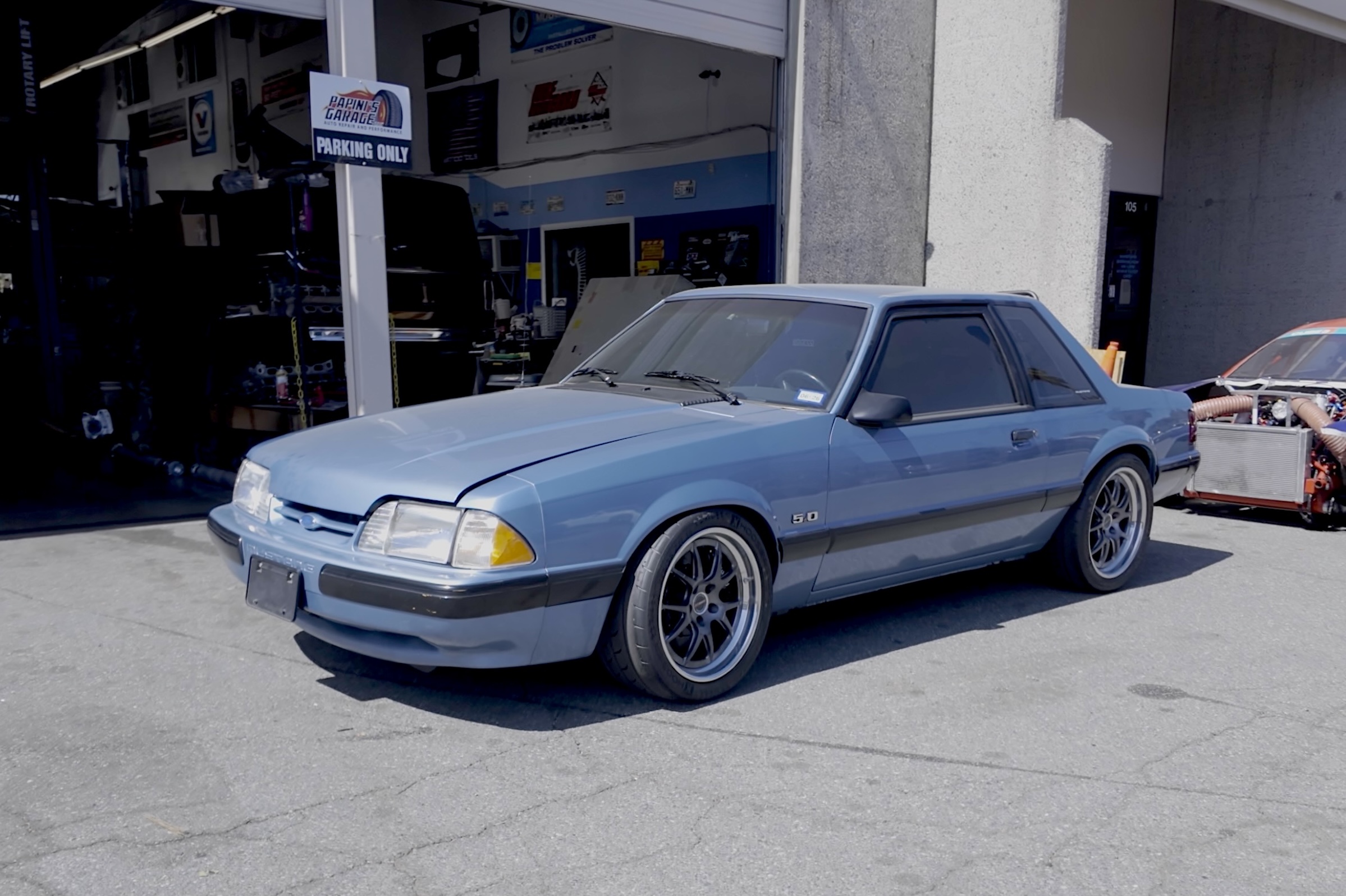
If you have been following along with the saga of the 1990 Fox coupe drafted in the starring role for the latest Horsepower Wars saga, Fox v Ferrari, you know it has a daunting mission. The idea is to see if an aftermarket-enhanced Fox Mustang can vanquish a factory supercar in the same price range as our $125,000 build budget. Obviously, that is going to require a significant handling upgrade, so we turned to Maximum Motorsports for a complete suspension overhaul.
That overhaul started with the part of the car that has to carry everything else: the chassis. Before Papini’s Garage starts feeding serious power through the drivetrain, LP Racing has already installed Maximum Motorsports Full-Length Subframe Connectors (P/N: MMFL-5PC; $269.97) to stiffen the unibody and test-fit the K-member and Panhard bar. With the car destined for street driving, track testing, and serious cornering, chassis rigidity is more than a nice-to-have. It is the foundation for everything that follows.
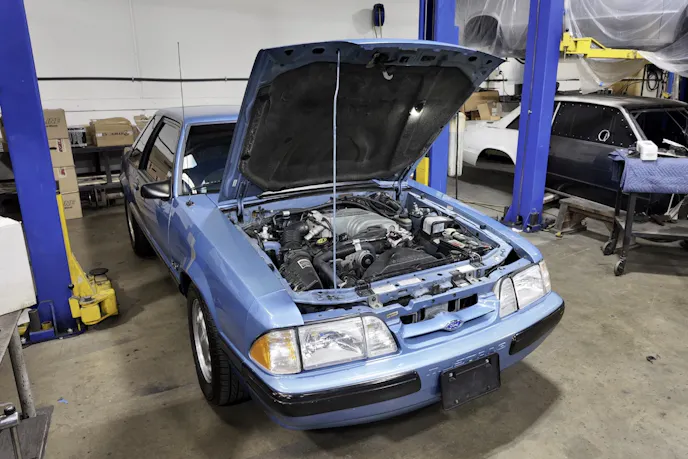
The full-length connectors tie the front and rear portions of the Fox unibody together with substantially more weld area than a short connector, while also providing additional support along the rear subframe. Maximum Motorsports’ full-length subframe connectors for the Fox platform fortify the formerly flexible foundation, and the company’s current design uses a taller tube for even greater bending strength.
Since this Mustang is being asked to do things Ford never intended a 36-year-old LX coupe to do, those connectors work with a custom LP Racing cage to fortify the Fox for the performance to come. It will eventually have a 5.2-liter Predator-based Coyote combination, a turbocharger, a ZF 8HP70 transmission, and a built 8.8 rearend. It also has to turn, stop, and remain streetable while doing it.
Compromise No More
Maximum Motorsports CEO Chuck Schwynoch has spent decades applying race-car suspension lessons to street Mustangs. His background includes crewing on SCCA and IMSA endurance-racing teams, autocrossing, and developing suspension components for the Fox Mustang. That engineering mindset remains central to the company’s approach.
“I believe Ford’s corporate policies produced a design focused first on low-cost manufacturing, and second on ride comfort, rather than performance handling. As a result, there is much room for improvement. The chassis lacks stiffness, which compromises both handling and ride quality. In the front strut suspension, the spring is mounted on the control arm — an unusual design that creates substantial friction,” Chuck Schwynoch, CEO of Maximum Motorsports, said. “At the rear, the opposing-link four-link suspension design is cheap to manufacture but performs poorly in corners. When Trans-Am race cars evolved beyond leaf springs decades ago, most went to some form of three-link suspension rather than a four-link. A four-link’s inherent bind can help during a drag-strip launch, but it limits cornering performance.”
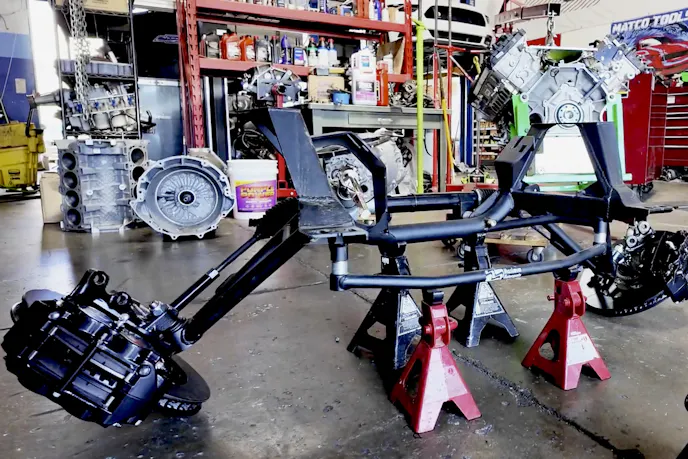
With that in mind, there is a clear upgrade path to meet the mission of Fox v Ferrari. The goal isn’t to turn the Mustang into a race car that is miserable on the street. It is to make the car dramatically more capable without losing the character and usability that make the Fox platform such an appealing performance canvas.
The central figure in the build is Maximum Motorsports’ vaunted tubular K-member (P/N: MMKM-2.1; $897.97). It replaces the stamped-steel factory structure while providing revised suspension geometry and multiple control-arm mounting positions. Those mounting options allow the suspension geometry to be optimized for the car’s ride height.
“The MM K-member improves the suspension and steering geometry for better handling. The front control arm pivot points are raised to improve the roll center height when the car is lowered,” Schwynoch said. “We have front control arm versions that move the ball joint forward to increase positive caster. When cornering, that additional positive caster causes the outside front tire to gain negative camber, which keeps the tire’s contact patch flatter on the road, which increases grip and therefore cornering speed.”
That is the kind of geometry work that makes a difference before the engine ever makes a horsepower. The K-member establishes the relationship between the chassis, control arms, steering, and struts, so getting that foundation right is critical when the eventual goal is to make a Fox Mustang hustle around corners with modern performance cars. It also provides the ideal mounting spot for the Coyote engine swap that will power the project.
Attached to the K-member are Maximum Motorsports matching tubular front control arms (P/N: MMFCA-FOX; $399.00), which reduce deflection and provide a more rigid connection between the spindle and K-member. Depending on the selected configuration, the arms can also alter caster and tire clearance while working with the K-member’s revised geometry.
Handling the upper strut location at the other end of the dampers are Maximum Motorsports Caster/Camber Plates (P/N: MMCC9093; $239.97). These replace the factory upper strut mounting arrangement with an adjustable system that allows the alignment to be tailored to the car’s intended use. That becomes especially important once the car gets the wide, square tire package planned for the Fox v Ferrari competition.
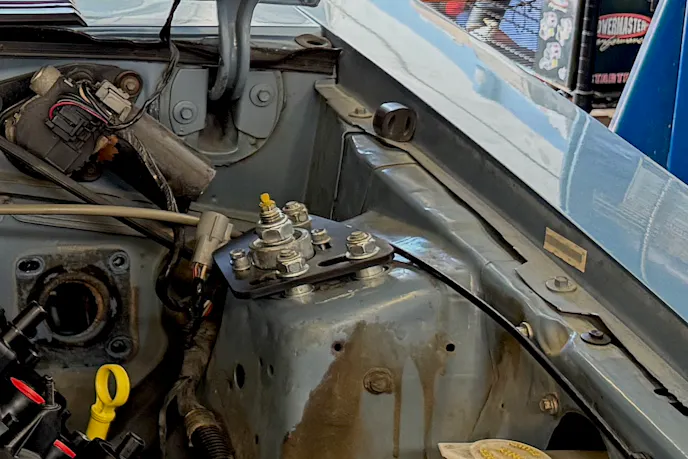
“The caster/camber plates allow increasing positive caster, and precisely adjusting the amount of negative camber to best suit the driving situation,” Schwynoch said. “Camber can be set more negative for more cornering grip, or to less negative if tire wear becomes excessive.”
Likewise, a Maximum Motorsports Bumpsteer Kit (P/N: MMTR-3; $189.97) addresses changes in front suspension geometry caused by the project’s Maximum Motorsports K-member. Lowering a Mustang changes camber, which in turn changes toe, but correcting those alignment settings after lowering leaves the car with essentially the same bumpsteer it had before. The adjustable outer tie-rod ends in the bumpsteer kit are needed here because the K-member moves the inner front control-arm pivot points upward, changing the relationship between the control arm and steering linkage. That allows the bumpsteer to be properly corrected rather than leaving the toe relationship to change as the suspension moves through its travel.
“The bumpsteer kit allows adjusting the tie-rod height at the spindle to minimize toe change during suspension travel,” Schwynoch said.
Spring Control
Another key to revamping the Fox’s handling is completely revising the dampers and springs. That starts in the front by moving the spring off the factory control arm and onto the strut with a coil-over conversion, which includes Maximum Motorsports’ front struts with Gen-4 R&T valving (P/N: MMD-FCRTG4), front springs (P/N RF25100350), rear shocks with Gen-4 R&T valving (P/N: MMD-RCRTG4), and rear springs (P/N: RF200040).
“For the front suspension, the coilover conversion provides the most substantial benefit. The stock location for the spring is on the control arm. That causes the spring to push the arm down, away from the chassis, loading the pivot bushings and trying to separate the ball joint from the spindle,” Schwynoch explained. “That creates a lot of friction in the control arm pivot points. Moving the spring from the control arm to around the strut eliminates that friction, which allows the suspension to move much more freely, improving both ride quality and handling.”
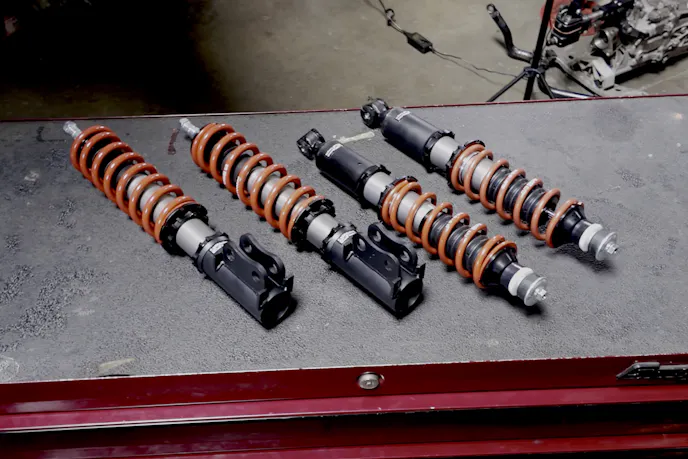
Coilovers aren’t part of the plan simply because they look like race-car hardware. Moving the spring changes the effective wheel rate and eliminates the friction created by loading the stock control-arm pivots with the spring.
“The term ‘wheel rate’ refers to the effective spring rate at the wheel/tire. Wheel rate is calculated based on the location of the spring. At the front of a Fox Mustang, the wheel rate is less than the spring rate,” Schwynoch explained. “It’s 25 percent of the spring rate for a spring on the control arm, and about 85 percent of a coilover spring rate. The higher the wheel rate, the less the body rolls when cornering, and the more quickly the car responds to steering inputs.”
That allows Papini’s Garage much more freedom to tune the car as the rest of the combination comes together. The Fox doesn’t need to rely on extremely stiff springs in the stock location to control body motion. The coilover arrangement provides a more efficient path for spring force while allowing spring rates to be changed for the street, drag strip, or road course.
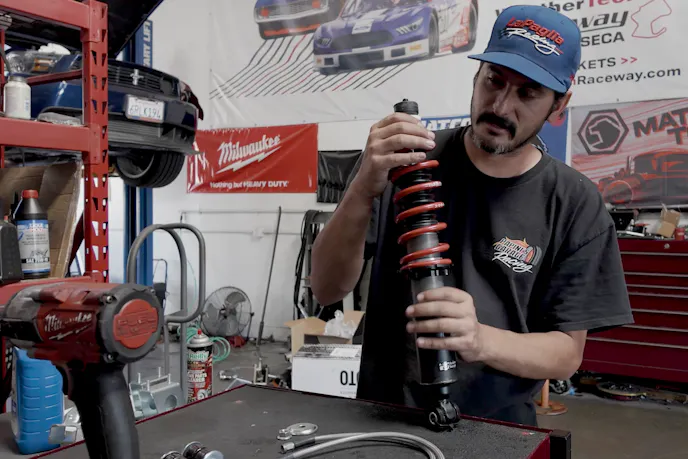
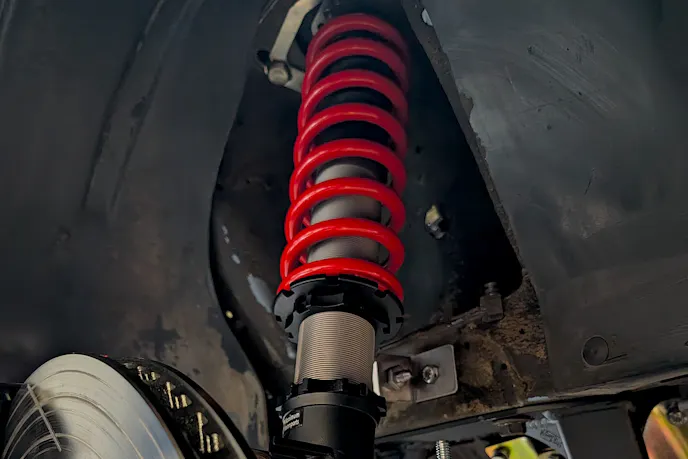
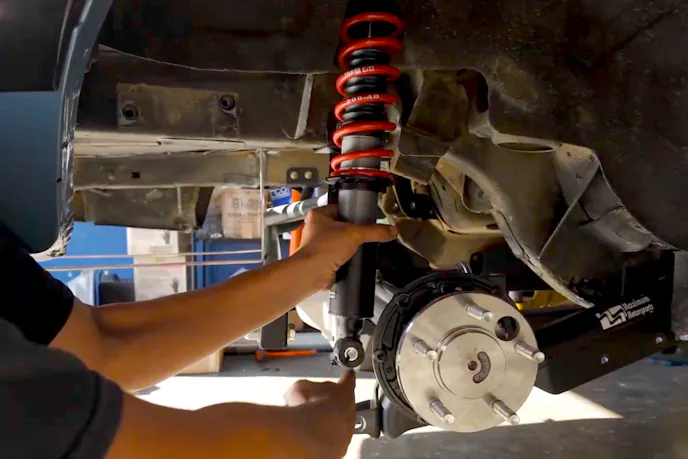
“When the spring is in the stock location on the control arm, increasing the spring rate also increases the friction at the control arm pivot points. That in turn degrades ride quality and handling,” Schwynoch said. “A coil-over spring rate can be increased significantly to provide a much higher wheel rate, and because that does not increase friction, there is far less degradation of ride comfort.”
This project is also a showcase for Maximum Motorsports’ newer damper valving through dyno testing and repeated Mustang testing rather than treating the shock as an afterthought.
“We spent a couple of years talking with smaller manufacturers about building dampers to our specs, in less-than-truckload quantities. We found a company with high-quality hardware, but we were dissatisfied with their valving, and encountered fitment issues on some Mustang model years,” Schwynoch said of the company’s new coilover dampers. “That led us to get a shock dyno. After a year of research and testing, we developed valving that delivers the performance and ride quality we wanted. We don’t believe that good performance comes at the expense of good ride quality.”
That philosophy fits the Fox v Ferrari build particularly well. This car has to be fast enough to challenge exotic machinery without becoming a competition-only machine.
Traction Transformation
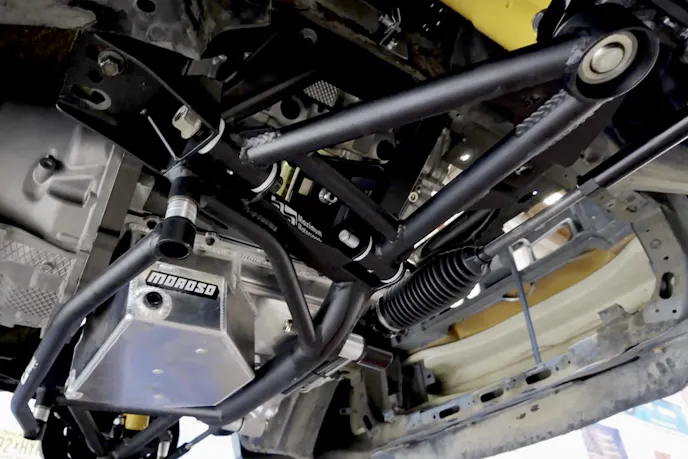
At the back, Maximum Motorsports attacks the fundamental limitation of the factory four-link with a torque arm and Panhard bar. The Maximum Motorsports Panhard Bar (P/N: MMPBA; $529.97) locates the rear axle laterally while lowering the rear roll center. That gives the rear suspension a more controlled path through cornering loads and removes some of the unpredictability inherent in the factory arrangement.
“For the rear, it’s the Panhard bar. The three major components may be installed one at a time or all together. The Panhard bar may be installed with the stock Fox rear suspension, where it makes a huge and very noticeable difference,” Schwynoch shared. “Even a passenger who rode in the car before and after installation will notice the difference. The car is much more stable and predictable when cornering, even at normal street speeds.”
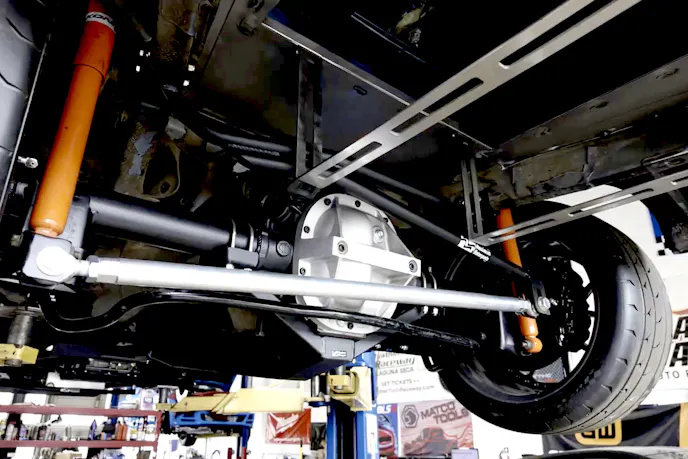
A more traditional upgrade, the rear lower control arms are Maximum Motorsports Extreme-Duty units (P/N: MMRLCA-30; $369.97). They reduce the deflection allowed by the factory components while improving the rear suspension’s ability to put the tires to work under acceleration and cornering.
“The rear suspension parts improve handling by giving the tires more grip in all driving situations,” Schwynoch said. “More grip allows higher cornering speeds, more responsive steering, and therefore more fun.”
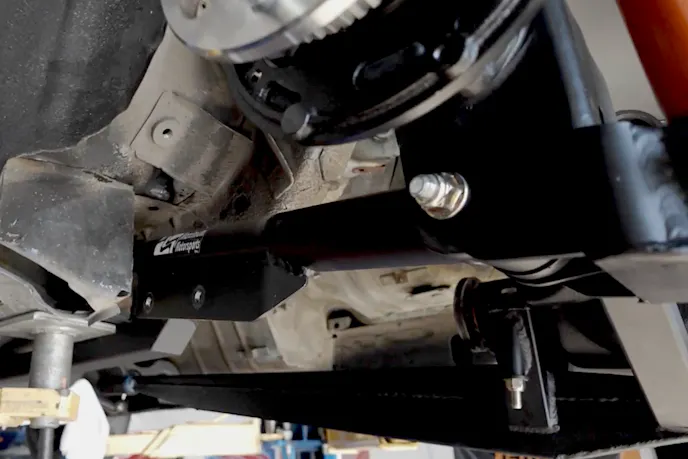
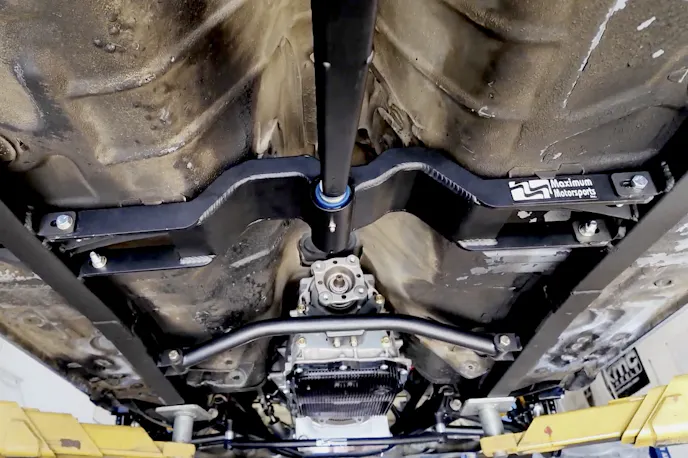
The final piece is the torque arm, which converts the Fox’s four-link arrangement into a three-link configuration. For this high-power application, Maximum Motorsports recommends the torque arm (P/N: MMTA3; $827) because it better controls axle windup and separates the jobs of longitudinal and lateral axle location.
“The torque arm and Panhard bar allow the rear suspension to move freely by eliminating the inherent bind of the stock four-link design. Binding of movement is effectively an increase in rear spring rate. The increase is not linear or predictable, and leads to snap oversteer,” Schwynoch explained. “The Panhard bar lowers the rear roll center from stock, which increases lateral grip and allows higher cornering speed. The Torque-arm improves the side-view Instant Center location, increasing anti-squat to over 100 percent while also reducing IC movement during suspension travel. The additional anti-squat provides much more rear tire grip for increased traction in all driving situations.”
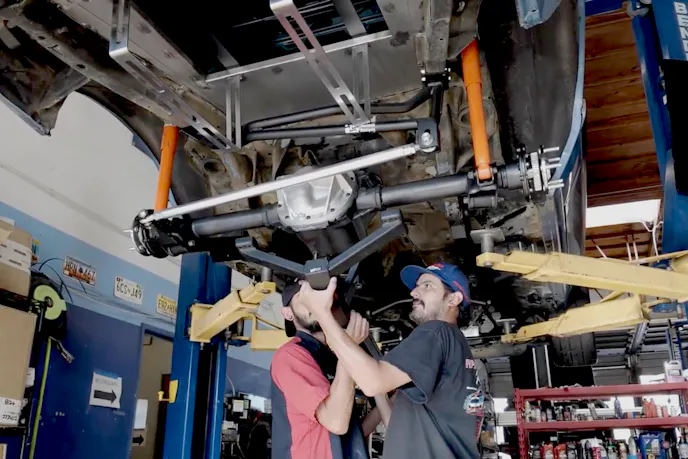
That is particularly relevant with the Coyote-based turbo engine planned for this Mustang. The goal isn’t merely to make big dyno numbers. The chassis has to be capable of translating that turbocharged power into acceleration the driver can predictably put to use.
Ready For More
With the Maximum Motorsports suspension installed, the Fox v Ferrari project takes a major step toward becoming the kind of dual-purpose performance car this Horsepower Wars challenge demands. The chassis is stiffer, the front suspension has modernized geometry and reduced friction, the springing and damping are adjustable, and the rear suspension is transformed into a more predictable three-link arrangement.
The Fox platform provides a lightweight, simple, and highly adaptable foundation, but this build is taking those attributes and giving them the suspension hardware necessary to exploit them. With a 275mm square tire setup planned, the car needs a chassis that can make the most of the available contact patch. With a high-output turbo Coyote engine coming later, it needs suspension geometry that can handle the power.
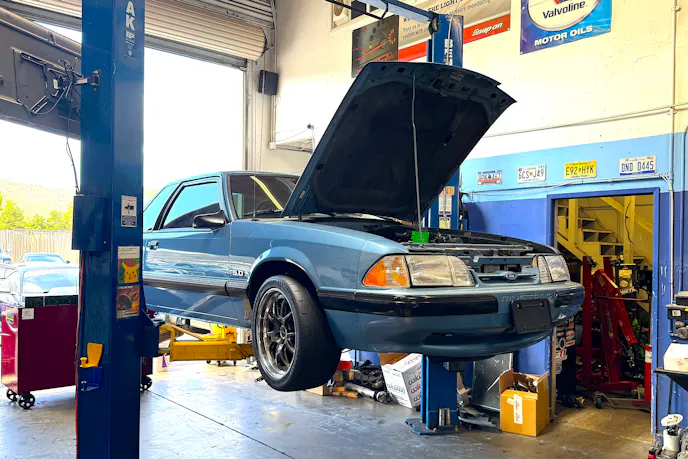
And with a $125,000 budget standing between this Mustang and a collection of used exotics, every component has to earn its place. The next phase will attack the other half of the equation: stopping and gripping. Brakes, wheels, and tires will give the Fox the hardware it needs to put all this newly developed suspension capability to work. That is when this 36-year-old Mustang will start looking less like a stock Fox coupe and more like a legitimate exotic hunter.
Horsepower Wars would like to thank its sponsors for making this show happen, including (and in no particular order): Old World Industries/PEAK, VP Racing, COMP Cams, ARP, ATI Performance Products, JE Pistons, Boostline Connecting Rods, Total Seal, Cometic Gasket, Moroso, Hoosier Racing Tire, ECU Master USA, HP Turbo, Pure Drivetrain Solutions, SPE Motorsport, Moser Engineering, Delta ABS, Forgeline Motorsports, and Maximum Motorsports.
You might also like
Holley Ford Fest Packed Beech Bend With High-Flying Blue Oval Action
Holley Ford Fest invaded Bowling Green, Kentucky. From oval track to off-road and drifting to drag racing, it had something for everyone.