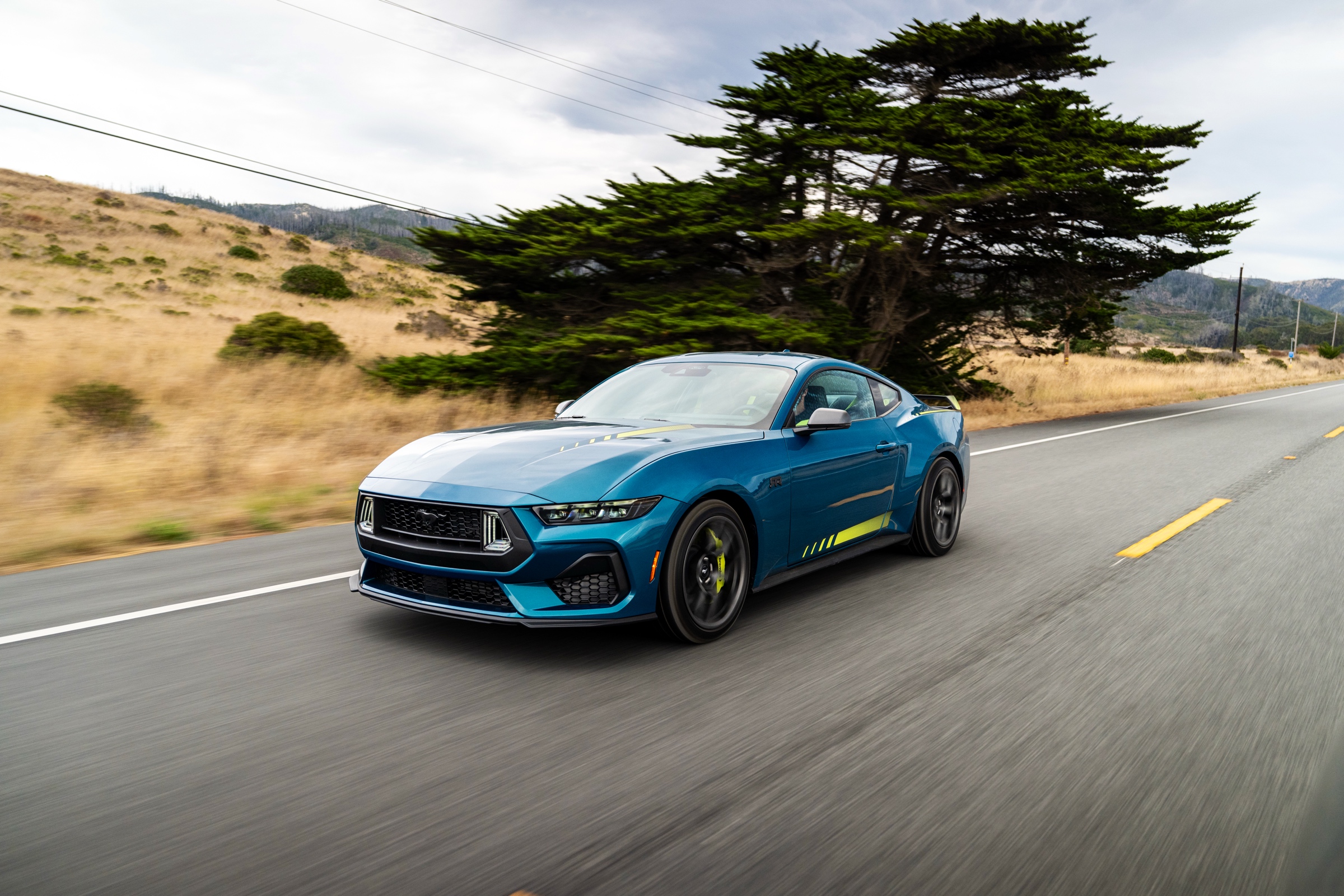
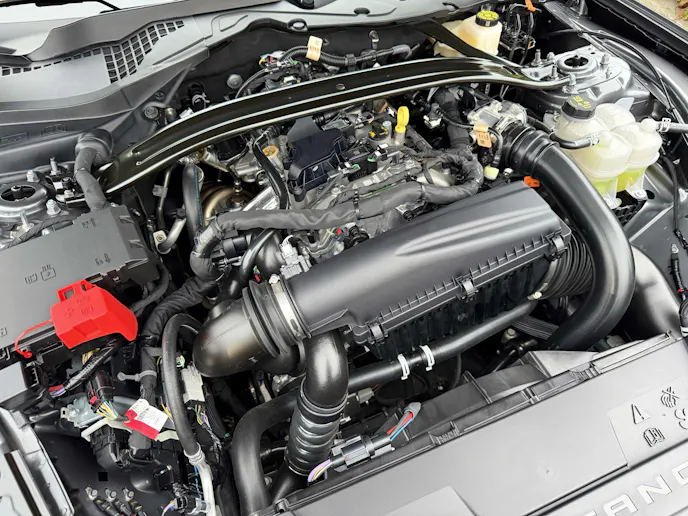
Charging off the line, the 315-horsepower 2.3 briskly builds boost and speed. Passing an orange cone, I yank the wheel, and the car starts to rotate as I grab what was once the parking brake, now electronically transformed into a Drift Brake. I hold the handle longer than it feels like I should before releasing it and stabbing the throttle, instantly commanding 350 lb-ft of torque to the rear tires. In an act of muscular alchemy, the rear tires send a cloud of smoke into the atmosphere as the S650 pirouettes in a circle, and my smile grows larger in lockstep with the duration of the drift.
In days gone by, you might assume this is a purpose-built tire slayer, but it’s just a revved-up version of a base Mustang that is factory-equipped with a fun handle. Honing in on how to get slideways in the 2026 Mustang RTR gives a mere mortal even more respect for what pro drifters, like Vaughn Gittin Jr., do with ease. However, what is even more impressive is that he is the second person to forge a partnership to create factory performance vehicles together, and this is his first effort at “building cool sh!t” with the Blue Oval.
If you aren’t familiar with his credentials, Gittin began drifting in Mustangs way back in 2005 and eventually decided to put his spin on aftermarket upgrade packages via his company, RTR Vehicles. Along the way, he has earned Formula Drift championships, Ultra 4 off-road wins, and partnered with Ford on numerous projects, including the development of the aforementioned Drift Brake.
“When I started to modify the car and wanted to make it my style, there just weren’t many offerings that spoke to me. I became a zealot for Mustang,” Vaughn Gittin Jr., RTR Vehicles Founder and CEO, said. “I had so much passion, and I wanted people to love it, and of course, I wanted my car to look amazing.”
While he pitched the idea of a factory Mustang RTR back in the S197 era, it wasn’t in the cards without an engineering co-development plan. After years of working with Ford, the time seemed right as the company leaves many of its legacy performance brands on the table and forges a new path with cars like the Dark Horse SC and Mustang RTR.
“We’ve had a relationship with Ford now since 2007, and we’ve done a lot of really cool special projects with them,” Gittin said. “We performed very high-end skunkworks engineering on the Mach-E 1400, Switchgear, and, of course, our success on the racetrack.”
That proven path led us to this point, where your scribe traveled to Northern California to drive the production Mustang RTR at Thunderhill Raceway and through gorgeous hills and mountains on the street.
In The Streets
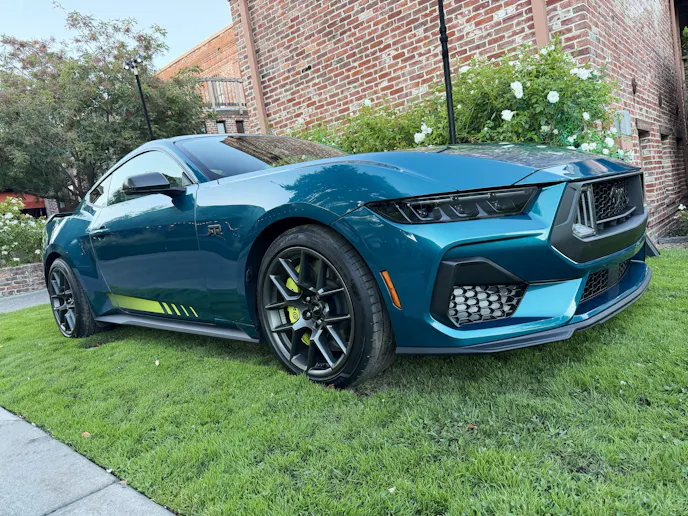
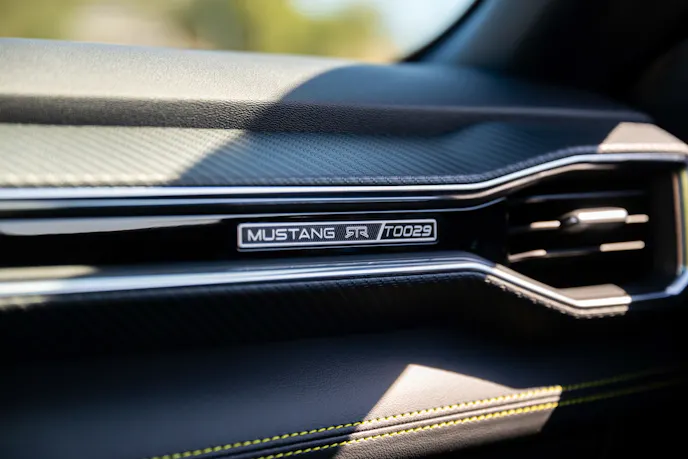
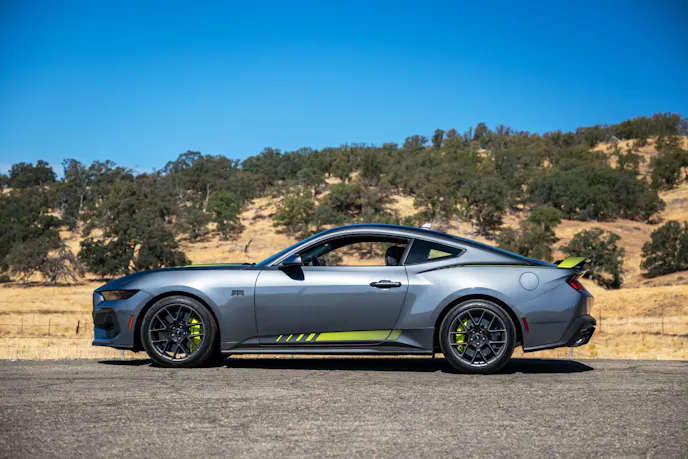
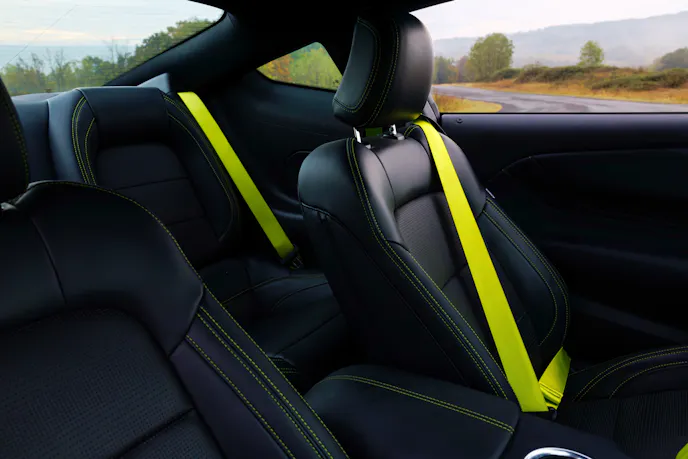
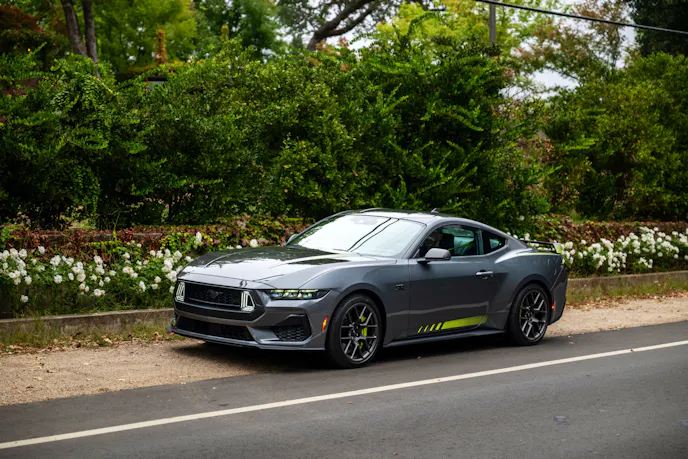
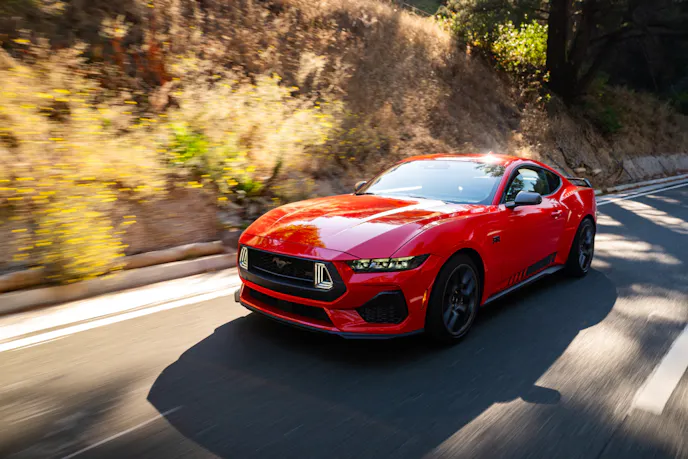
From the moment you approach the production RTR, you recognize there is something special about this Mustang. Sure, it is the next evolution of the massively underrated Mustang EcoBoost Hi-Po package, but this one is reworked in the image of the man behind the brand, and it carries just enough unique (and Hyperlime) touches to signal that it is something special.
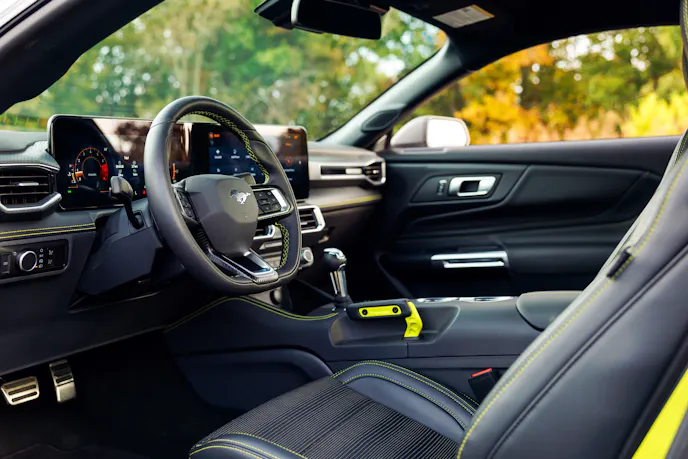
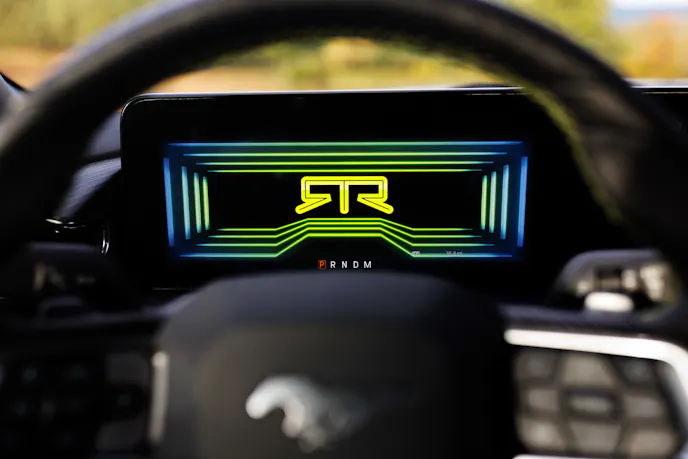
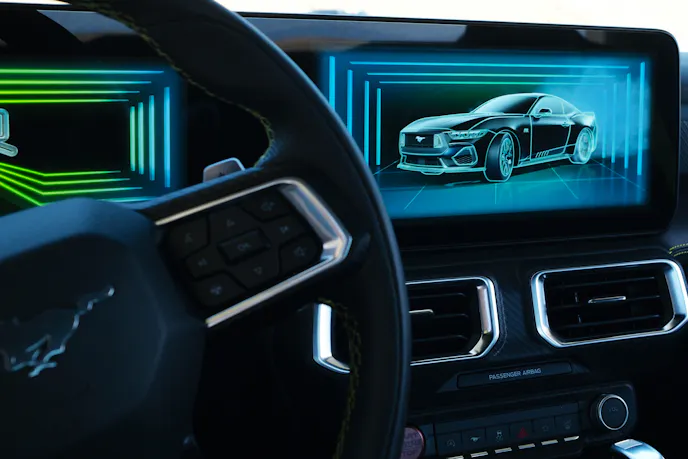
Push the start button, and you are immediately greeted by bespoke RTR graphics and animations on the widescreen instrument panel. This is no sticker-and-badge package; it is a fully integrated factory performer. As we hit the road, once again pairing with popular Mustang YouTuber StangMode for the trip, the combination of the swift-boosting turbo and 10-speed automatic keeps the engine in its powerband sweet spot.
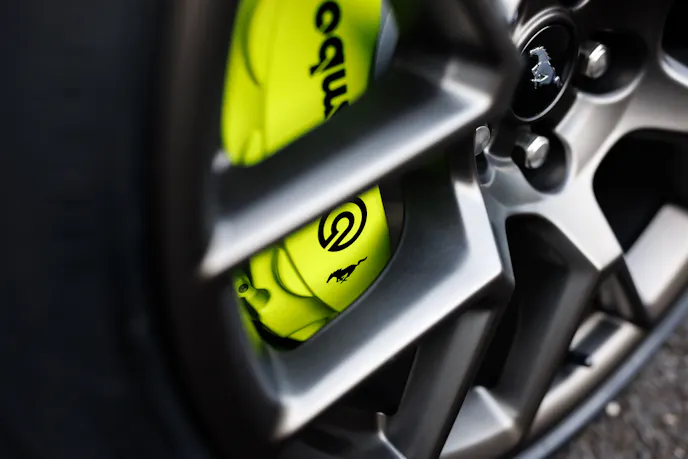
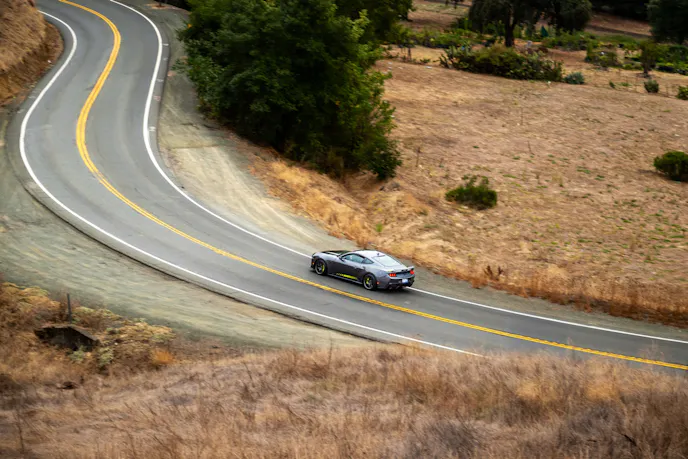
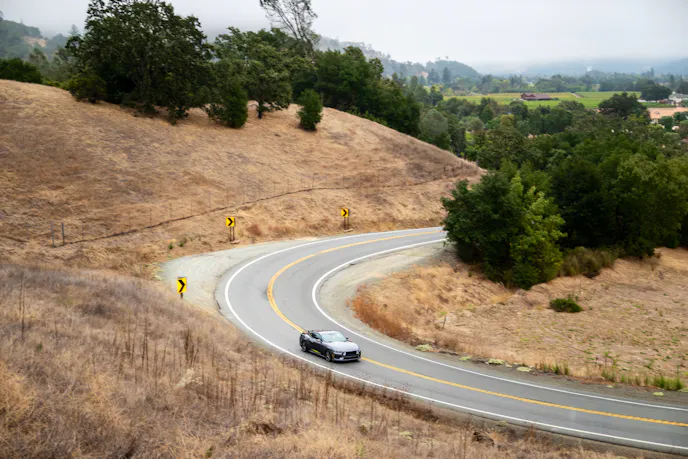
As we hit the curves in Sport mode, the Mustang RTR leverages its weight balance to dart through the corners. The big Performance Pack brakes were responsive and linear, and the power suited the tight mountain turns.
“One of the standout features that I like over the V8 is the excellent 54/46 weight distribution,” Gittin enthused. “The front end feels sharper and nimbler right out of the gate, and the power and weight balance of the turbocharged EcoBoost engine with the 10-speed automatic transmission is enough to put a smile on any driver’s face.”
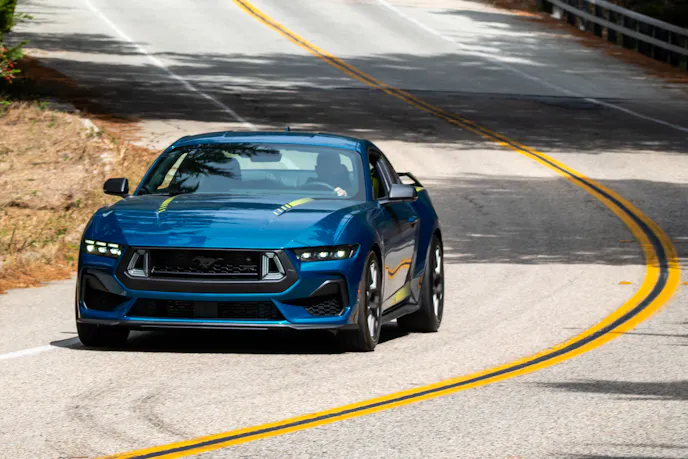
Moreover, the light front end and MagneRide suspension allowed the car to slough off any imperfections in the road and keep carving corners. Its balance encouraged the driver to push a little harder, and the MagneRide to easily adjust to the changing terrain.
“It makes the package really broad in terms of its scope of capability,” Adam Brecher, Ford Mustang Vehicle Development Engineer, said. “…It’s a very reasonable daily driver in terms of ride, but then you hit Track mode, and you’ve got everything handled out here.”
Flatout Fun
Having fun right out of the gate led us down a twisty path to Thunderhill Raceway for a chance to sample the Mustang RTR at speed. We didn’t run the full west course, but it was enough to put the car through its paces across elevation and some technical corners. What was revealed on the street carried forward on the track, with the balance allowing the car to remain composed even when this scribe made tactical errors.
Dark Horse sway bars keep it flat through the turns, a revised cooling system keeps power consistent, and a unique MagneRide calibration brings the whole package together for balanced performance. Likewise, the power comes on quicker and keeps pulling through the midrange, with the transmission and anti-lag tech keeping the boost and the revs in sync to muscle out of the corners.
“This was something that was noticed during track testing, especially in drifting. When pulling the handbrake and getting back on throttle, there was a little more of a delay than wanted,” Gittin said. “The team went into the Ford GT Le Mans calibration, pulled the anti-lag calibration out, and mapped it to this hot rod.”
Of course, this is still an EcoBoost, so the power does flatten toward the top of the tach as peak power arrives at just 5,500 RPM, reminding you that there is no muscular V8 underhood; as you dart through the corners, you certainly don’t miss the extra weight.
“I mean, it’s a great car. And I use it internally at work if someone is learning a new track, say, ‘Hey, please take this car,’” Brecher said. “And then it’s a great chance to go out and, like, this does everything you want it to do, and you’re just focused on learning the track and your skill.”
Catch My Drift
Speaking of learning, we shifted from the road course to another part of Thunderhill where cones were laid out, not for an autocross, but for an exercise to, well, get a handle on that Drift Brake that Gittin and his former co-driver Chelsea Denofa developed with Ford. Denofa and other pros were on hand to coach, and once you get the hang of it, shredding tires in the Mustang RTR is a blast.
“This is not a drift car, but it is drifting capable. It is drifting optimized,” Gittin said. “We have additional steering angle in the front end. Also, every vehicle comes with the Drift Brake.”
In addition to the Drift Brake, suspension tweaks, and the anti-lag tech working in concert to help you get slideways, the Mustang RTR benefits from much more forgiving parameters when you tap the traction-control button once. It’s not completely off, as when you hold the button, but it acts as “training wheels” for drifting with the “wheels” at the highest setting.
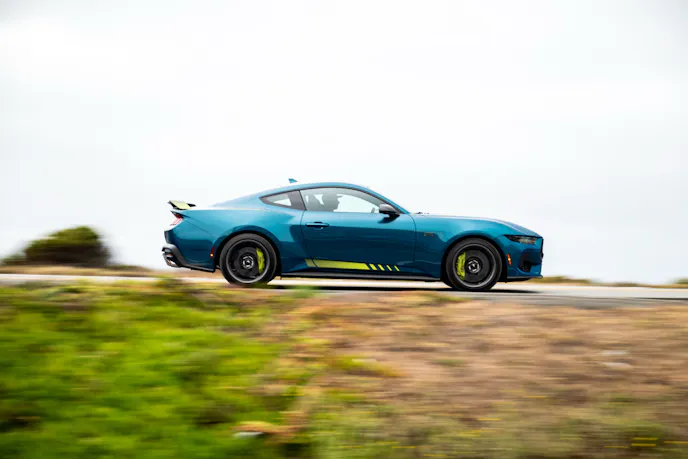
“We also modified the stability control. For this vehicle, something that we wanted to optimize for drifting, we opened up the parameters on the one-touch,” Gittin said. “It kind of acts as training wheels for drifting, especially at lower speeds. For people that are going to go to a safe, open lot and go have some fun, it is a really good trainer.”
Fun Foundation
In practice, there is plenty of leeway to turn your tires into smoke and slide your way to a good time. Power also seems ample for this duty, but as with anything, more would always feel better, and RTR Vehicles is likely to support these vehicles with a post-title upgrade path to add even more performance to this entry-level performer.
“We have an ecosystem developed for the car or in development. I’ve got a prototype turbo kit I’ve been working with Ford Racing on, and some calibration stuff we’ve been working with Ford Racing on,” Gittin added. “All of our suspension, including our coilovers, bolt right on. All of our appearance parts also bolt right on.”
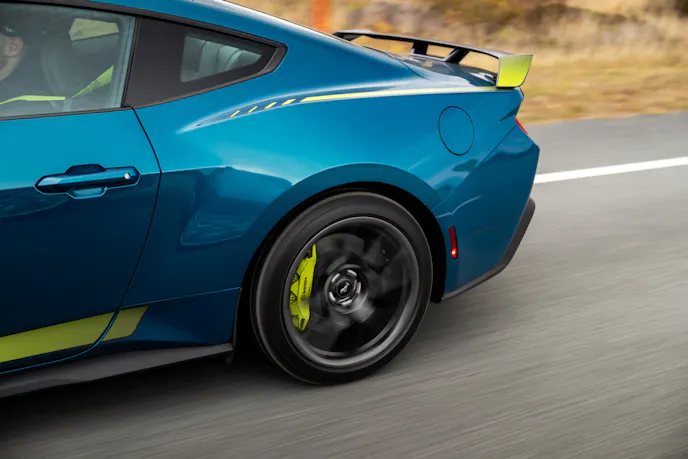
With pricing in the low-$40,000 range, the Mustang RTR offers a lot in the way of style and performance at an affordable price point. Plus, it is better on gas and cheaper to insure than a Coyote-powered machine, but it still has to overcome that four-cylinder stigma. That’s where Ford is counting on Gittin’s authentic enthusiasm to rub off on would-be entry-level buyers. And who knows? If this one is a hit, we might see other RTR variants sliding sideways out of the factory.
You might also like
Building A Solid Fox Foundation To Take On Exotic Performance Machines
A 1990 Mustang LX gets a serious chassis makeover for Fox v Ferrari. LP Racing preps the Fox for Coyote power and an 8HP swap.