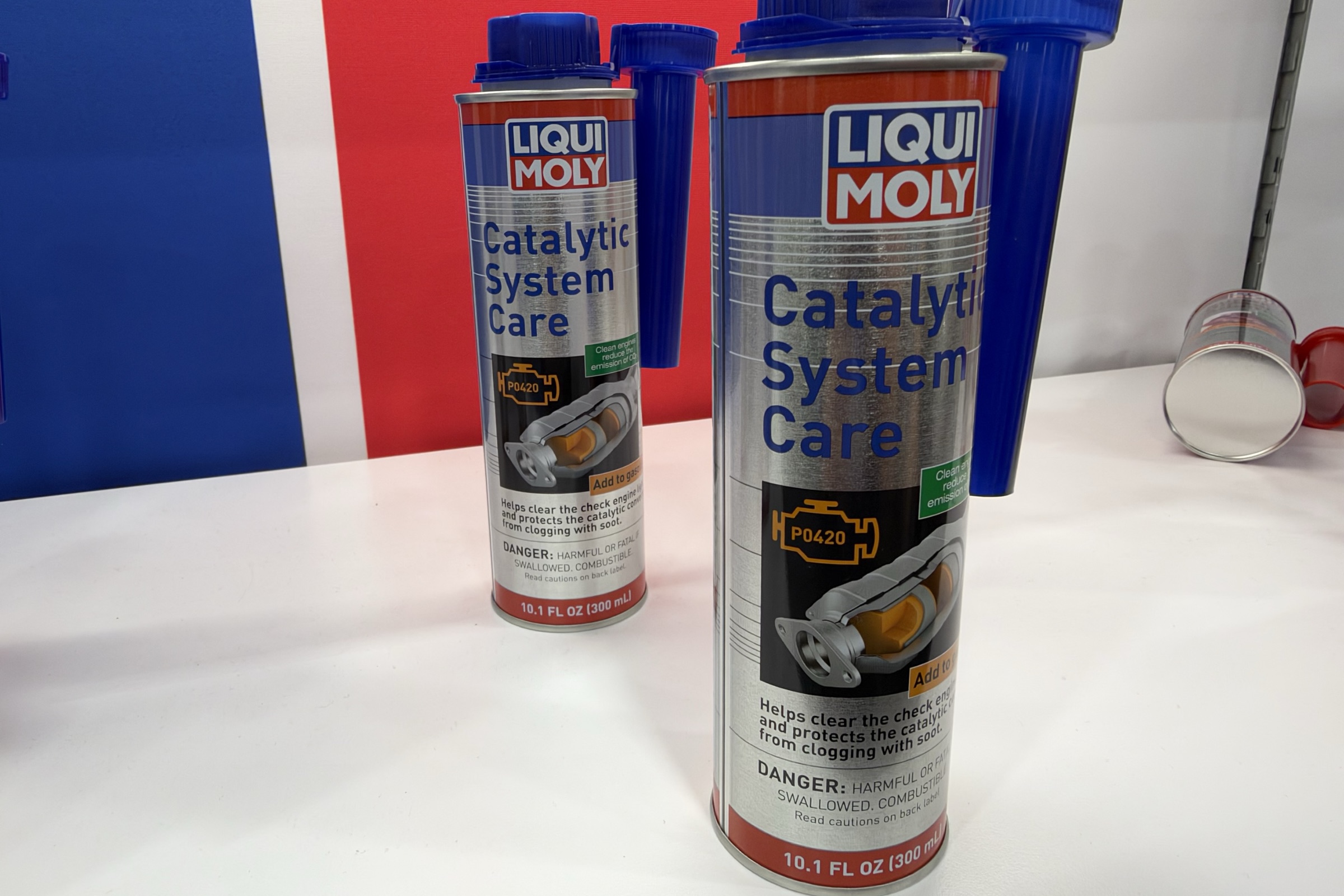
A wrench light on the dash and a trouble code in the PCM can spoil your day. If your car is flashing a common catalytic converter trouble code, there might just be a simple solution. As a first course of action, LIQUI MOLY developed its Catalytic System Cleaner, an advanced fuel system cleaner that might just clear your trouble code without a trip to the dealership.
A P0420 diagnostic trouble code often points toward catalytic converter efficiency, but the underlying cause isn’t always a failed converter. Fuel delivery problems, injector deposits, and an incorrect air-fuel mixture can contribute to emissions-related issues. That’s where this cleaner enters the picture.
Displayed at the SEMA Show, LIQUI MOLY’s latest-generation chemical formulation is designed to clean the fuel and intake systems, helping restore proper combustion and address some of the conditions that can trigger a check-engine light. Rather than immediately replacing expensive exhaust components, the product offers another potential first step for owners chasing down problems on a high-mileage vehicle.
“Most of the time, when you get a P0420 code on your dashboard, something is wrong with either your lambda sensors or your fuel injection system. It comes down to an incorrect air/fuel mixture. This is one of our latest-generation fuel system cleaners,” Steffen Niemietz, Engineer & Global Technical Support at LIQUI MOLY, explained. “It restores injector efficiency so the air/fuel mixture can return to the correct ratio. On many high-mileage vehicles, that can make the check engine light go away. If it doesn’t, you may have a damaged sensor or another issue that needs attention. This product addresses the fuel system; it does not clean the catalytic converter or oxygen sensors.”

The chemistry is what separates this formulation from older fuel-system treatments. LIQUI MOLY continually develops its additive technology, incorporating newer chemical ingredients to improve deposit removal. Niemietz explained that the company evaluates cleaning performance through controlled laboratory testing, measuring how effectively a formulation removes contamination.
“This is the next step in the development of our fuel system cleaners. New raw materials and chemical technologies are continually becoming available, and this product is based on the latest chemical platform,” Niemietz added. “In our laboratory testing, we use a controlled contamination process and then measure how effectively the product cleans that buildup. Compared with our previous generations of fuel system cleaners, this one delivers outstanding cleaning performance.”
While it isn’t a magic fix for a failed catalytic converter or damaged sensor, such a simple solution to a common problem is alluring for those suffering from this common trouble code. To learn more, visit LIQUI MOLY’s website for additional product details and application instructions.
You might also like
Give Your Classic Fairlane Or Galaxie A Hydraulic Clutch Upgrade
Upgrade your classic Fairlane or Galaxie with Modern Driveline’s Lightfoot hydraulic clutch kit. It delivers better feel and less effort.