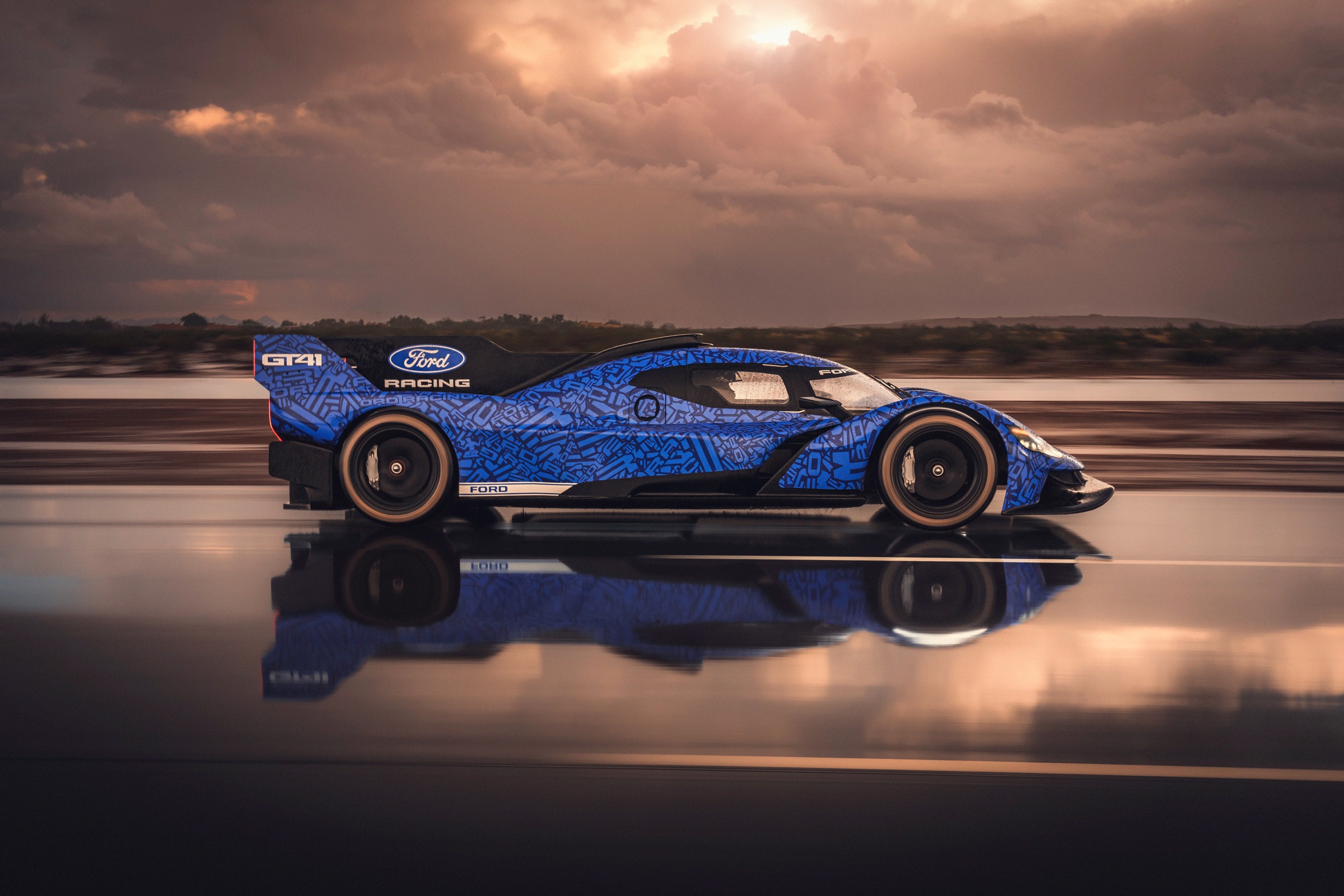
You’ve seen it make test laps in full camo, you’ve heard its Coyote 5.4 make simulated Le Mans test laps on the dyno, and finally Ford’s long-teased hybrid Hypercar broke cover today. Debuted during the Detroit Lions vs. Chicago Bears Thanksgiving NFL football game, the GT41 is a stunning work of automotive art that has historical aspirations to build on the legacy of its GT40 forefathers.
Unveiled at Ford Field, the new Hypercar represents the next chapter in Ford Racing’s return to the top class of the FIA World Endurance Championship and the 24 Hours of Le Mans. Sixty years after Ford famously swept the podium at Le Mans in 1966, America’s Race Team is preparing to take on the world’s best manufacturers again. This time, however, the effort is being developed entirely in-house, with the GT41 serving as the flagship of Ford’s endurance-racing ambitions.

The name is a deliberate homage to the original GT40. Just as that legendary machine measured 40 inches from the ground to its roof, the new Hypercar stands 41 inches from the ground to its air intake. It’s a clever connection between two generations of Ford racing machinery, but the ultramodern GT41 is truly its own beast.
“Ford’s racing history began 125 years ago when my great-grandfather won a race that helped him found Ford Motor Company. Our 1-2-3 triumph at Le Mans in 1966 remains one of the defining moments in motorsport history,” Bill Ford, Executive Chair of Ford Motor Company, said. “We cherish that history, but we are driven by the opportunity to take on new and greater challenges. The Ford GT41 is exactly the kind of audacious, go-like-hell project that gets our blood pumping. It’s our chance to return to Le Mans and compete for the outright win. And we race for more than trophies. Competing at the highest level pushes us to innovate, and what we learn on the track helps us build better vehicles for our customers.”
Exotic Power
The most exciting piece of the GT41 package for Blue Oval enthusiasts is under the bodywork. Ford Racing developed a naturally aspirated 5.4-liter Coyote-based V8 to power the new Hypercar, pairing it with a hybrid system for top-level endurance competition.
Calling it Coyote-based denotes that this isn’t a mere member of the pack; it is an alpha predator. This isn’t a production Mustang engine dressed up for the track. It’s a purpose-built competition powerplant developed in-house by Ford Racing, and its willingness to zing effortlessly to 9,000 rpm on the dyno tells you plenty about its exotic nature. We’ve already heard the engine run through simulated Le Mans laps, and its high-revving soundtrack promises to be a welcome addition to the Mulsanne Straight.
Ford hasn’t released official specs or engine output, but factory driver Sebastian Priaulx hinted at the output, which seems modest for such a highly engineered powertrain. The hybrid hardware adds another layer of engineering complexity, with Ford drawing on knowledge from its Formula 1 involvement through Red Bull Ford Powertrains and its broader motorsports operations.
“This Hypercar is a different beast compared to a GT car. It’s super quick, with 750 horsepower, electric motors and everything else,” Priaulx enthused. “It’s pretty much an F1 car for sports car racing. GT racing is an amazing category, but it’s different. Hypercar is the top level of sports car racing.”
For Mark Rushbrook, Global Director of Ford Racing, bringing the entire program under the Blue Oval roof is a point of pride. Rather than simply funding an outside effort, the company assembled the people and resources to design, engineer, develop, and validate its own Hypercar.

“To finish one, two, three, to dominate against Ford v Ferrari in 1966 and to win overall for four years in a row, to now be coming back to have the opportunity as America’s Race Team to be doing this program in-house with the design, development, engineering, all the prove-out is being done here inside of Ford with our resources, with our people, and to put all that together to now go back to Le Mans with even more manufacturers,” Rushbrook reflected.
That investment has implications beyond the racetrack. Ford intends to use the engineering experience gained through its international racing programs to advance its production vehicles, sharing knowledge in areas such as hybrid systems, software, advanced manufacturing, and vehicle development.
“The Hypercar program brings together the very best of Ford Racing and Ford Motor Company. It creates opportunities to transfer knowledge, technology, and expertise between our racing programs and the vehicles we build for our customers,” Rushbrook said. “Le Mans has a special place in Ford’s history, and we are incredibly proud to be returning to compete for overall victory. But this is about more than one race. It’s about building a competitive motorsport program that delivers value across our business and helps shape the future of Ford Racing.”
The Big Stage
Having already completed an extensive European testing program, the GT41 accumulated valuable experience as Ford continues refining the car ahead of its competition debut. The blue-on-blue design displayed at Ford Field replaces the functional camouflage used during development and incorporates subtle references to Ford’s American identity, including the American flag, bald eagle, and Spirit of Detroit.
The final competition livery will arrive ahead of the 2027 season opener in Qatar. Until then, the new design gives enthusiasts their first unobstructed look at the machine Ford hopes will carry its endurance racing legacy into the history books again.
The competition awaiting the GT41 won’t make that task easy. Ford is returning to the top class for the first time since 1969, and the modern Hypercar field includes manufacturers that have spent years developing and racing their own sophisticated prototypes.
The challenge is considerable, but Rushbrook believes Ford has put the right pieces in place to make a legitimate run at the top step.

“It’s not just Ferrari; it’s the best manufacturers in the world. And they’ve been competing for the overall win at Le Mans for many years now. We’re going back for the first time since 1969 for the overall win,” he elaborated. “So it’s a new challenge for us to go in against companies that have been there for many years. But I think we’ve got the right resources, the right approach, and we’re doing absolutely everything we can to give the team a chance to compete for that win.”
The Blue Oval Hypercar’s public debut is a major milestone, but the development team has plenty of testing and refinement left before the GT41 takes the green flag.
“Revealing the Ford GT41 is a significant moment for everyone involved in this program. It’s the result of an enormous amount of work across our engineering, design, and development teams and an important milestone on our journey toward 2027. We know the scale of the challenge ahead — the level of competition in Hypercar is incredibly high, and there are no shortcuts to success,” Dan Sayers, Ford Racing Hypercar program manager, stated. “Our focus has been on building the right foundations, bringing together the right people and making sure we learn as much as possible from every stage of development. We’ve made encouraging progress through our testing program, but there is still a huge amount of work to do before we arrive for the season opener. Everyone in the team shares the same ambition, and we’re determined to give ourselves the strongest possible platform from which to compete.”
Road To Le Mans
Ford also assembled an experienced international driver roster for the campaign, including Logan Sargeant, Tom Blomqvist, Matt Campbell, Sebastian Priaulx, Mike Rockenfeller, and Nick Yelloly. Tom Dillmann will serve as the team’s reserve driver.
Additional testing is scheduled in the United States throughout December 2026 and January 2027, but Sargeant, who brings Formula 1 experience to the effort, already spent significant time behind the wheel and sees encouraging progress as the team works through the development process.
“The Ford GT41 testing program has been really positive so far. Every time we get in the car, we’re learning more, making improvements and building a better understanding of what we need to be competitive. There’s been a huge amount of work going on behind the scenes, and it’s encouraging to see that progress translating onto the track,” he said. “The official reveal of our Ford GT41 is a really special moment for everyone involved and makes 2027 feel that much closer. We know there’s still a lot of hard work ahead, but I’m incredibly excited to be part of Ford Racing’s return to the top class of endurance racing and can’t wait to see what we can achieve together.”


Ford Racing’s return to the top class of endurance competition will encompass nine rounds of the 2027 FIA WEC. The campaign opens in Qatar in March before heading to Imola, Silverstone, and Spa-Francorchamps. The centerpiece arrives in June with the 24 Hours of Le Mans, followed by rounds in São Paulo, Austin’s Circuit of the Americas, Fuji, and Bahrain.
The schedule gives Ford plenty of opportunities to measure the GT41 against its rivals before the season reaches its defining moment in France. And while the historical parallels are obvious, past victories won’t make today’s competition any easier. Winning Le Mans requires speed, reliability, execution, and a team capable of making the right decisions over 24 grueling hours.
We can’t wait to hear that 5.4-liter V8 scream down the Mulsanne Straight in 2027 and see what America’s Race Team can do when the lights go out.
You might also like
Prepping Project Airstrike To Hook With Four-Digit ProCharged Power
Project Airstrike already has four-digit power, so it needs more traction. It’s time for suspension, tire, and wheel upgrades.