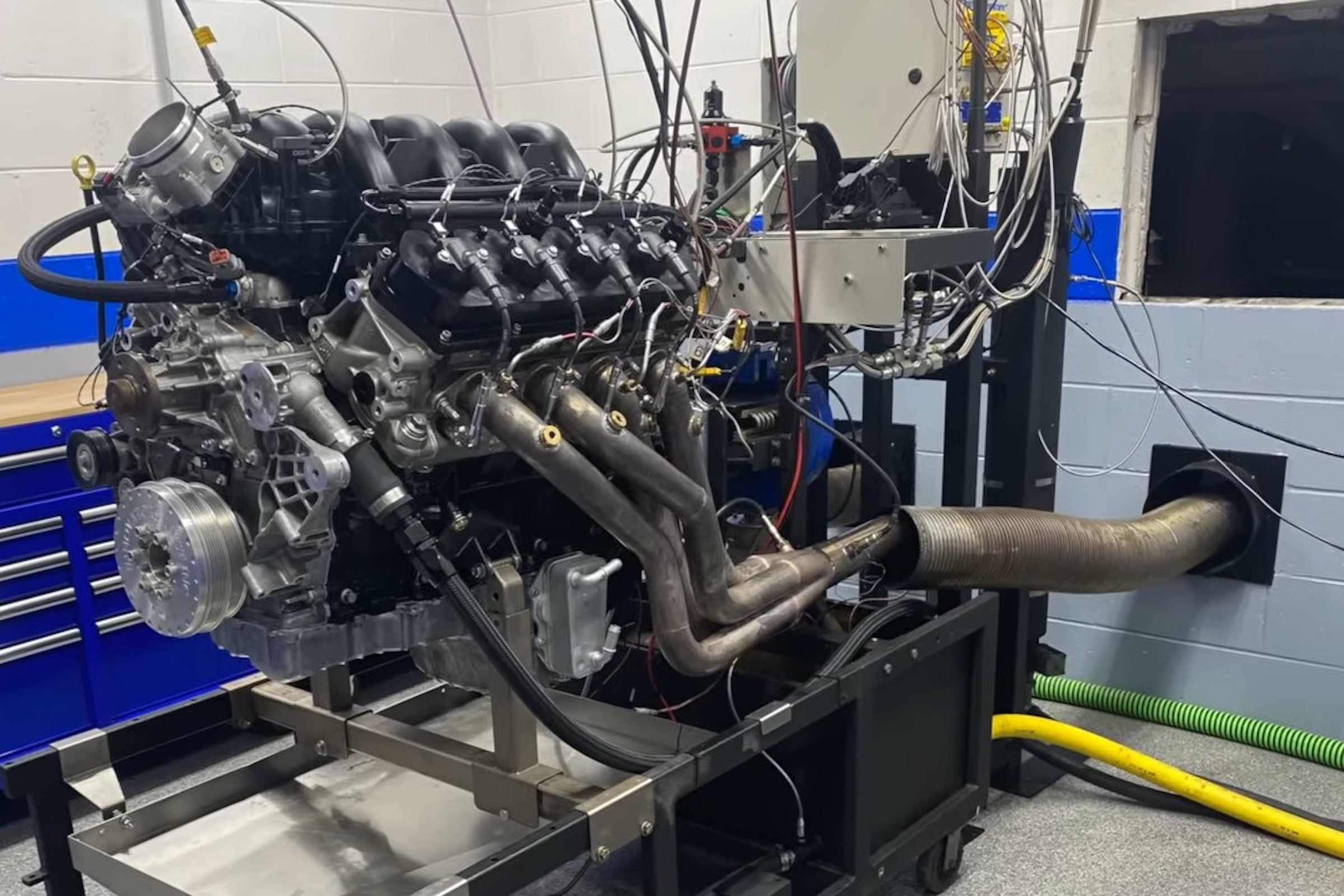
Ford’s Godzilla 7.3-liter V8 is a pushrod powerhouse that is ripe for performance builds. A case in point is this twice-boosted test mill. Brian Wolfe, of Willis Performance Enterprises, and Ben Strader, of EFI University, added twin turbochargers to a fortified Godzilla engine and generated numbers normally reserved for all-out racing engines. The Godzilla Godfather partnered with the EFI University founder to break down the exact mechanical steps required to build an 1,800-horsepower monster.
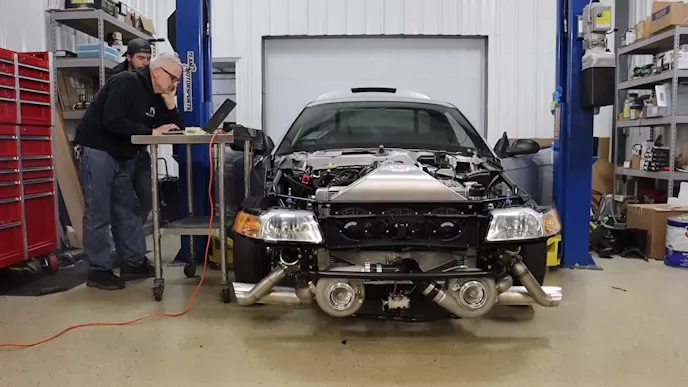
Wolfe previously managed engine development at Ford before retiring to build performance applications part-time. Transitioning from naturally aspirated builds to forced induction, he installed a turbo kit originally plumbed for a New Edge Mustang. Initial dyno passes resulted in heavy room contamination from the exhaust. Rerouting the piping outside cleared the air and allowed the engine to breathe properly.
“We swapped out to this new Borg-Warner 6880 turbo. Their R version and you know it made 1,890 horsepower and like 1,460 lbs of torque,” Wolfe said.
Getting the factory-based engine to reliably handle that power required resolving a valvetrain issue. During early dyno testing, Wolfe noticed a severe horsepower drop past 7,300 rpm. Swapping to lighter titanium intake valves and conical springs cured the high-rpm instability. Applying forced induction to this specific Ford Godzilla technology then sparked a debate regarding valve spring pressure. Many incorrectly assume massive boost levels physically push the intake valves open.
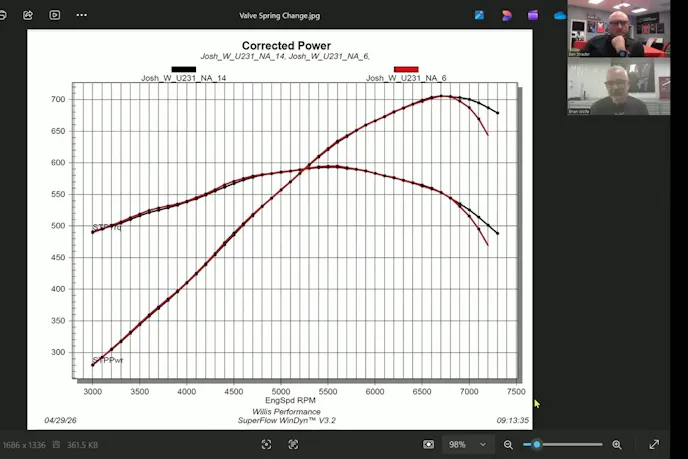
Strader presented actual cylinder pressure data from a Pro Mod engine to disprove the common valve float theory. Reviewing the four-stroke cycle, he proved that internal combustion pressure constantly exceeds manifold boost.
“There’’s never a time anywhere in the four-stroke cycle where we end up with a positive pressure gradient across the valve,” he explained. “What I mean by that is there’s never a time when we end up with more pressure here than what’s here.”
Building an engine this powerful didn’t require a lot of other exotic hardware, however. Wolfe used a 5-year-old factory block, a stock crankshaft, and standard multilayer steel head gaskets to keep the cylinders sealed at 26 psi of boost.
Using mostly standard off-the-shelf parts and cast blocks, the two experts successfully pushed the limits of Ford’s Godzilla technology. Their rigorous testing proves that modern engine architectures possess enormous horsepower potential right off the assembly line.
You might also like
Holley Ford Fest Packed Beech Bend With High-Flying Blue Oval Action
Holley Ford Fest invaded Bowling Green, Kentucky. From oval track to off-road and drifting to drag racing, it had something for everyone.