Memories of Sunday mornings spent in the garage alongside his father come to the fore when Bryan Rankin reminisces. He thanks his dad for the inclination and the education. By studying his old man closely, he picked up enough to start tinkering on a few small motorbikes of his own. After a childhood and adolescence spent setting the stage for motorsport, he finally acquired the mechanical know-how and, crucially, the income needed to start racing his motorcycles.
“We spent a lot of time working on the family cars and trucks; rebuilding engines and transmissions in the driveway, on the back deck, and sometimes on the kitchen table. Mom was a trooper,” Rankin reminisced.
Fast forward 10 years, and Rankin left home to start his career as a commercial pilot. This was as much due to a friend’s suggestion as it was his limited funds as a recent hire. “I had always wanted to try cars, but they were way, way too expensive to track at that stage, so I ran bikes for about seven years or so until my frontal lobe finally developed. Eventually, I had to accept they were too dangerous to keep going,” he explained.
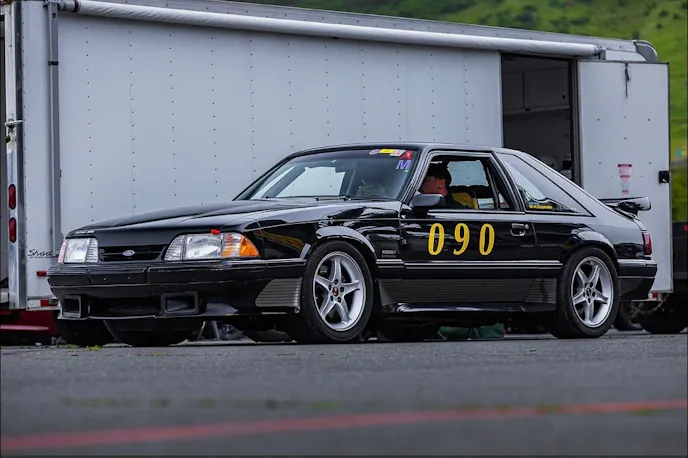
While he was building his skillset, Rankin’s future father-in-law, Craig, was getting his kicks tracking a Saleen Mustang. Craig and his friend Mike Smiley, both pilots, decided to start tracking this basic Saleen package consisting of a 302, a small Paxton supercharger, a five-speed manual gearbox, and Saleen’s shocks and springs.
Complete Overhaul
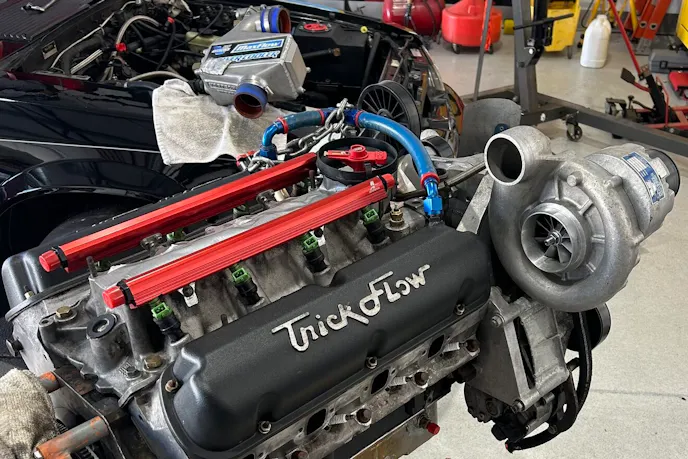
Soon, the two were overhauling the engine. They replaced the original 302 small-block with a 347-cube stroker fitted with Trick Flow heads and a bigger Vortech centrifugal supercharger. On 10:1 compression and 10 pounds of boost, the new combo put down 630 horsepower to the wheels on a chassis dyno, which required a stronger TREMEC TKO five-speed manual transmission.
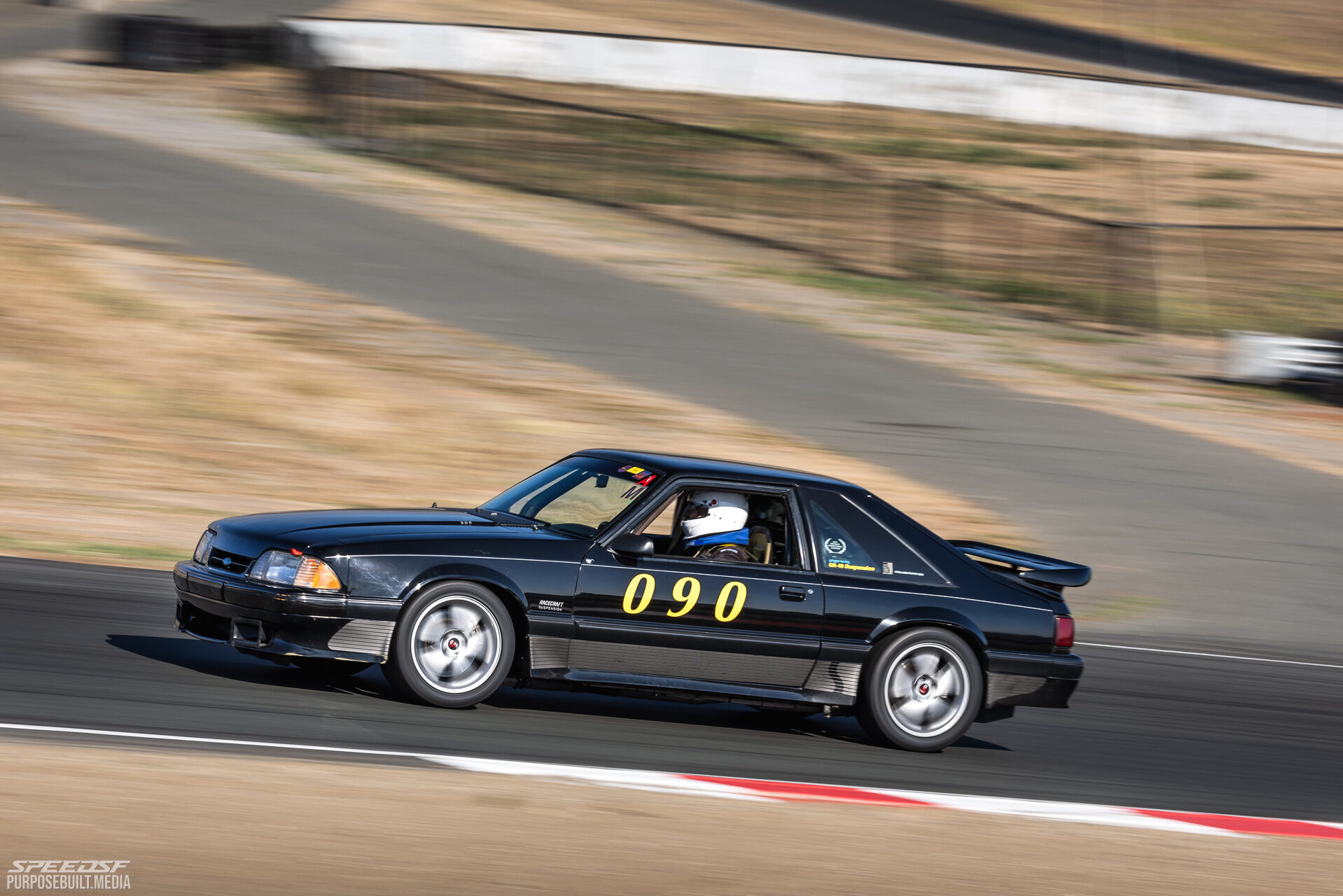
Frightening power alone wouldn’t have given this car a chance to shine on the long-distance hillclimbs and flowing road courses Craig had in mind. What set it apart from the rest of the basic Fox Mustang crop was the next major upgrade: a Griggs Racing’s GR40 handling kit consisting of lower control arms, upper control arms, links, Koni shocks, and a Panhard bar.
At the back, they fitted a Ford 8.8-inch rearend with a locking differential and Cobra-style spindles to support the Saleen five-spoke wheels as well as bigger Cobra calipers and rotors. At the front, they installed SN-95 four-piston Cobra calipers, Hawk Performance HP+ pads, and slotted 13-inch Brembo rotors. The brake kit added 3-inch tubing that begins in the air dam and blows on the backside of the disc. The package allowed them to run a set of 275/40R-17s Hoosiers at all four corners, which is enough to put the power down and support the 3,050-pound body along winding mountain passes.
With so many boxes ticked and a real effort made to sharpen the car, Craig and Mike had a decision to make: whether or not to keep it moderately streetable. A short debate concluded that the Saleen would become their dedicated track car, and as all the essential single-purpose bolt-ons, including a fire system and a cage, were put in place.
Even Distribution
With perfect 50/50 weight distribution, it was about as optimized as a hobbyist could expect a Fox Mustang to be on an everyman budget, and best of all, it looked as inconspicuous as a 200-mph track car could.
Its power advantage wasn’t always the easiest to exploit on smaller Northern Californian tracks. With an interest in seeing how well the motor would carry it along on faster, less technical layouts, they loaded the Saleen on its trailer and headed southeast to Nevada for the Virginia City Hillclimb, a time trial over a 5.2-mile winding pass.
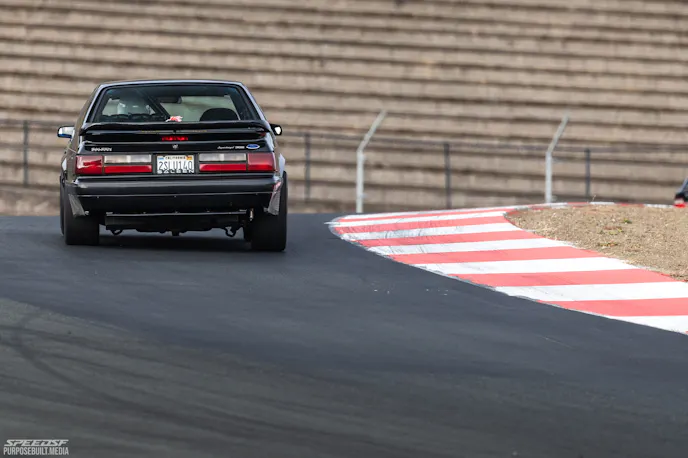
“It’ll take five years to learn this hill,” the organizer told Craig. That was about right, as in his fifth year there, he was crowned King of the Hill. “Who won that?” one bystander asked. “Oh, that black Mustang,” another replied.
In the final year he was there, Craig covered the pass in a remarkable 3 minutes and 23 seconds, and after winning the event twice, he decided to hang up his crown. Timing issues, logistical challenges, and an increasing workload convinced him it was time to take a break from the big events, and he ended up spending the remainder of his time with the car attending track days at Thunderhill Raceway and Infineon Raceway.
In the meantime, Rankin had established himself in his career. His growing savings gave him the chance to try four-wheeled vehicles on track. It seemed like kismet; Craig leaving the sport behind at the time his son-in-law started, as it was only a matter of time before he handed the keys off to the next in line.
Track Ready
Over his seven years tracking bikes, Rankin had learned so much of what it takes to get a wheeled vehicle around a road course, but the finer differences between managing two and four wheels at a time took a while to grasp.
“You need to manage the weight differently, but it’s generally more comfortable once you’re pushing hard, since you can slide a car a little more than you can a bike. Plus, all the modifications had made it very progressive near the limit; it wasn’t hard to trust,” he explained. “Compared to a stock S197, I was able to drive on track, the Fox-body feels much less likely to swap ends. There are other things people can’t do, either — braking in a corner generally leads to low-siding, for example. Things like that.”
With all those ideas in place, Rankin had sufficient grip with the Hoosier RCES already on the car. “On those, the car puts the power down pretty well. Sure, wheelspin’s always a possibility in the first few gears, but it’s not as nasty as you might think. I appreciate that since I’m still pretty new to all this, I tend to be driven to my comfort level. There’s definitely a lot of performance I haven’t accessed yet,” he admitted.
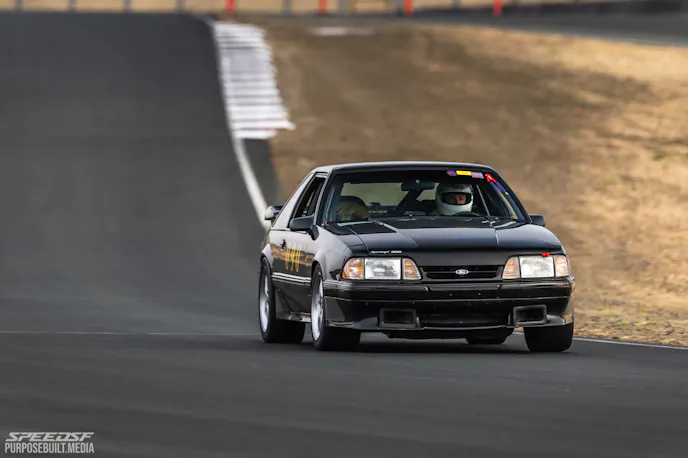
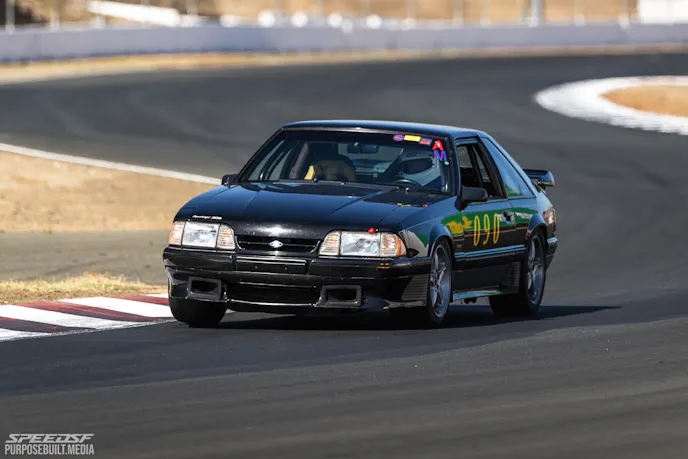
Perhaps that’s for the best at the moment, as the motor will get toasty toward the end of a 20-minute session and drastically limit the power output. Funnily enough, its old-fashioned ECU doesn’t like being driven too gingerly, either. It truly is a time machine.
“If you’re not quick-shifting and you take too long to match revs, it’ll go into a closed-loop cycle that throws the timing and makes the car run rich, which forces you to return to the pit lane and restart it,” Rankin laughed. “After about 20 seconds, it’ll run right again. It’s just as well they made it a track car because it would be a terrible street car.”
Despite these hang-ups and his careful approach, Rankin already managed to lap Sonoma Raceway in the 1:54-minute range. Given his experience, that’s nothing to sniff at.
Reliable Runner
For what it lacks in practicality, it makes up for in reliability. “It’s been reasonably cheap to run. Besides a Fuel Safe cell, it’s only needed basic stuff a 35-year-old car needs – most of which are available through Summit. The spindles, wheel bearings, and other Ford Racing parts are available through Motorcraft. It’s all pretty reasonable,” he noted.
However, it hasn’t been hassle-free. One failing motor mount started a Rube Goldberg machine-like sequence and revealed a weak point.
“I threw it up on the lift and figured he’d change the throwout bearing while changing the clutch, and I saw chunks in the oil, so I couldn’t stop there,” Rankin explained. “One of the motor mounts was crushed, so the steering rack and pinion pressed on the pan, which pushed up on the sump tube, which broke the mounting flange on the sump tube, which connects to one of the main bearing cap bolts, which broke into two pieces and fell into the bottom of the pan. I just installed new mounts and shimmed up the passenger side by 1/16-inch to minimize contact.”
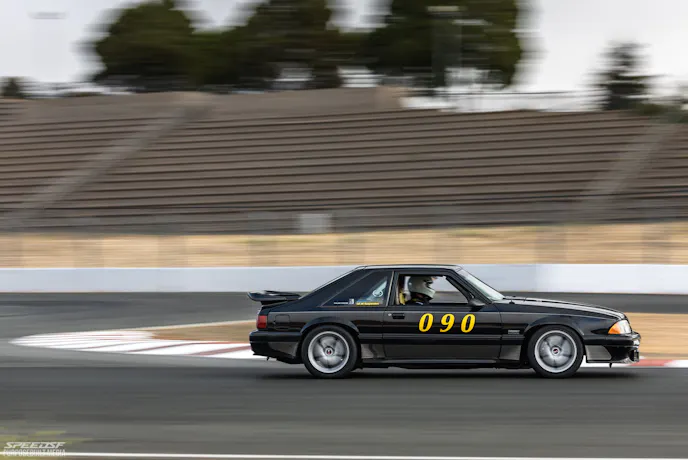
There is one item he plans on adding, though, more for the purposes of keeping a closer eye on the car than eking out any additional performance.
“It was tuned before the remote OBD-II plug-ins were available, so I’m looking for a new ECU so I can EFI-live it with a bunch of different fuel maps,” he explained.
As Rankin acknowledges he’s got to find a lot of the performance currently available, he doesn’t have major plans for modification in the near future. He and his wife have recently welcomed their first child, and, sadly, this Fox Mustang has taken the backseat. Once he gets his ducks in a row, though, he’s going to try to give the car another shot at the Silver State Challenge. It’s nice to know that heirlooms, when given to the right recipient, can keep the family torch alight.
You might also like
Ridetech’s Four-Link Rear Suspension Adds Formidable F-150 Traction
Ridetech created an F-150 four-link rear suspension upgrade. This system improves traction, geometry, and adjustability.