When it comes to making serious horsepower with a boosted engine, managing charge-air temperatures can be just as important as selecting the right power adder. Excessive heat robs power, limits tuning flexibility, and can make life miserable, especially for racers competing in drag-and-drive events where weather and track conditions are rarely ideal. That’s exactly the problem VMP Performance set out to address with its new Leviathan intake system, and one of the first real-world installations is already putting the company’s approach to the test.
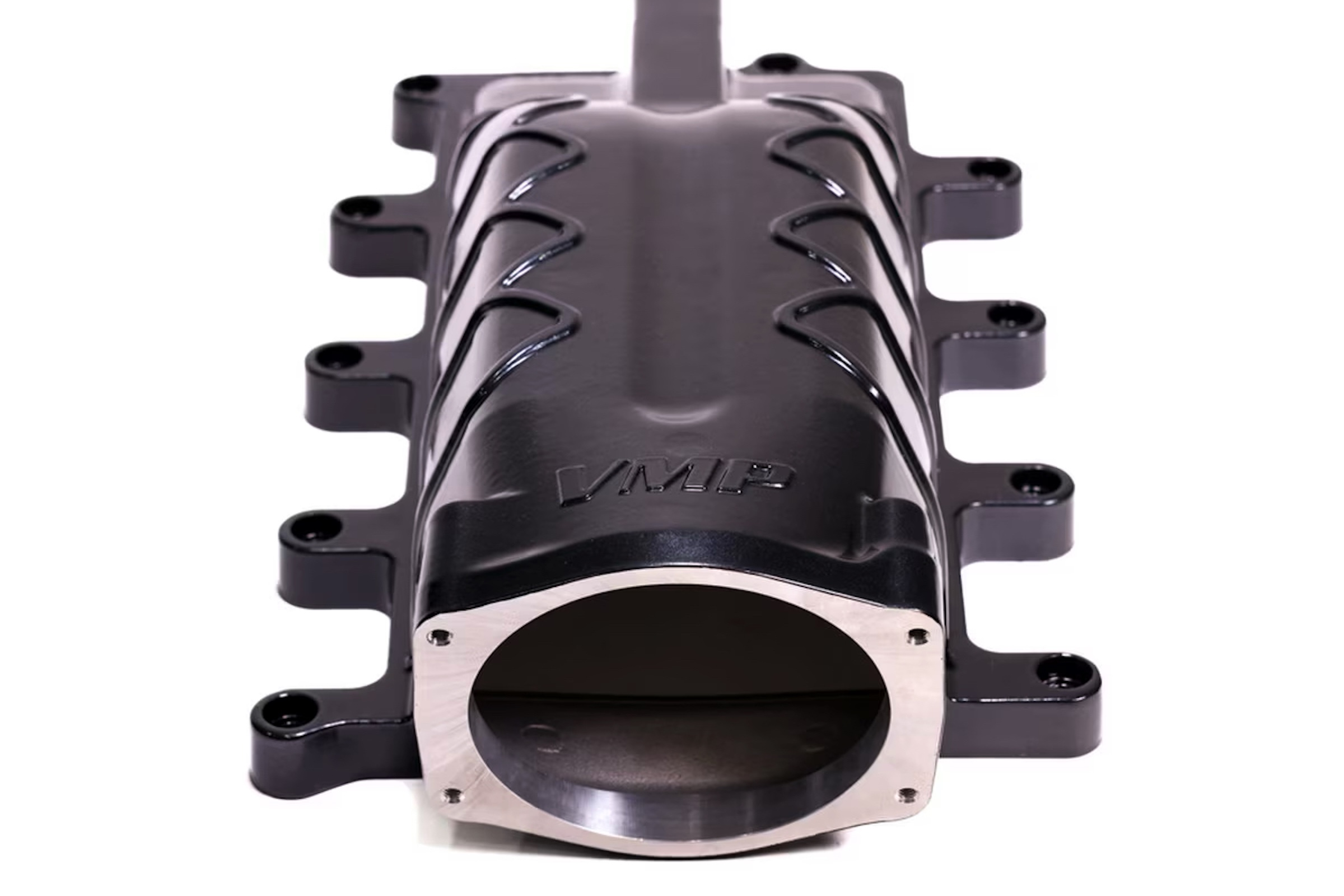
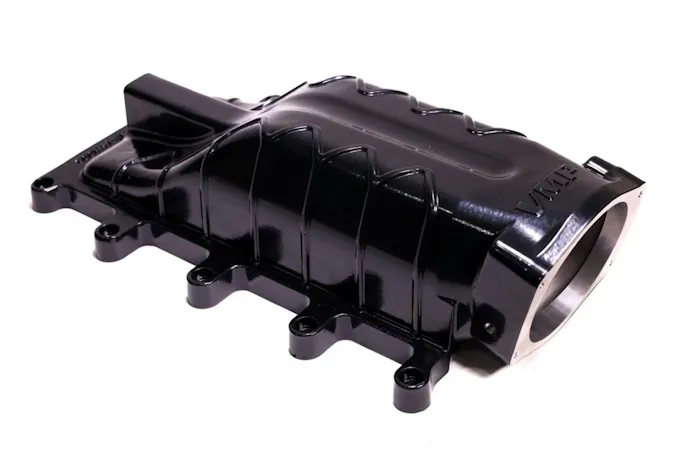
Installed on Sean Kelley’s turbocharged 1997 Mustang Cobra, the combination of the VMP Leviathan Turbo Hat in Gloss Black (P/N: VMP-LVN110; $999.99) and the VMP Leviathan Lower Intake Manifold for Gen 1-3 Coyotes (P/N: VMP-LVN210; $1,999.99) was designed to bring VMP’s extensive air-to-water intercooling experience to high-horsepower turbo applications. While the system promises improved cooling, streamlined packaging, and minimal restriction, Kelley’s drag-and-drive Cobra offered an ideal opportunity to see how the design’s efficacy translated to the real world.
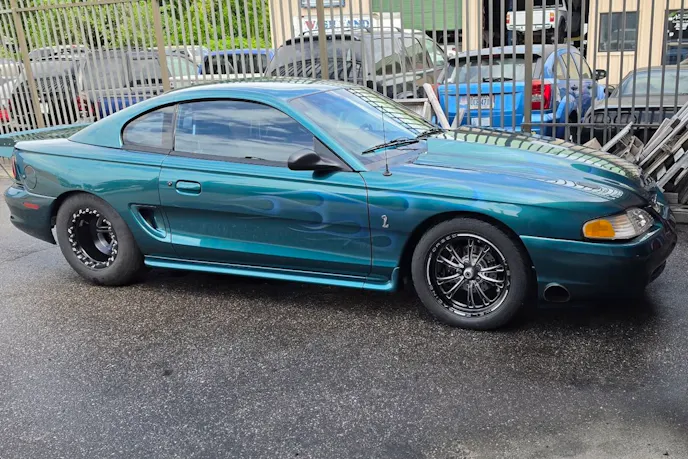
Kelley’s SN-95 is a purpose-built drag-and-drive machine featuring a 25.3-spec chassis; a Gen 2 Coyote with forged rods, forged pistons, and upgraded camshafts; a Powerglide transmission; and a Neil Chance converter. The combination still utilizes a built-and-braced 8.8-inch rearend, reflecting the car’s dual-purpose mission of surviving both street miles and hard dragstrip launches. While the current engine is relatively modest by modern radial-racing standards, Kelley has a sleeved TKM short-block waiting in the wings. He plans to push the combination into the 1,500- to 1,800-horsepower range once development progresses.
The move away from a traditional front-mounted air-to-air intercooler wasn’t simply about chasing a bigger dyno number. Kelley wanted a cleaner, more compact package that better suited the drag-and-drive events and street outings that make up much of the car’s workload.
Simple Solution
“I wanted to try it out and simplify the engine bay,” he explained. “The old air-to-air took up a lot of space and blocked airflow to the radiator, which made the car run a little warmer than I wanted. I made a few other cooling system changes, as well, that helped out.”
That search for a more efficient solution led Kelley to VMP Performance founder Justin Starkey. Having known Starkey and his wife Rebecca since the early days of the Coyote platform, Kelley originally contacted him looking for one of VMP’s existing lower intake manifolds and planned to fabricate a custom upper section himself. Instead, he learned VMP was already developing something purpose-built for exactly the type of application he had in mind.
“I have had a relationship with Justin and Rebecca since back in the early Coyote days, and he came to mind when I started thinking about changing setups, and I thought of using one of his VMP lower intakes and just making a custom upper,” Kelley said. “He was excited about this project and asked me if I was interested in working with him to test it out. Of course, I was really interested and excited in doing this once he explained some of the differences in this lower intake setup compared to what was currently being used for the VMP blower setups.”
While Kelley sought a solution for his turbocharged combination, VMP founder Justin Starkey was already exploring ways to apply the company’s extensive intercooling expertise beyond supercharged applications. Years of development on GT500 systems, Coyote supercharger packages, and VMP’s Apex Predator technology created the foundation for a new direction: a purpose-built turbo intake system that could leverage the same air-to-water cooling knowledge in a different environment.
Efficient Cooling
“At VMP, making horsepower and racing both fun and accessible is part of our core values. As we continue to expand our design and engineering capabilities, a lot of things we once thought were out of reach are now well within our grasp,” Justin Starkey explained. “While I was in the middle of refreshing some of our older product offerings, I thought, ‘Why not try this turbo hat idea?’ The truth is, all power adders run hot and need efficient cooling. We’ve focused intensely on supercharger cooling for so many years, so it made perfect sense to bring that hard-earned expertise to the turbo crowd.”
The Leviathan Turbo Hat is designed to bolt to existing GT500-style lower intake manifolds while retaining proven air-to-water intercooling hardware. It incorporates the same found in VMP’s Apex Predator lid systems, supports multiple throttle body configurations, and maintains stock hood clearance on popular Coyote and GT500 applications.
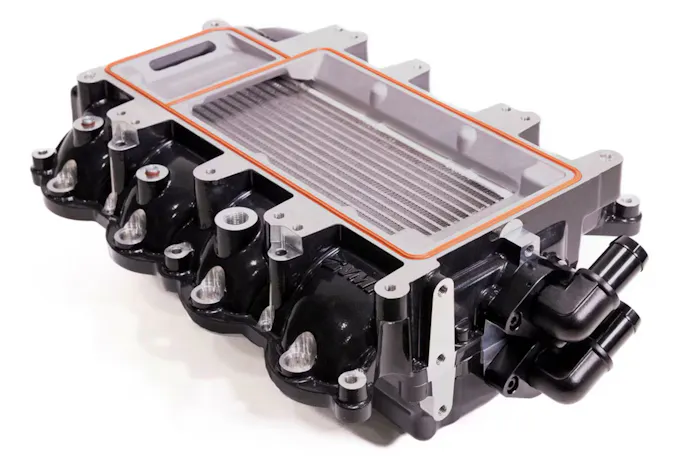
Supporting the upper section is the Leviathan Lower Intake Manifold, which consolidates years of intercooler development with patent-pending airflow technology into a single casting. Each unit ships fully assembled and includes VMP’s Street Intercooler Upgrade intercooler brick (P/N: VMP-SUC050; $999.99), a high-flow core designed to maximize cooling efficiency while maintaining strong flow characteristics. The casting also integrates common airflow improvements, supports multiple intercooler fitting configurations, and accepts aftermarket Coyote fuel rails.
“We’re supercharger people at our core, and blowers produce a lot of high-temperature air in a very concentrated area. Because of that background, our design naturally lends itself to proper distribution and maximum cooling, and Sean’s on-track results speak for themselves,” Starkey said. “We don’t put a horsepower rating on this intake because we’ve already tested it up to 2,800 rear-wheel horsepower in a car running low-4-second eighth-mile times.”
Engineering Challenge
The engineering challenge, according to Starkey, wasn’t just cooling. Rather, it was balancing that cooling efficiency with airflow efficiency across a wide performance window.
“Superchargers require a massive amount of power just to turn, and turbos do create power-robbing exhaust back pressure, so we understand the delicate balance racers must achieve,” Starkey shared. “It would be disingenuous to say we can cool anything without consequence, because cooling often comes at the cost of restriction. However, we’ve engineered around that challenge to hit the perfect sweet spot between minimal restriction, optimal distribution, and maximum cooling.”
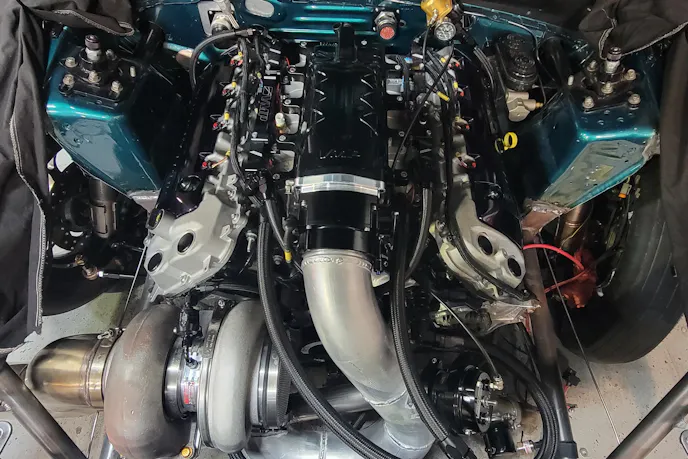
The first track outing delivered the kind of data that validates the concept. Running only water through the intercooler system with no ice, Kelley recorded inlet air temperatures 144 degrees cooler than the previous air-to-air setup while seeing only about 1 psi of pressure drop through the intercooler brick. The revised combination also improved engine-bay packaging and freed airflow to the radiator, both important considerations for a car that spends time on the street between passes.
“Street/strip and drag-and-drive cars stand to benefit the most from a setup like the Leviathan,” Starkey said. “The ultra-short piping runs and near-zero pressure drop allow for incredibly precise, controllable boost levels. That predictable power delivery is exactly what you need when you’re trying to navigate varying race-track surface conditions.”
Real-World Results
That philosophy showed up immediately in Kelley’s early data. Beyond the dramatic temperature reduction, the minimal pressure drop suggests the turbo system is operating more efficiently to achieve target boost levels.
“Sean is seeing only 1 psi of pressure drop through our intake, which means his turbos don’t have to work as hard and that power-robbing backpressure stays lower,” Starkey said. “Adding ice into the mix will allow him to safely command higher boost levels, especially when fighting adverse weather conditions. It’s going to be a game-changer on those punishingly hot summer days typical of drag-and-drive events like Sick Summer and Hot Rod Drag Week.”
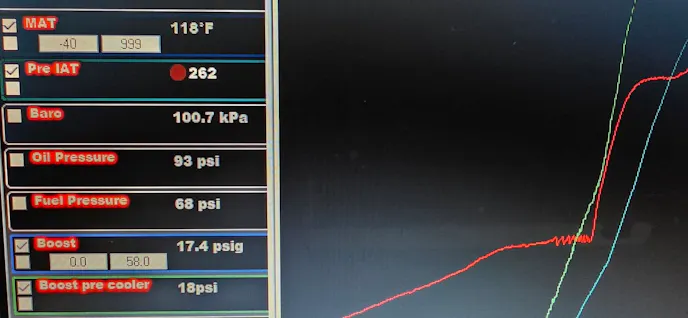
For Kelley, the results are encouraging but still early in the development curve. The car remains on conservative boost while he dials in the chassis and prepares for the upgraded engine combination.
“With the new short-block going in, I plan to push this thing up into the 1,500- to 1,800-horsepower range,” Kelley said. “Probably will keep it on the lower side of that range for my drag-and-drive races and turn it up for our local 10.5-type races.”
Promising Option
Future testing will include ice in the intercooler system and additional boost as the combination comes fully online, but even at this early stage, the results are promising. This intercooled intake is ready to unlock the potential of his twin-turbo combo, and there is likely more on the table as he optimizes the combination.
“We will use ice for sure. Just didn’t get a chance to get that far on the first outing,” Kelley said. “Was just trying to get the chassis sorted first on lower boost and wanted to see how it would do on just water that way.”
With additional testing ahead and significantly more horsepower on tap, the Leviathan intake looks like a serious option for turbo Coyote racers looking to simplify packaging while improving thermal efficiency and consistency in demanding conditions on the street and race track.
You might also like
First Drive! The 795HP Dark Horse SC Does It All In Dominating Fashion
We drove the 2026 Mustang Dark Horse SC on the street and track. It is an impressive machine, and the Track Package is the star of the show.