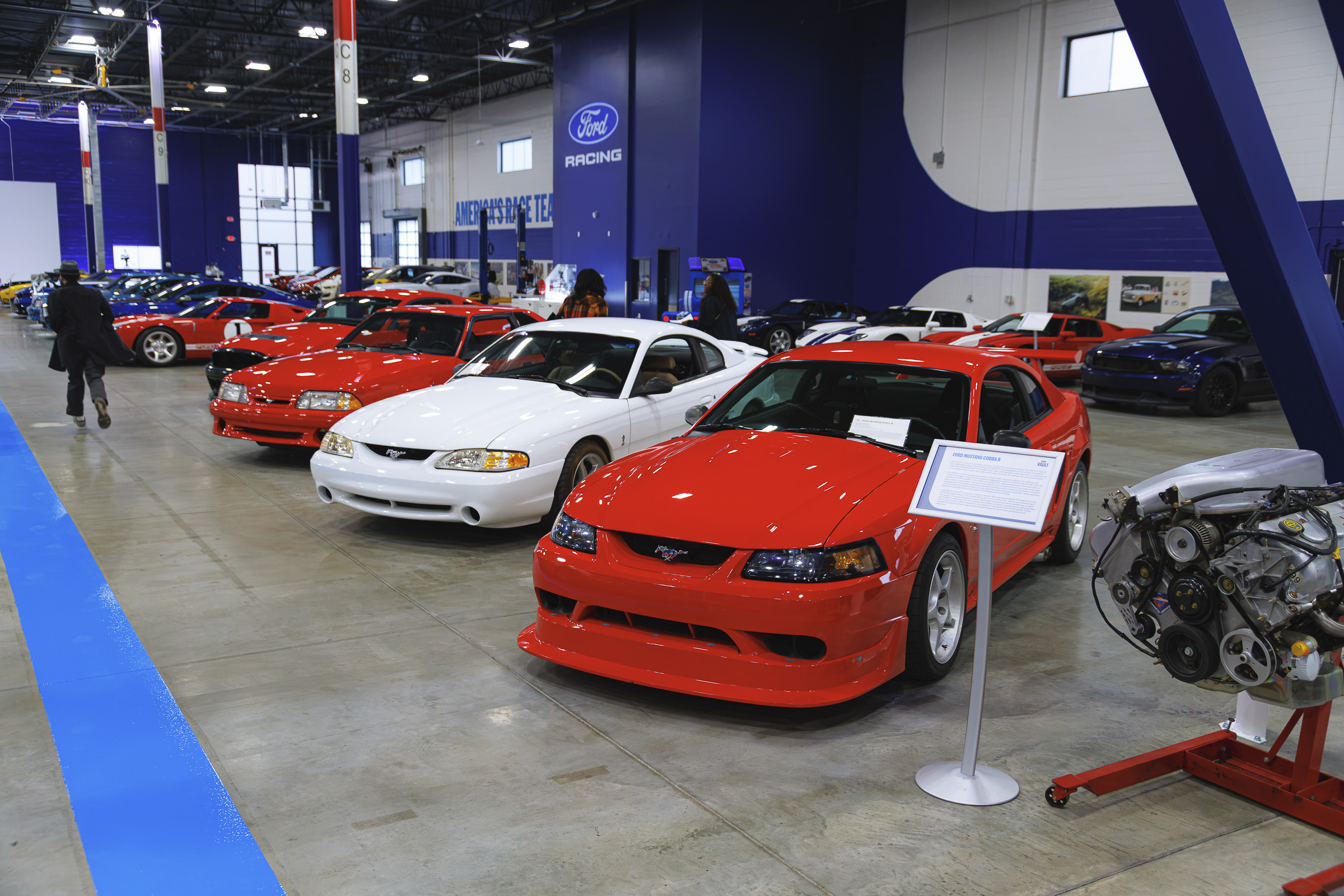
The smell of fresh paint and construction filled the air, but the floor already had a message for visitors: “All Roads Start With Ford.” A blue-striped roadway winds through the collection, linking one era to the next, and near the entrance, a 1965 Mustang that once paced the Indianapolis 500 greets you on a rotating display. That was the first sign Ford had not simply parked its history in a warehouse to collect dust.

The warehouse part is literal. The Ford Vault covers about 79,000 square feet. Roughly 125 vehicles from Ford’s Heritage Fleet now live there. For years, those cars were scattered across engineering departments, Ford Performance, and outdoor storage lots. We even heard stories of employees who hid cars away to prevent them from being crushed, and we’re glad they did.
Ford began pulling the effort together in 2024 and gave the public a taste in March 2025 with a display of more than 50 cars in a temporary home inside the retired Ford World Headquarters. The Ford Vault is the first time the vehicles have a proper, permanent home.

Guided Tour
Last week, Ford brought media in for a guided preview, and the tour had three hosts. Ted Ryan, Archives and Heritage Brand Manager, opened the day and led us through the first half of the building. Nick Terzes, Ford Racing Heritage Business Manager, took over for the racing collection. Gordon Platto, Design Director for Design Excellence, closed with the design section and the concepts. Employees and community members got their turn on Saturday, November 14, and we’ve been told spots filled up in just a matter of hours.
Ford calls the Vault a working resource. Designers, engineers, and product teams can use these cars as reference for what comes next. The collection exists partly because carmakers historically crushed or dismantled prototypes once the work was done. The cars here survived because someone along the way decided they mattered.

Unseen Treasures
That attitude explains some of the best Mustang stories in the building. Take the 2005 Mustang GT nicknamed “Johnny Cash,“ the first prototype for the 2015 GT350. Engineers gave it that name because it was built one piece at a time. Under the hood sits a prototype 4.6-liter, flat-plane-crank V8 that had spent years in storage. The independent rear suspension is modified from an ’03 SVT Cobra, and the transmission and driveshaft came from a 2013 GT500. Everything except the headers, alternator, and battery was borrowed from other test cars. You can trace a straight line from this hot-rod mule to the production Shelby GT350.

A 2011 GT500 sits nearby. Previously used as a vehicle dynamics test car and was used to tune and validate the 2013 GT500 program, including time at the Nürburgring. The Mustang lineup also includes SVT Cobra R models from 1993, 1995, and 2000, the Boss 351 concept, the 10 millionth Mustang, and the final Mustang built at Dearborn Assembly in May 2004. Production started in Dearborn in 1964, so that last car closes a long chapter.

Not every vehicle here is about performance. A 1973 convertible from The Mary Tyler Moore Show is on display. It began as a Ford Twin Cities office car loaned to the show’s producer, was sold in 1974, stayed in private hands until Ford bought it back in 2025, and still wears its original interior. Then there is the bright orange Mustang Ute, a hand-built pickup-style one-off made by apprentices in the EVB/NMPDC metal and body shops as a real-world training exercise. It was never a production proposal, and that is the charm.

Racing Through History
The racing section is where the history gets heavy. Ford’s 1966 Le Mans sweep, with the Bruce McLaren and Chris Amon GT40s leading a 1-2-3 finish, is represented by GT40 machinery you can walk right up to. They even have a photo rig set up where you can grab a photo with all three iconic GT40s and have it immediately sent your way.

Among the headline new additions is the 1998 Stewart SF02 Formula 1 car, powered by a 3.0-liter Zetec-R V10 making 735 horsepower at 18,000 rpm. Rubens Barrichello, Jan Magnussen and Jos Verstappen all drove for Stewart, which later became Jaguar F1. Ford eventually sold that operation to Red Bull, creating the modern Red Bull Racing.

The engineers get their moment as well. A stock, production 2021 Bronco Wildtrak nicknamed “Pepper” was raced in the 2022 NORRA 1000 by Ford engineers and finished without major issues. And the three original 2005 Ford GT prototypes are back together: Job 1 in Centennial White with a blue stripe, Job 2 in Mark IV Red with a white stripe, and Job 3 in Midnight Blue Metallic.
They were unveiled at Ford’s centennial celebration at the Glass House in 2003 and have not been shown as a trio since. Job 3 was repainted in 2006 Heritage Edition colors to launch that package, and it has since returned to its original Midnight Blue.
Beyond Racing
Other additions deserve a mention too: a 1941 Ford GP, Ford’s wartime Jeep-type vehicle, built on a modified Ford 9N tractor engine and transmission, and a green 1911 right-hand-drive Model T that came over from the U.K. in 2025. Jay Leno’s 1934 Flathead Ford pickup also greets you as one of the first vehicles you see upon entering the facility.

Walk toward the back and you’ll find about 30 of them have not been seen since their original unveilings, and many people assumed they no longer existed. The early 1960s Cougar II is among them, and the wider collection stretches well beyond Mustang, with a 1992 Michigan State Police Fox Mustang coupe, a Bronco tied to James Garner’s off-road racing days, and Super Duty concepts.
For enthusiasts, the bigger story is that Ford treats prototypes, development cars and one-offs with the same respect as the famous winners. For anyone who cares about how a Mustang or a GT actually gets made, these are the cars that explain it.

Ford hasn’t announced when the general public might be able to visit the Vault, so for now access depends on special events. Keep an eye on Ford’s channels, because a collection this good is one you don’t want to miss out on seeing.
You might also like
One Can Of LIQUI MOLY’s Catalytic System Cleaner Can Clear Your Code
LIQUI MOLY’s Catalytic System Cleaner targets fuel-system deposits that trigger P0420 codes. One treatment might turn off your dash light.