If you are an old-school hot-rodder, the idea of generating 700 horsepower from a factory 3.0-liter engine sounds absolutely nuts. Thanks to strong OEM engine design, a deep aftermarket, and clever modern tuning, that idea is a proven reality. For example, Nathan “Dirt” Derrick made that kind of power with his pickup powered by Ford’s twin-turbo 3.0-liter EcoBoost V6.
“I miss the performance trucks of my youth: the Cyclone, Lightning (the gas one), Ram Viper truck, etc. My older brother had a new ’93 Ford GT with a supercharger, nitrous, and chrome five-stars. It was beautiful, and the fastest thing I had ever been in. I followed in his footsteps/foothills and loved anything with a motor. We were riding it, racing it, wrecking it, building it, etc.,” Derrick recalled. “Fast forward to the F-150 Coyote blower builds that are going crazy. I bought one to build. Then I saw that the Ranger Raptor was coming to the US. I told my dealer I wanted one…”
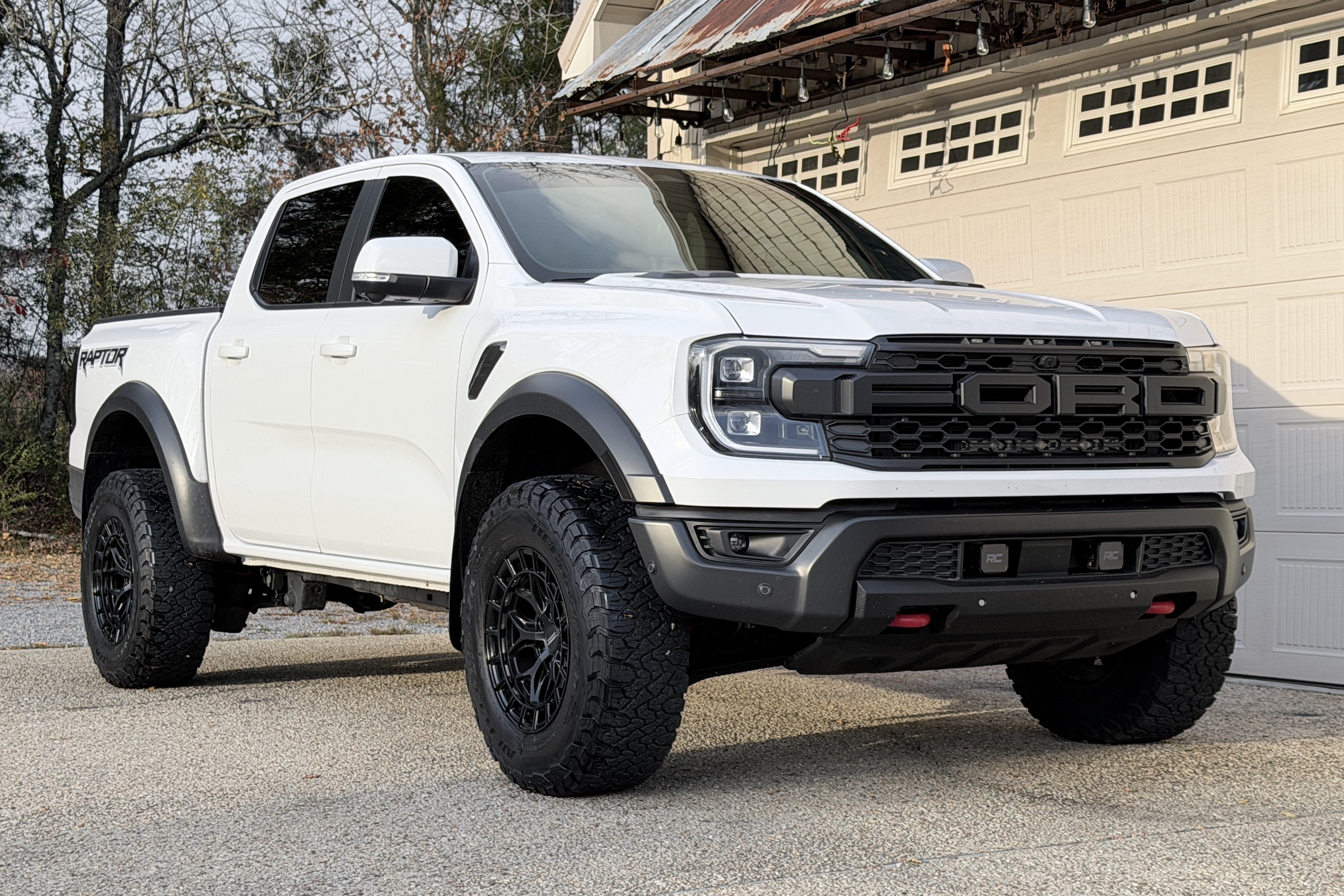
What began as a clean, street-friendly 2024 Ford Ranger Raptor quickly escalated into one of the more impressive EcoBoost truck builds around. From the start, Derrick partnered with Adam Staszak, owner and lead tuner at ZFG Racing, to chart a path toward four-digit crankshaft potential while maintaining the truck’s usability and mechanical soundness. That collaboration dates back to the earliest days of Ranger Raptor tuning in the U.S., when this truck became one of the first examples successfully unlocked and tuned using HP Tuners hardware through a creative ECU solution adapted from the F-150 platform.
“Much like other EcoBoost engines, the best part of these engines is their ability to be modified and turned up,” Staszak said. “Our 93-octane tunes on their own typically pick up 60 to 90 horsepower and 70 lb-ft at the wheels, and with e50, you are looking at gains of 125 horsepower and over 100 lb-ft. That’s tune-only! That is why people love them. Enthusiasts love making modifications to the EcoBoost platforms because they produce large gains and really change the seat-of-the-pants feel of the trucks.”
Turbocharged Testing
Early testing focused on bolt-ons and pump gas, and even then, the 3.0-liter EcoBoost showed why it has earned a reputation for strength. As the build evolved and the horsepower goal crept upward, the turbocharger limitations became evident. Off-the-shelf Garrett PowerMax turbos delivered gains, but once the target shifted firmly and 700 rear-wheel horsepower, airflow, and efficiency at higher rpm became the priorities.
“Much like the sister engine in the 3.0-liter Explorer that we are very familiar with, they bring strength and reliability to the table, being an engine that Ford designed from the ground up to be an EcoBoost versus other architectures, like the 3.5-liter, that are based on NA engines. Despite being the same family of engines as the Explorer 3.0-liter, there are some key differences. The compression ratio is higher (10.5:1 vs. 9.5:1) than the Explorer, which provides better throttle response off boost, better spool, and more overall power potential, especially on ethanol-based fuels,” Staszak explained. “The Integrated Exhaust Manifold is positioned differently and has different flanges of similar size but completely different turbos. Inside the engine, the lower block is completely different. The Ranger Raptor/Bronco Raptor has a much better lower block design that ties into each main cap, which helps to stabilize the main caps and prevent them from moving around, which is a common issue we have on high-horsepower Explorers.”
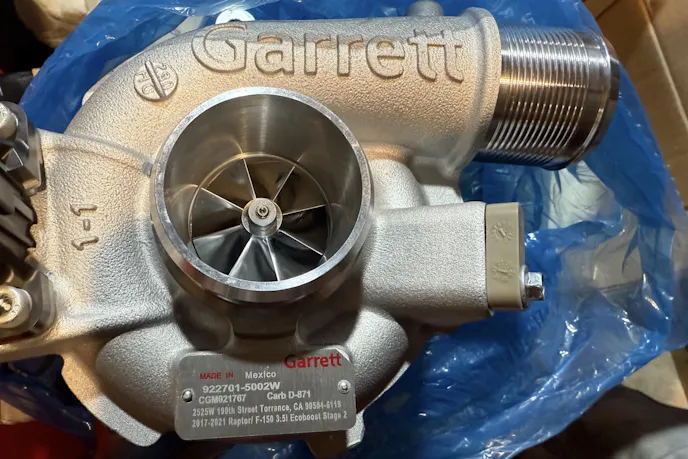
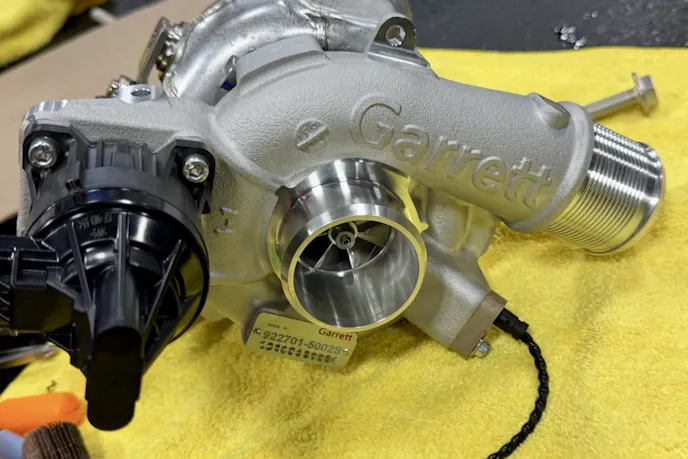
The solution came in the form of turbos modified by TurboBay. Starting with Garrett PowerMax units, the turbos were modified with larger compressor wheels to increase airflow and reduce shaft-speed stress under big boost.
“The off-the-shelf Garrett turbo, which is a great turbo, don’t get me wrong, it’s capable of adding 60 to 70 horsepower all day long on a 3.0-liter, but it can leave people wanting more, especially with the amount of money spent and work to swap turbos,” Staszak explained. “Modifying the Garrett turbos with a bigger compressor, which really unlocks their potential and pushes the gains to 120-plus horsepower. There are some drawbacks to these turbos; you lose some spool, but it’s manageable with an aftermarket turbo, and you gain a lot more usable power past 6,000 rpm.
Supporting Mods
The supporting airflow improvements are just as critical. The intake and throttle body were ported and polished by GPE to reduce restriction and improve efficiency, while CVF Performance charge pipes replaced the factory plumbing with larger-diameter aluminum tubing on both the hot and cold sides. A Wagner Tuning intercooler with nearly 70 percent more volume than the stock unit keeps intake air temperatures in check when the boost is turned up.
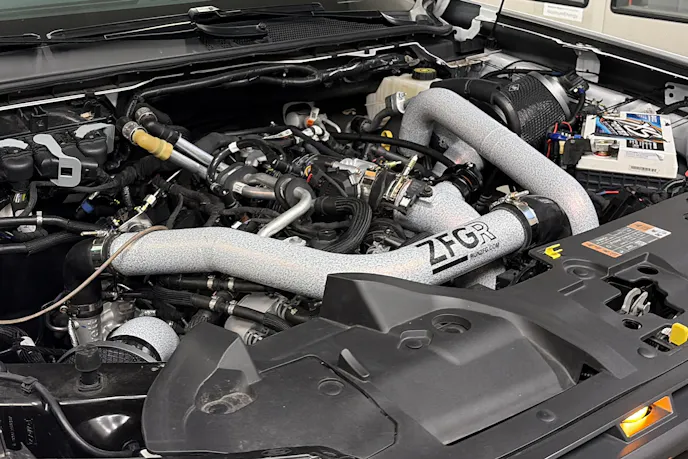
“Traditionally, on the EcoBoost, like the F-150, intakes have not played that big of a part. The factory intakes were not horrible, and the pressure drop wasn’t really that bad. On the Rangers and Broncos, both 2.7- and 3.0-liter, the factory intakes are terrible with a very large pressure drop as you try to turn the boost up,” Staszak said. “On cars where the wastegate duty cycle was maxed out at 100 percent (turbos over speed), we have seen as much as a 30- or 40-horsepower gain on the dyno from changing intakes and adjusting the tunes after, and still having margin in the wastegate duty cycle. We have not seen gains like this on any other stock turbo EcoBoost platform from intake upgrades.”
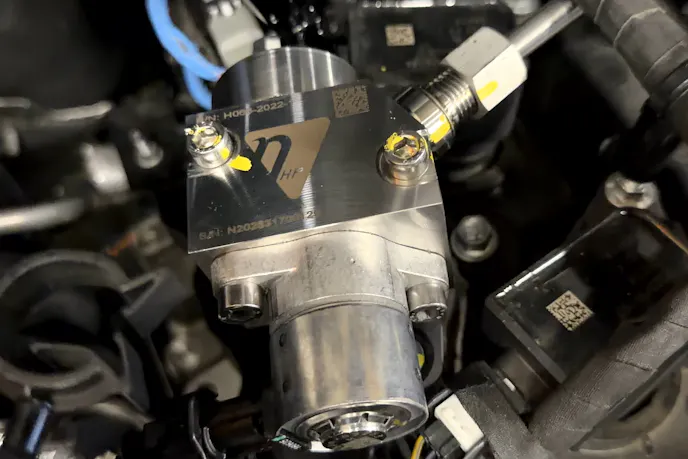
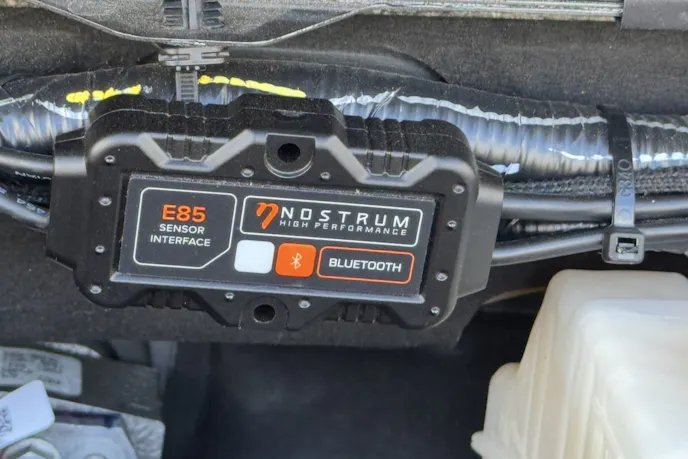
A fuel system capable of pumping a plentiful volume of ethanol-rich fuel was a necessity. Nostrum Stage 3 injectors and a Goliath high-pressure fuel pump provide the necessary headroom to safely run pump E85. An ESSIM Ethanol content Bluetooth reader keeps the ECU informed, allowing the tuning to take full advantage of the fuel’s knock resistance and power potential and adjust for the mix of pump fuel, which varies in step with the weather.
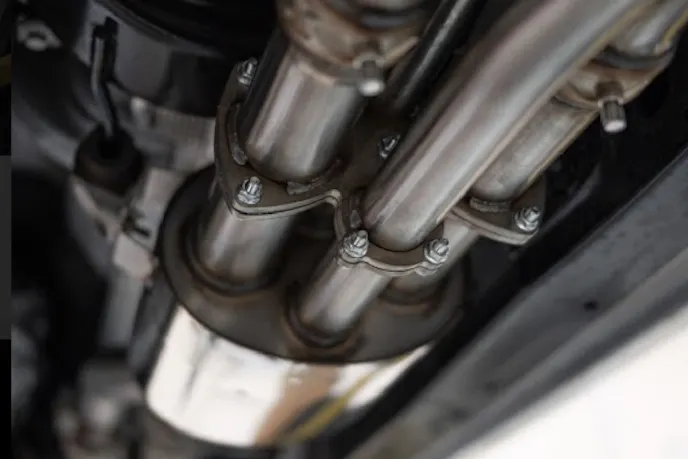
On the exhaust side, a carefully matched hardware combination minimizes backpressure without sacrificing street manners. SPD Performance stainless downpipes with high-flow catalytic converters feed into an HAE Performance equal-length midpipe and Borla polyphonic X-pipe, while a Milltek valved exhaust completes the system with a refined but aggressive sound.
Impressive Output
All of this comes together under a custom calibration from Staszak at ZFG Racing via HP Tuners software and hardware. The tuning carefully manages torque to protect the 10R60 transmission. To support the added output, the truck also benefits from some Suncoast transmission upgrades, improved cooling, stronger driveline components, and brake enhancements suited for real-world use.
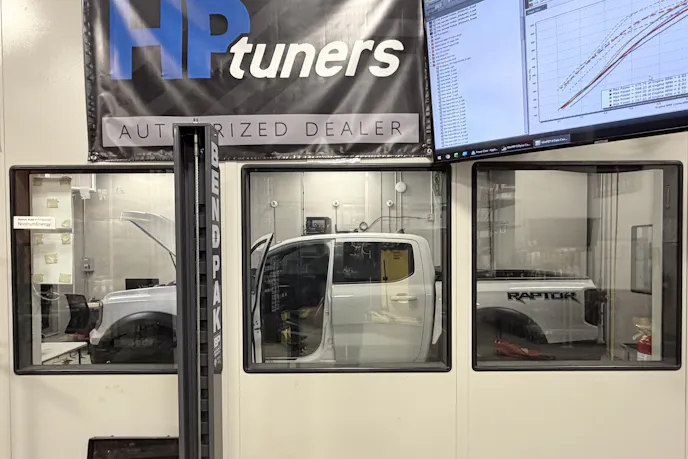
“The one thing you have to be careful of with these is the fact that they do have a 10R60 (just like the Bronco Raptor), and you do have to manage the torque and keep it at a sensible number, around 530 to 550 lb-ft. Also, the factory trans tune uses a good amount of ‘clutch slipping’ to kind of round off the peaks on the shifts and make them smoother,” Staszak said. “As the torque goes up, that becomes problematic and causes excess heat and wear and tear on the clutches. So, we adjust the trans tuning to make the shifts quick and firmer to minimize the time spent slipping the clutches when shifting, and this significantly increases the lift span at that 520 to 550 lb-ft range. The good news is that there are plenty of options available for built transmissions for these.”
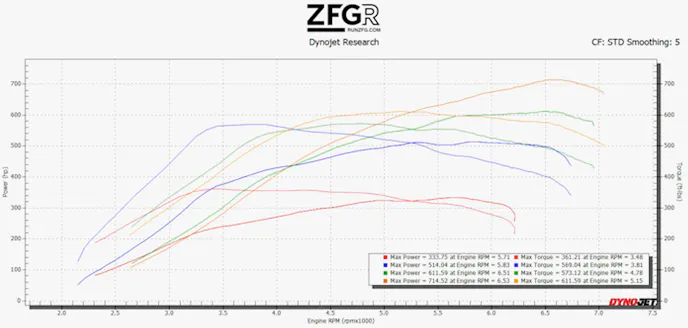
When Derrick’s Ranger Raptor hit the dyno on E85, the result was undeniable. The 3.0-liter EcoBoost delivered more than 714.52 horsepower and 611.59 lb-ft of torque at the rear wheels.
“It still feels stock, which is what we were after, but with smoother power delivery, better starting, and the transmission feels electric smooth. When you put it in Sport/Track mode, it will run a sub-3-second 0-60 in a 5,300-pound truck that is very stable at racetrack speeds,” Derrick enthused. “We more than doubled the stock 336 rear-wheel factory horsepower at 714 rear wheel horsepower, and it just keeps pulling.”
More On The Table?
There was likely a bit left in the combination, but they played it safe as the modified transmission wasn’t yet fully fortified for higher outputs.
“All I can say for sure is we walked away from dyno having met Nathan’s 700 wheel horsepower goal with turbo and spark advance on the table yet! I do look forward to pushing it harder and finding the next weak spot,” Staszak added. “We are currently having the first (that I know of) built short-block put together for the 3.0-liter Ranger/Bronco featuring our spec pistons, rods, and some main studs to help lock in the bottom end. So, we will be ready to take the next step when it’s time.”
700HP 2024 Ford Ranger Raptor Mods
Turbochargers
Garrett PowerMax Turbos
DirtD Signature R Modification By TurboBay
Garrett Bluetooth Speed Sensors
Fuel System
Nostrum Stage 3 injectors
Goliath High-Pressure Fuel Pump
ESSIM Ethanol Content Bluetooth Reader
Fuel
Pump e85 (average e71)
Exhaust
SPD Performance 304 Stainless Downpipes With Custom 400-Cell High-Flow Cats
HAE Performance 3-inch 304 Stainless Steel Equal-Length Midpipe
Borla Polyphonic Mufflers Into An X-pipe
Milltek Performance 3-Inch Valved Exhaust T304L Stainless Steel After-Cat Exhaust With 4.5-Inch Tips
Induction
Weapon R Air Filters
Dual Direct-Flow Weapon R intakes
GPE Ported & Polished Throttle Body
GPE Ported & Polished Intake Manifold
CVF Performance Charge Pipes:
3-Inch Cold Side and 2.5-Inch Hot Side Aluminum With Palleon Fire Powder Coated
Tial Cold Pipe Adapter For TurboSmart Raceport
Wagner Tuning Intercooler
Brakes
DBA 4000 Series Slotted Rotors
DBA Front Pads
EBC Yellow Stuff Rear Pads
Dot 4 High-Temp Brake Fluid
Drivetrain
Suncoast Performance 3.0L EcoBoost 10R60 Category 3 Extra-Capacity Rebuild Kit Suncoast Performance Pro-Lov Valvebody
Suncoast Performance 260MM Pro-Loc 10R60 Torque Converter
Suncoast Performance 10R60 Stock-Capacity Transmission Pan
Suncoast Performance Ultra-Low Viscosity Transmission Fluid
Knoxville Driveline One-Piece Aluminum Driveshaft
Cooling System
SPD Performance 170-degree performance Ford Thermostats
CSF Heavy-Duty Aluminum Radiator
Aluminum Coolant Overflow Tank
DEI Heat Control
Tie Rods
RoughCountry HD Forged Tie Rods
Tuning
ZFG Racing E85 and 93-Octane Custom Tuning
HP Tuners MPVI4
With more mods in the offing, this Ranger Raptor isn’t done pumping out big numbers. Derrick seems to enjoy pushing this platform to higher levels of performance while retaining its usability, and perhaps more impressive is that he is comfortable doing this with the truck his wife drives on the regular.
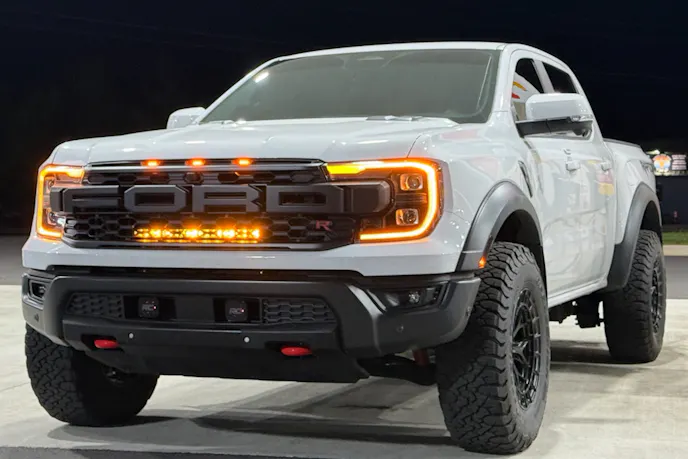
“We know it has a lot more in it, potentially 750 horsepower and 750 lb-ft of torque at the tires, and we will get there soon. Then I plan to actually drive it and enjoy it. We purchased two Ranger Raptors, and they stay on the road getting tested, modified, etc.,” Derrick added. “Our gray one stays looking more like Frankenstein’s monster with all the test parts. The white one has a clean, classy, more factory sleeper look. You may be talking to my wife next time, she loves it, and has named it Snow White. I start praying when I hear her leave in Baja mode…”
You might also like
The Punisher Celebrates Raptor’s Origin Story In New Ford Racing Commercial
Ford Racing revisits the Raptor’s origins in a new Ben Affleck-directed ad. Jon Bernthal narrates the story of the engineers who made it.