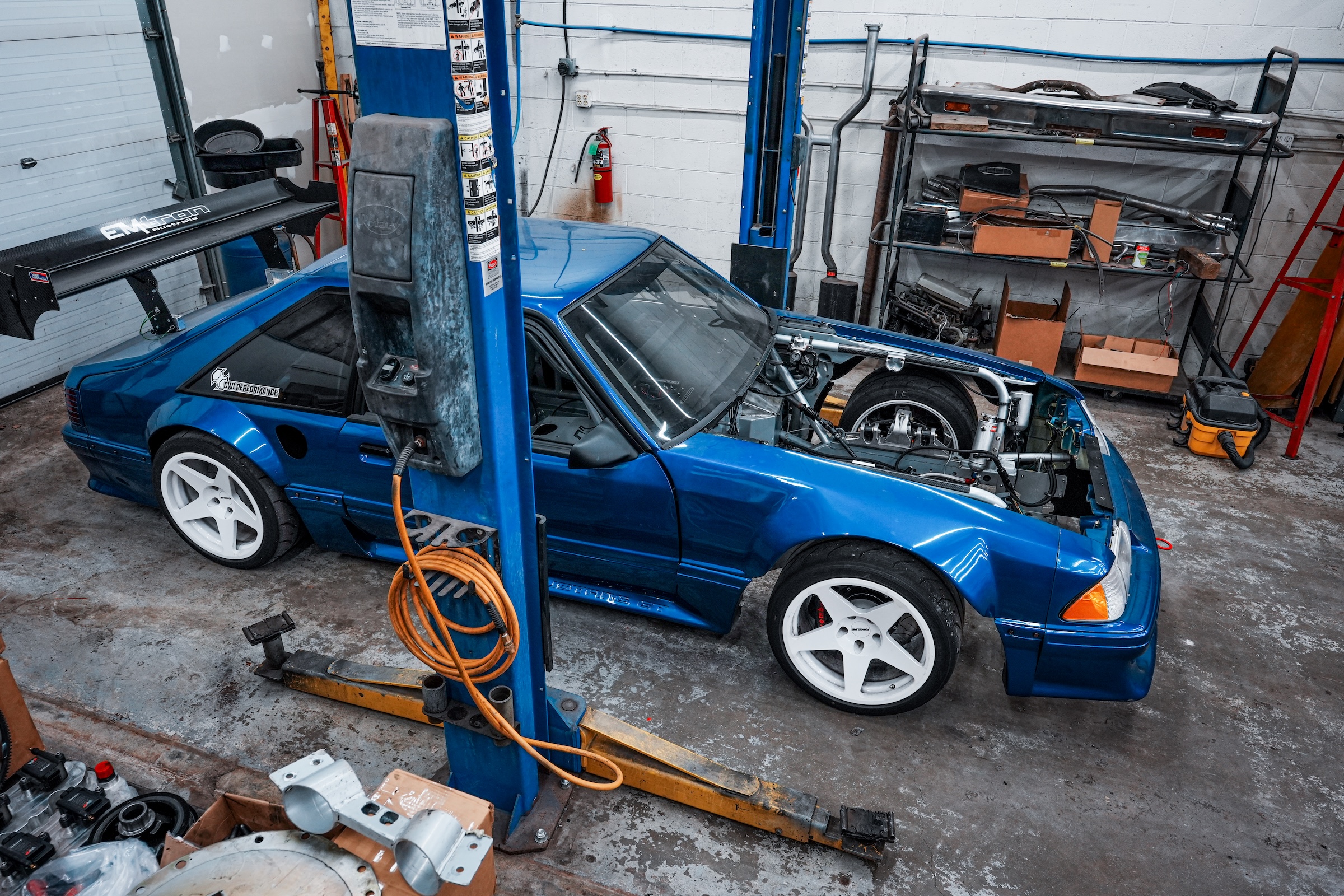
If the name Foxzilla sounds familiar, it is a Fox Mustang project that made a splash at the SEMA Show as one of the first to make use of the 7.3-liter Godzilla engine. Designed as a do-it-all performer that competed in the Optima Ultimate Street Car Challenge and other performance venues, it made quite a splash. However, for the team at Creative Werks, Inc., it was time to take it up a notch with some modern updates, which they are documenting in a new video series.
Foxzilla is rising up again, but this time the team is rethinking the entire combination. Bob and Preston Folkestad are replacing the previous supercharged Godzilla setup with a naturally aspirated 7.3-liter V8, pairing it with a ZF 8HP automatic transmission and adding modern traction control, ABS, and updated electronics, which is a similar path to the Horsepower Wars: Fox v Ferrari Mustang build.
“The original car gave us a place to develop products, test ideas, and, more importantly, figure out what happens when something gets pushed hard. Some of those lessons made their way into products. Others simply taught us what not to do the next time around,” Bob Folkestad, President of Creative Werks, Inc., said.
The goal is to create a capable track car that doubles as a development platform for companies including Indy Power Products, Emtron, Detroit Speed, Creative Werks, and GC Cooling. Rather than chasing power numbers alone, the team wants to test products under real-world conditions, where sustained loads, chassis dynamics, and thermal demands reveal what an engine dyno cannot.
Natural Wonder
The previous Foxzilla combination reportedly produced 1,000 horsepower with a supercharged 7.3-liter Godzilla. This time, the team wants to explore what the big-displacement Ford V8 can do without forced induction, targeting more than 800 horsepower while building a package suited to road-course use.
During an initial planning session, Preston Folkestad met with Jim Ryder of Indy Power Products and development driver Billy Johnson to discuss the engine, transmission, and control systems. The proposed engine package includes an eight-stack intake, cylinder-head development, and a solid-roller valvetrain, with the preliminary plan calling for engine speeds around 8,000 rpm and power approaching 900 horsepower.
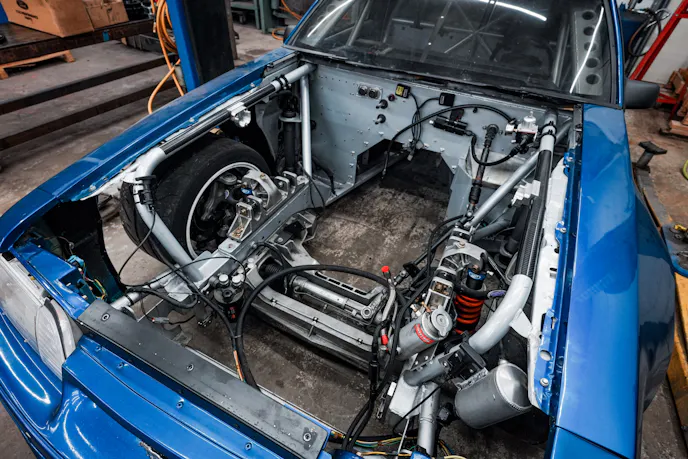
Those are development targets, not completed results, but the strategy has merit. Removing the supercharger and its air-to-water intercooling system also eliminates associated weight from the nose, while allowing the team to concentrate on the engine’s oiling system and other components under development.
Foxzilla previously helped Indy Power Products evaluate oiling-system hardware at tracks including Road America. The new combination will continue that work, giving the company another opportunity to test its components under actual vehicle loads.
Enter The 8HP
The transmission swap is one of the most significant changes. Foxzilla previously used a six-speed manual, but the team believes the ZF 8HP’s fast, repeatable shifts could make the car quicker around a road course while providing a useful alternative to an expensive specialty racing transmission.
“I think a lot of race cars that I drive, I think that’s the same transmission that’s in the BMW M4 GT4, and it’s awesome,” Johnson said. “And a lot of people are putting that in all sorts of builds. So, there’s a lot of support with the transmission control module and the tuning and programming with that. And, yeah, it seems to be very stout and really good performance.”
The plan is to integrate the transmission with the car’s existing Emtron engine management ecosystem with the company’s TM16 unit, potentially avoiding the need for a separate standalone controller. However, making the hardware fit required more than bolting on an adapter.
For the uninitiated, the ZF 8HP is a family of eight-speed transmissions offered in multiple configurations depending on the original vehicle application. While the internals share a common design, differences in the case and mounting arrangement can make a big difference when adapting one to a different engine.
“It’s important to know which style of transmission you have. If you get a 4×4 style, it’s cheaper to find, but you’re going to be buying or building an adapter. If you get a 2WD version, it makes the swap a lot easier,” Bob Folkestad cautioned.
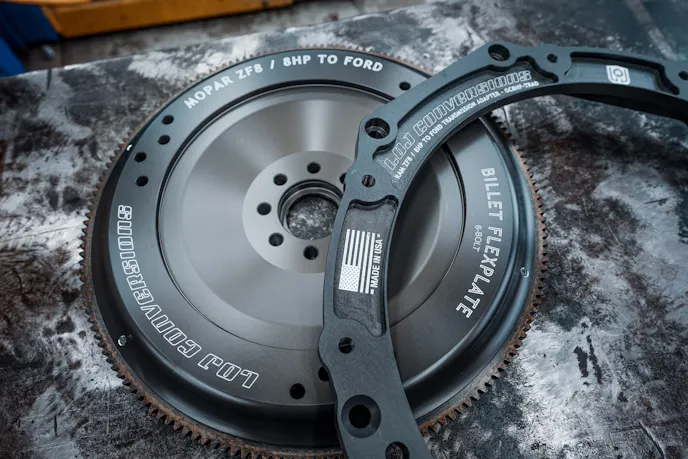
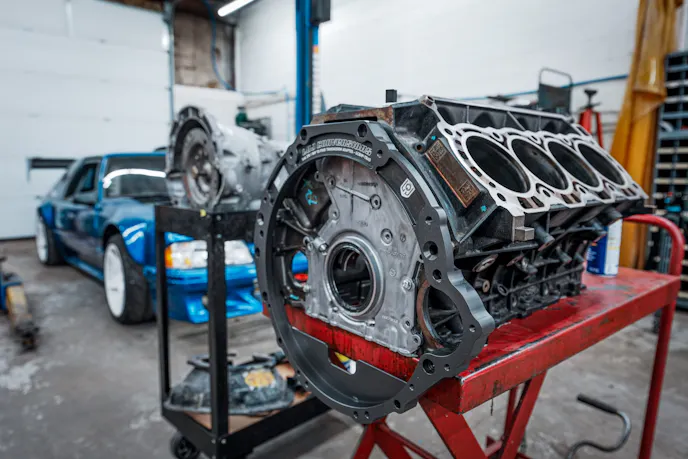
The team used an LOJ Conversions adapter plate and bellhousing arrangement to mate the mock-up Godzilla block to the 8HP. The factory Ford truck starter interfered with the transmission housing, so they had to clear space around the starter cone before assembling the components.
“Stephen (Dorrick of LOJ Conversions) and I had talked quite a bit about his experience with the 8HP. What was great to find out was that he had already designed an adapter for the 7.3-liter Godzilla, along with several other engine combinations,” Preston Folkestad, Marketing & Design at Creative Werks, Inc., said.
With the engine and transmission together, attention shifted to fitting them into Foxzilla’s heavily modified chassis.
Fabrication Challenges
The car’s low ride height and flat underbody leave little room for a larger transmission. Compared with the outgoing manual, the 8HP, as you would imagine, has a different shape, particularly around the bottom and rear of the case. The transmission needed to sit high enough to protect its pan above the car’s scrub line while leaving room for the driveshaft and exhaust.
Bob Folkestad started the custom transmission mount with a sheet-material template, shaping it around the transmission and existing mounting points. He then used an ArcDroid plasma-cutting system to reproduce the design in heavier material before refining the bracket for installation.
That hands-on approach kept the project moving, but it also highlighted the realities of swapping modern components into an older platform. Transmission dimensions, mounting points, starter clearance, and the specific 8HP variant all influence the amount of fabrication required.
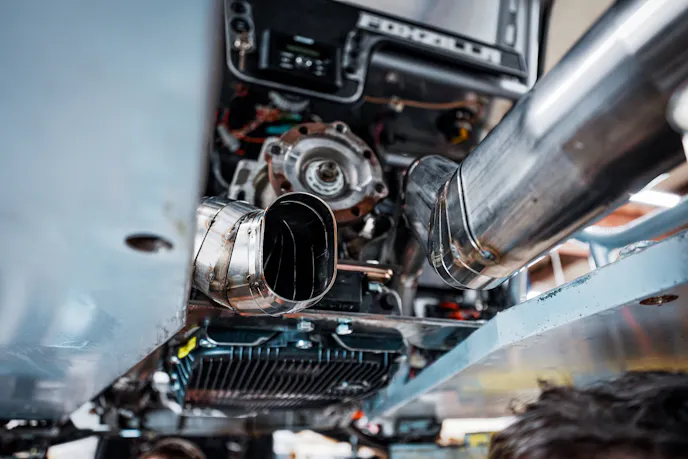
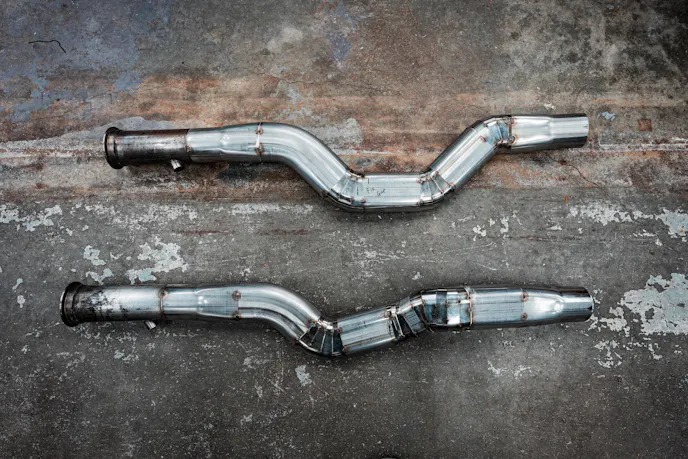
The exhaust presented another challenge. Although the existing headers fit, the piping behind required reworking around the larger transmission and restricted tunnel. The team experimented with 3-inch round tubing, a round-to-oval transition, and angled pie-cut sections to route the exhaust through the available space without rebuilding the entire tunnel.
The goal is to preserve clearance for the driveshaft and leave room for heat shielding. Final fitment and thermal protection remain on the to-do list, along with resolving the driveshaft’s transmission-side yoke or flange.
Dynamic Drivelines is helping with the new driveshaft, while the team is also evaluating whether the rearend housing needs to change to properly center the pinion. These details are critical to making the drivetrain function reliably, especially in a low car intended for hard track use.
Modern Control
The rebuild extends beyond the engine and transmission. Foxzilla is also slated to receive modern traction control and Bosch Motorsport ABS, adding systems that can improve braking consistency and make the car more manageable at the limit.
“Those systems are really advanced. We have them in pretty much all of our sports cars and IMSA cars at that level. So it would make it a little easier to drive. It would make the car really consistent for braking,” Johnson said.
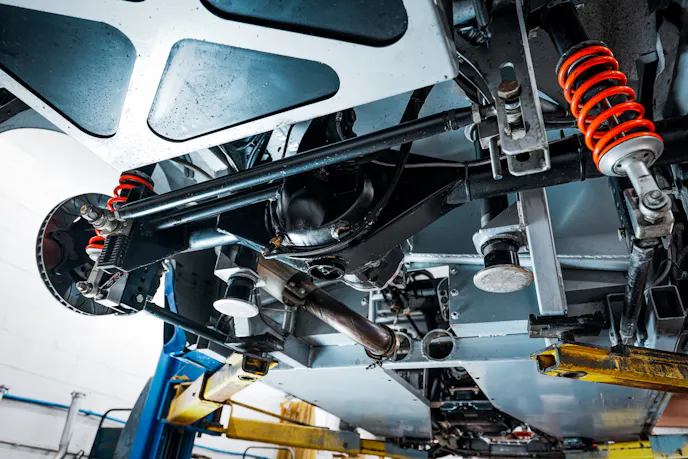
Integrating those features means coordinating the engine management, transmission electronics, wiring, and chassis sensors. The team must also address transmission cooling, oil-system plumbing, fuel-system condition, and the supporting hardware required to bring the car back to life. The existing radiator is expected to remain, though transmission cooling evaluation is ongoing.
This early part of the process is about establishing the foundation for this new combination. With the engine and transmission mocked up, the custom mount is taking shape, and the exhaust is being adapted to the tight confines of the chassis. Plenty of integration and testing remain before the car can demonstrate what the new package will deliver.
Next up, the Foxzilla saga will follow the team through the remaining packaging and fabrication work, drivetrain integration, cooling and accessory-drive considerations, oiling-system development, and the solutions required to bring this modernized Fox Mustang closer to the track.
You might also like
JEGS Launches A New Website To Make It Easier To Find Your Next Mod
The performance parts retailer completely overhauled its digital storefront with live inventory tracking and more accurate fitment data.