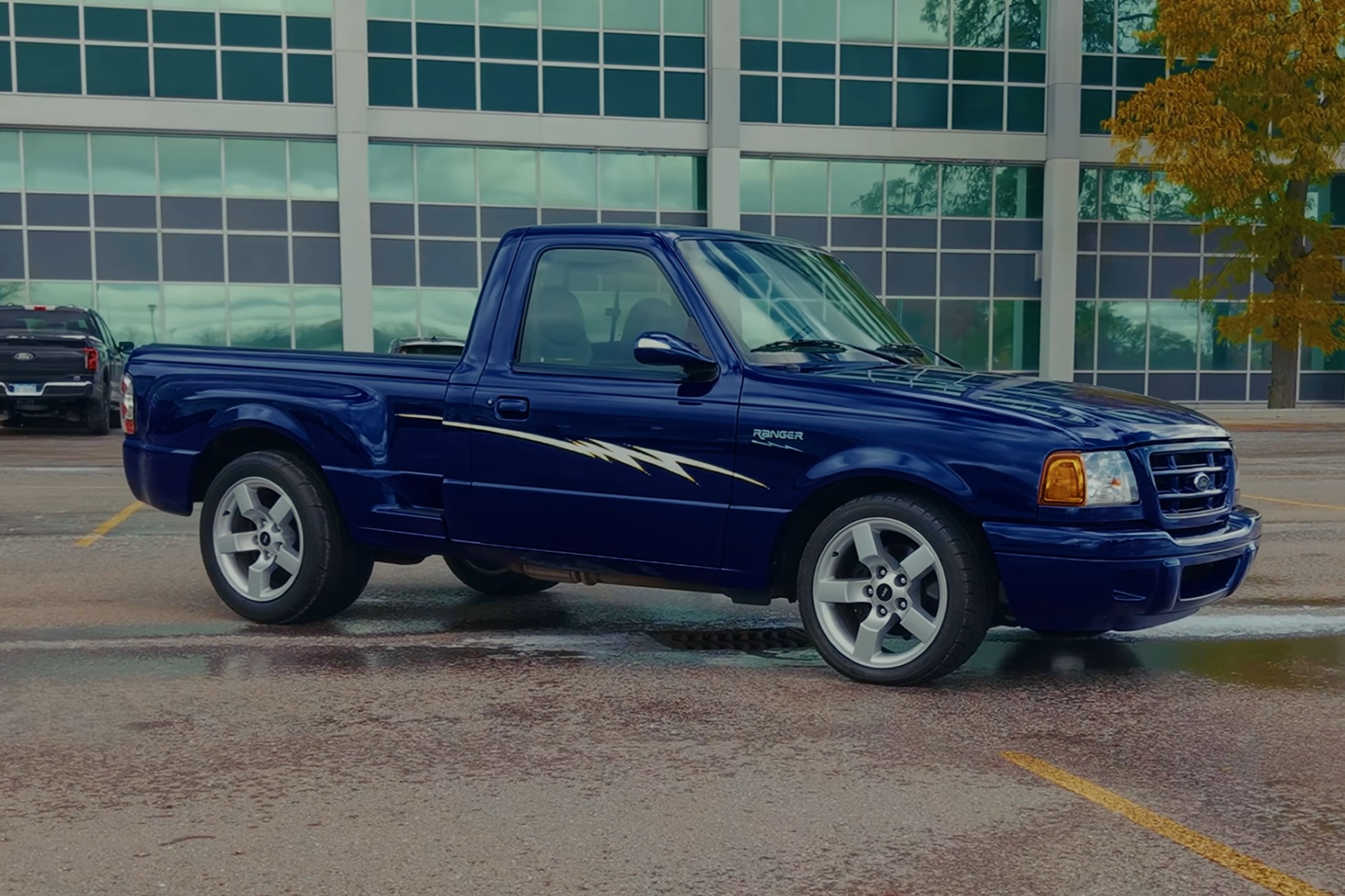
Tucked inside a Detroit parking garage behind Ford’s former headquarters sits a fleet of one-of-one prototypes that defied the company crusher. Hosted by James Pumphrey and Vin Anatra on the Ford Racing channel, a tour of the facility reveals a 2002 SVT Ranger Lightning Bolt concept parked beside historic Mustang models. How a compact pickup ended up packing a supercharged V8, and how employees saved it, takes a little more explanation.
After the full-size F-150 Lightning proved successful against street trucks like the Chevrolet 454 SS and GMC Syclone, Ford’s long-defunct Special Vehicle Team wanted to drop the same powertrain into a pickup weighing 1,000 pounds less. Engineers took a black Ranger XL work truck, pulled the 2.3-liter four-cylinder, and installed a 420-horsepower version of the Lightning’s 5.4-liter V8 topped by an Eaton supercharger.
“To fit a supercharged V8 in a place where a four-cylinder used to live, the team cut the firewall and moved it back two inches,” Pumphrey explained. “They also fabricated custom 2-inch equal-length headers with a 3-inch dual exhaust and moved the battery to the bed.”

Handling the extra torque required major chassis fabrication. Engineers fully boxed the frame, added cross-bracing, and massaged the transmission tunnel to fit a heavy-duty 4R100 automatic transmission from an F-350 Super Duty. Upgraded internals and a shift kit help the gearbox survive hard launches. To clear the drivetrain, the team removed the stock gas tank and mounted a fuel cell in the bed. Finished in Sonic Blue Pearl as used on the SVT Cobra of that era, the exterior features Lightning graphics, clear taillights, and a rear roll pan.

Putting 420 horsepower to the ground in a light pickup also demanded serious rearend hardware. To make the SVT Ranger Lightning hook up on the street, engineers installed wide Mickey Thompson tires and full-size truck components.
“It has F-150 Lightning brakes and an F-150 Lightning rear axle that they actually had to narrow so you can fit the biggest tire possible,” Pumphrey noted. “It feels like an OEM car, and it has air conditioning, heat, and a radio so it can idle in traffic.”
Inside the cab, Katzkin leather seats, billet switches, and color-matched door panels complete the package.

Despite its turnkey street manners and impressive performance, Ford passed on production. The custom fabrication made the truck too expensive for showrooms, and its power-to-weight ratio proved too wild for buyers. Although company policy required crushing nonproduction concepts, defiant employees thankfully washed the truck from company ledgers and hid it inside a warehouse until it joined Ford’s official Heritage Collection.
You might also like
Kenny Brown Speed Academy Takes Enthusiasts To School Online
Learn Mustang engineering, setup, and driving from Kenny Brown Speed Therapy Academy. The next 16-week online sessions start next week.