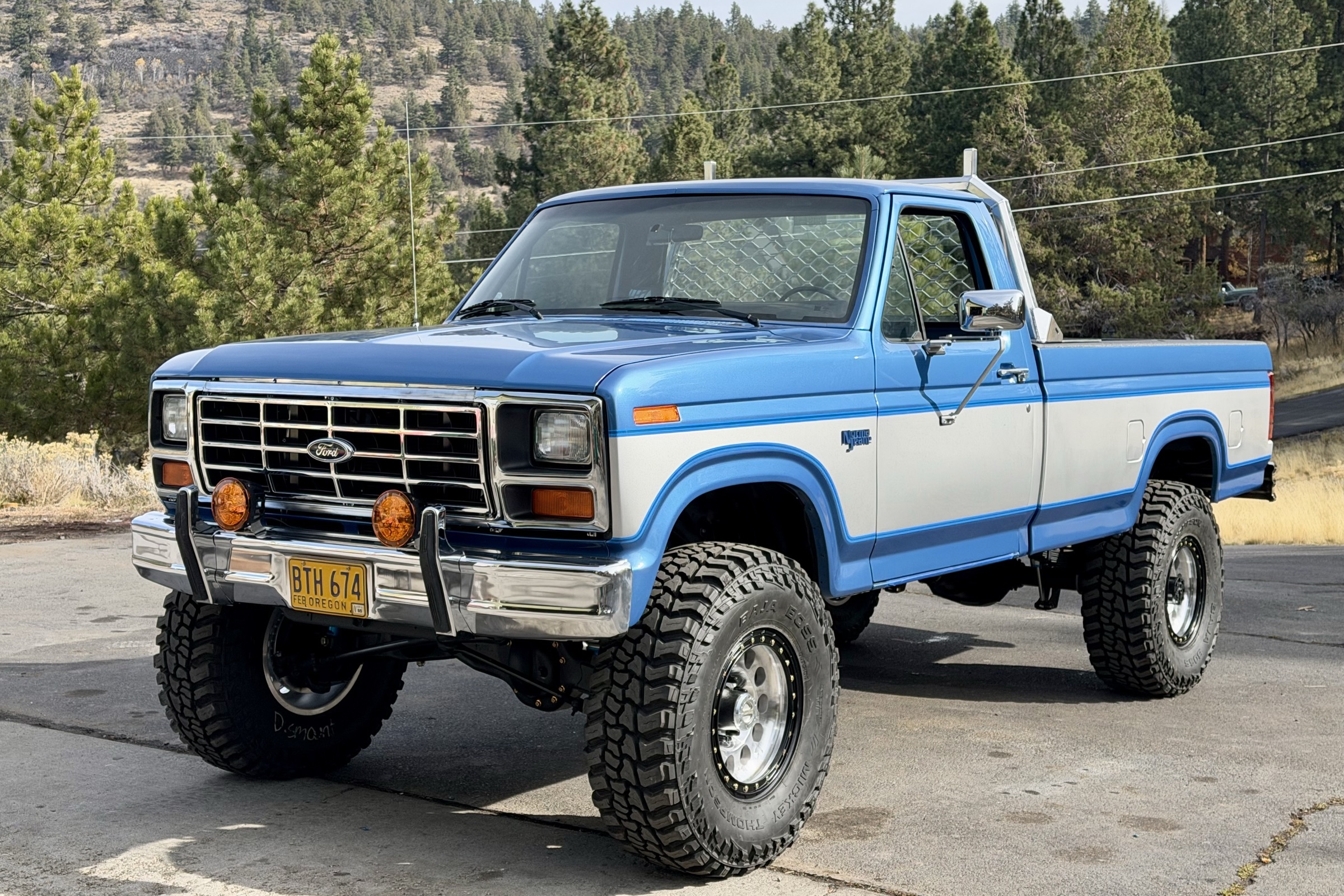
Showing a renewed commitment to its heritage crate engines, Ford Racing partnered with a grassroots builder to showcase its 351W-based 460-cube stroker. That engine powers a 1985 F-250 pickup that Matt Johnson saved from rotting on a ranch in Oregon. He turned the $800 truck into a show-worthy machine that is holding court in Ford’s display at the 2026 SEMA Show.
Sometimes the most impressive project vehicles start with little more than an unusual choice and a creative vision. In this case, Johnson imagined a high-performance interpretation of Ford’s classic Bullnose-era F-Series that combines vintage styling with serious modern off-road hardware and a healthy dose of small-block power.

The mechanical engineer and owner of Doc Johnson Restorations in Klamath Falls, Oregon, originally contacted Ford Racing Parts about putting a 2.3-liter EcoBoost engine into one of his Toyota FJ40 Land Cruisers. That conversation eventually took a different direction when Ford Customization Specialist Olivia Cin and Ford Racing Parts Product Manager Michael Goodwin proposed using one of the company’s heritage engines instead.
With that suggestion, Johnson had another idea for the pushrod powerplant.
“I had a meeting with the Ford team. They were talking about the Land Cruiser, and to me, the little EcoBoost motor in the Land Cruiser is a perfect match,” Johnson explained. “But a rowdy small-block, like a Heritage engine — that needs to go in a Ford. So, I said, ‘Let me just stop you right there on the Land Cruiser idea because there’s a couple of cool Ford trucks I have behind the shop.’”
Ford Tough
Johnson chose a 1985 F-250, a truck with personal significance. He had previously owned a similar pickup, driving it through college, to work, and even on the beach when he proposed to his now-wife. The classic squared-off styling and unmistakable Bullnose front end made it an appealing foundation for the project.
The particular truck he selected spent years abandoned in a ranch field, exposed to the elements. Johnson picked it up for just $800, initially intending to use it as a shop truck. However, its original engine had other plans.

“It was just an abandoned ranch truck that had been sitting in a field and getting rained on for years. I bought it for $800. I was going to use it as a shop truck, and I wanted another bullnose based on the truck I’d had before,” Johnson said. “I thought it was going to be perfect, and then it immediately started overheating. It blew the radiator up; it Yellowstoned on me! Just a full geyser out of the radiator. That motor was toast.”
Rather than putting the truck out to pasture again, Johnson saw an opportunity to build something considerably more entertaining. The replacement was Ford Racing’s 460-cubic-inch small-block rated at 575 horsepower and 575 lb-ft of torque.
“When Matt approached us, we thought that era of truck would be a great vehicle for one of our heritage engines. What we landed on for his build is a 575-horsepower, 460-cubic-inch, 351 Windsor-based small-block,” Goodwin said.
Supporting Cast
That combination gives the F-250 a substantial bump in performance while retaining the familiar architecture of the original powerplant. Goodwin also emphasized that Ford’s Heritage engines are assembled entirely with new components rather than relying on reused or repurposed parts. The crate engine is designed to drop into vehicles originally built around that engine architecture, making it a compelling option for traditional Ford builds that need considerably more muscle.
“One thing worth mentioning is that all our engines use brand-new components. We don’t reuse or repurpose anything,” he explained. “This engine drops right into a vehicle that originally had that architecture when it was produced, and we’re really proud to have it in Matt’s truck at SEMA.”

Of course, a 575-horsepower engine needs a chassis and suspension package capable of putting that output to work. Johnson connected with John Carrick of Carrick Customs, whose specialty is a heavily reengineered version of the F-250’s original Twin Traction-Beam suspension. That collaboration helped transform the truck from an inexpensive ranch find into a capable off-road machine.
The finished combination rolls on 37-inch Mickey Thompson Baja tires, giving the classic Ford the footprint and stance to match its considerably expanded performance envelope. Importantly, the build retains the original chassis, demonstrating how carefully selected aftermarket components and modern engineering can elevate the platform without turning the truck into an entirely different vehicle.
Big Job
Ford saw the project’s potential early. About 11 or 12 days after the build began, the company contacted Johnson about elevating it from its original appearance at the Carlisle Ford Nationals into a full-fledged SEMA contender. With only 40 days initially allotted to complete the project, that change dramatically increased the workload.
“Most of the time, I’m working alone in my home shop, although many friends have stepped in to help, which has been amazing. I now have a couple of lifts and an old forklift. It helps a lot, but it’s a 1984 model, so I have to add hydraulic oil every time I use it,” Johnson said. “We’re in a small, isolated town with few resources nearby. The truck had to be transported elsewhere for paint and bodywork, but a friend stepped in to help get it done. He’s a hobby painter, but he’s very talented and did an awesome job.”
That grassroots effort is a big part of what makes the F-250 a compelling show vehicle. It wasn’t conceived as a factory-backed concept with an unlimited engineering budget. Instead, it evolved in a home garage, with Johnson relying on his own mechanical experience, a network of friends, and the right industry partners to bring the idea together.

“This truck started out as an $800 abandoned ranch truck in Oregon. Most people probably saw it as a piece of junk, something that belonged out in a field. Matt Johnson saw something very different. He saw the foundation for a modern, high-performance off-road F-250,” Matt Simpson, Executive Director of Ford Customization, reflected. “Today, it’s a 575-horsepower truck with long-travel suspension and 37-inch tires, and it will be in the Ford booth at SEMA. The journey from a forgotten truck in a field to a SEMA showstopper is exactly why we love working with grassroots builders like Matt.”
On the eve of the 2026 SEMA Show, the Blue Oval is just getting warmed up with its show builds. Expect others to be revealed during its Tuesday-morning press conference in Las Vegas.
You might also like
SVT’s Ranger Lightning Bolt Concept Escaped The Company Crusher
Ford engineers dropped a supercharged 5.4-liter V8 into a compact pickup to build the one-off SVT Ranger Lightning. Somehow it still exists.