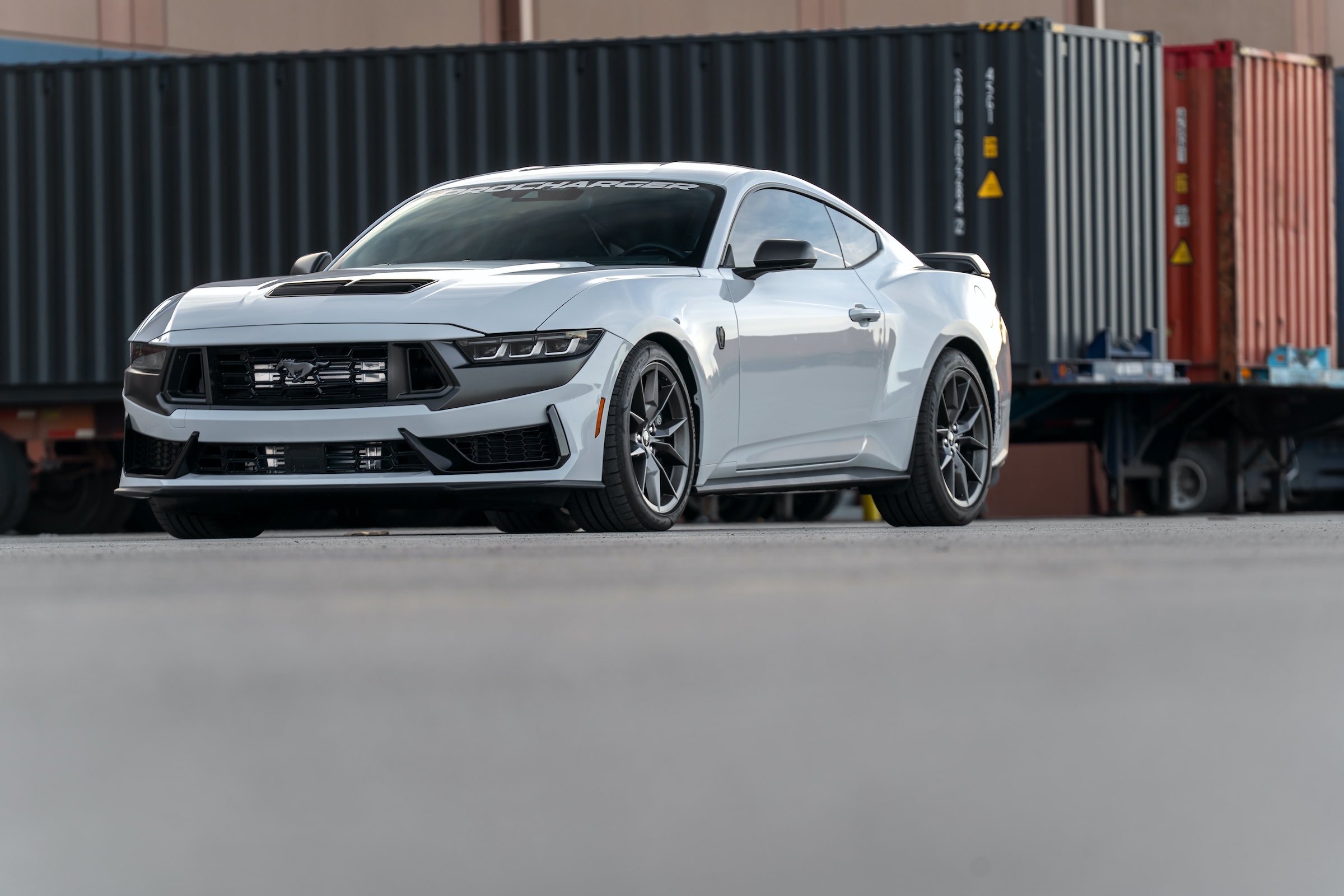
If you’ve been around hot rodding for a while, you know that there was a time when having 500 horsepower under the hood made your Mustang the baddest ride on the block. Now you can drive a Mustang Dark Horse off the lot with that many ponies under the hood from the factory. Likewise, the idea of bolting on little more than a blower and making four-digit power would have been beyond comprehension. As ProCharger has proven, that goal is also a reality today.
Honestly, I don’t know if I will ever stop talking about how much I love the P-1X. The blower is just perfect for someone at the start of their build, and can grow with them with simple pulley changes… — Erik Radzins, ProCharger
“So this ‘project,’ if you want to call it that, of pushing a stock Mustang to its limits (with no other mods to the engine, exhaust, or drivetrain) wasn’t the original idea. The car was living double-duty as a daily driver, and dyno mule to develop calibrations to ship to customers,” Erik Radzins, Director of Communications and Calibrations at ProCharger, explained. “While on the dyno, I was talking to the CEO of ProCharger (Ken Jones) and said, “I bet the Dark Horse will make 1,000, with the base kit and maybe a pulley swap and injectors.’ Ken was totally on board, and the dyno runs started.”
The company already pushed Ford’s most powerful 5.0-liter engine yet, backed by the optional 10R80 10-speed automatic, to 1,014.80 horsepower and 739.51 lb-ft of torque at the rear wheel with nothing more than the company’s Stage 2 kit for the S650. That kit enhances the HO system, based on the vaunted P-1X head unit, with a dedicated eight-rib supercharger drive and a larger intercooler.
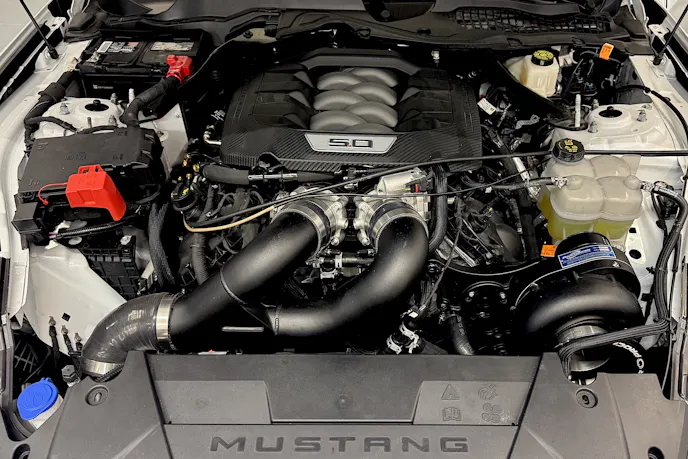
“Honestly, I don’t know if I will ever stop talking about how much I love the P-1X. The blower is just perfect for someone at the start of their build, and can grow with them with simple pulley changes,” Radzins enthused. “No matter if they are making 600 horsepower on pump gas or 1,000-plus horsepower on E85, it’s been well known on the Internet that the P-1X is ready for the task. The fact that it’s included at no extra cost on the S650 kit is the icing on the cake.”
With nothing more than the Stage II kit and a ProCharger fuel pump voltage booster to increase the flow of E30R fuel, he dialed in a hotter custom tune and pushed the stock Dark Horse to 1,033 rear-wheel horsepower.
“Normally, to any customer, I would always recommend a good set of headers and a full fuel system (including rails ) from any of the amazing companies out there,” Radzins said. “However, I personally wanted to know, could the stock fuel system do it? Could the base kit with the included 55-pound injectors do it? What was the limit going to be?”
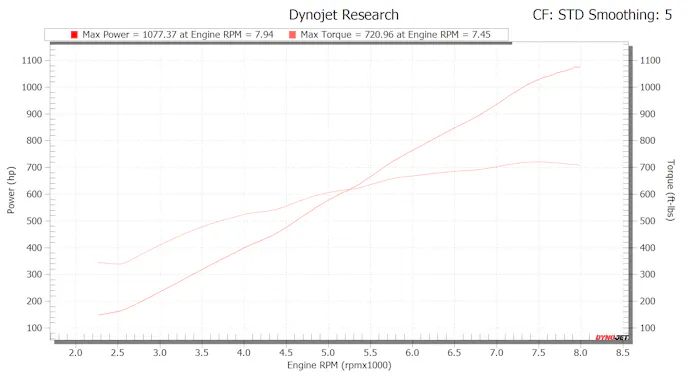
At this point, the fuel system was at its limits, so Radzins grabbed some lightly used parts from the shelf that had previously been used on an S550 project. They included Hellcat fuel pumps and an octet of 95 lb/hr injectors seated in the factory fuel rails. The result was 1,059 rear-wheel horsepower.
Next, he added a bell mouth to the inlet of the P-1X to add a bit more boost without swapping blower pulleys. The result showed that the combination was closing in on the limits of the factory hardware, particularly the fuel rails and exhaust. However, it belted out an impressive 1,077.34 horsepower and 720.96 lb-ft of torque, which is downright impressive for a bolt-on blower with a mild fuel system and custom tuning.
“Could it make more, probably. However, I really started to wonder if the stock exhaust manifolds, resonator, and mufflers were really stoked about making over 1,200 crank horsepower (more than double the factory horsepower). The other issue that I could see from the data is that the factory fuel rail was really at the end of the line,” Radzins added. “I feel pretty confident that adding headers, removing the resonator, and larger fuel rails, there is easily another 100 horsepower on tap. However, at that point, I would say, someone would probably want to be thinking about rods and pistons for the motor for safety reasons.”
Obviously, more mods would unlock more power, but knowing that the factory hardware can go this far is worth celebrating. It is a huge endorsement for the vehicle that Ford engineers designed, as well as the supercharging system developed by ProCharger.
You might also like
Limited Shelby Cobra Daytona Coupe Run Celebrates Historic Win
Shelby Legendary Cars is building more Shelby Cobra Daytona Coupes. These World Championship editions honor a historic FIA GT world title.