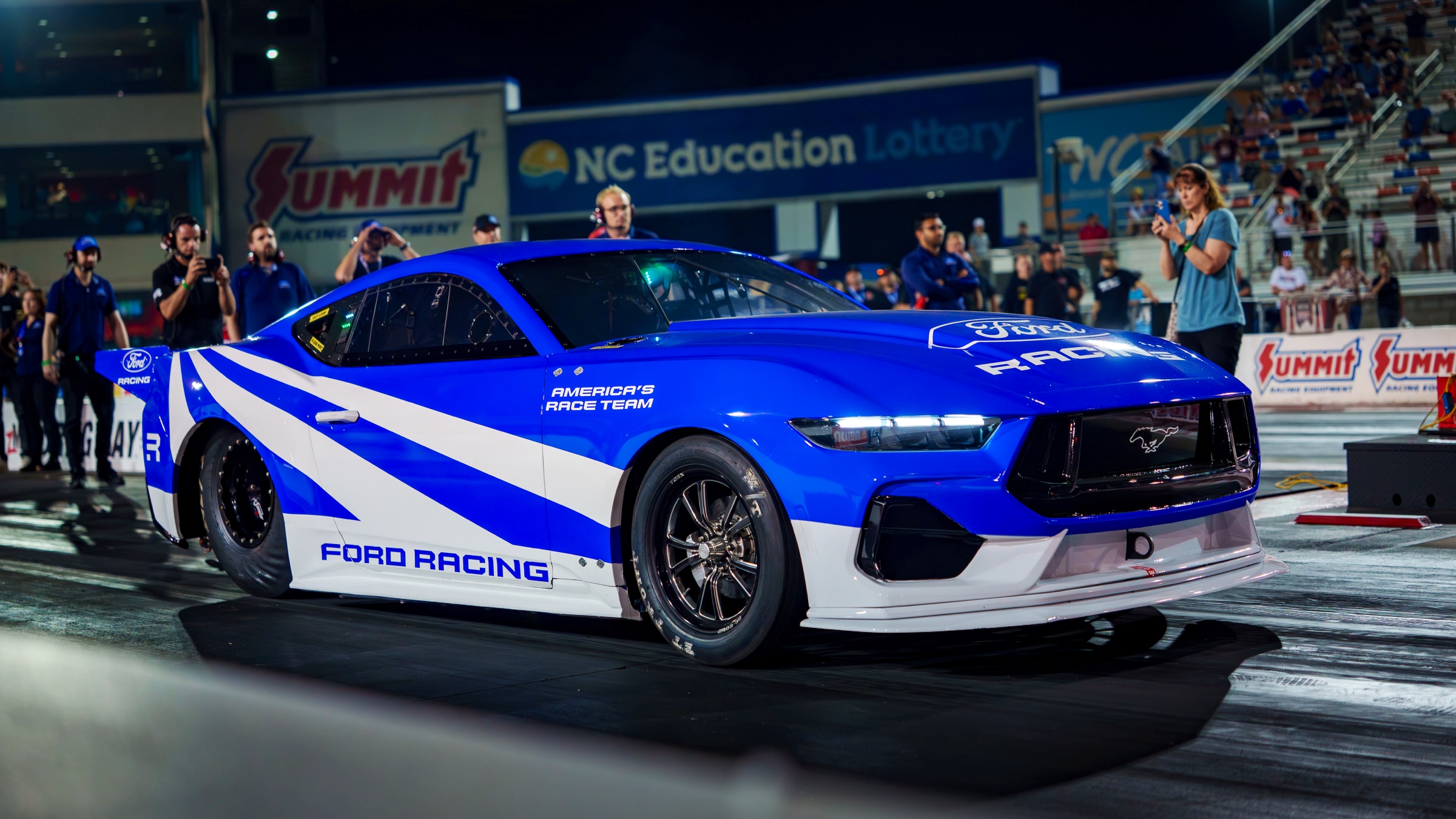
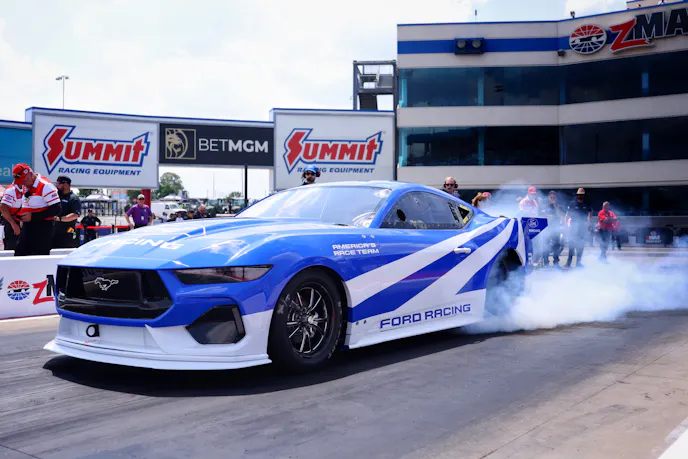
It is popular in automotive enthusiast circles to hate electric vehicles, but it’s hard not to love a 6-second, stick-shift machine that’s factory-engineered to fly. That’s exactly what the Ford Racing Cobra Jet 2200 delivered at the NHRA 4-Wide Nationals, where the Blue Oval’s latest electric drag car ripped off a 6.872-second pass at 221.05 mph to reset the EV quarter-mile benchmark. It eventually improved on that record-setting pass with a 6.869 seconds at 222.36 mph rip.
Unlike the previous electric drag snakes, the Cobra Jet 2200 is a clean-sheet car built in concert with MLe Race Cars, and it shows the moment you peer under the sleek bodywork. Built around a Pro Mod-style platform, the whole package is designed with one goal in mind — traversing the 1,320 as quickly as possible. Part of that design ethos was weight savings, so Ford Racing pared the Cobra Jet 2200 by another 900 pounds versus the Super Cobra Jet 1800, which was 1,000 pounds lighter than the Cobra Jet 1400.
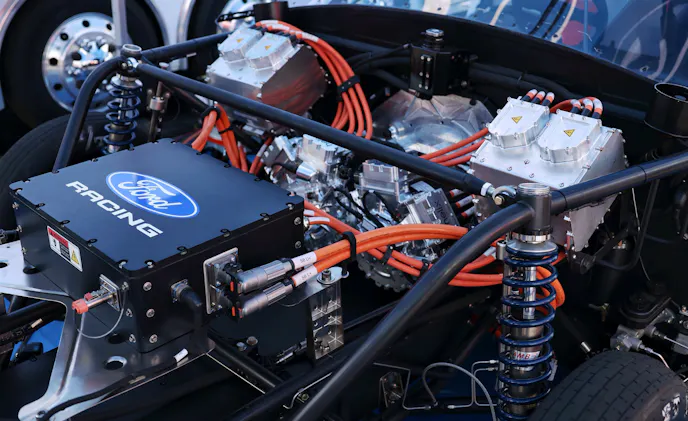
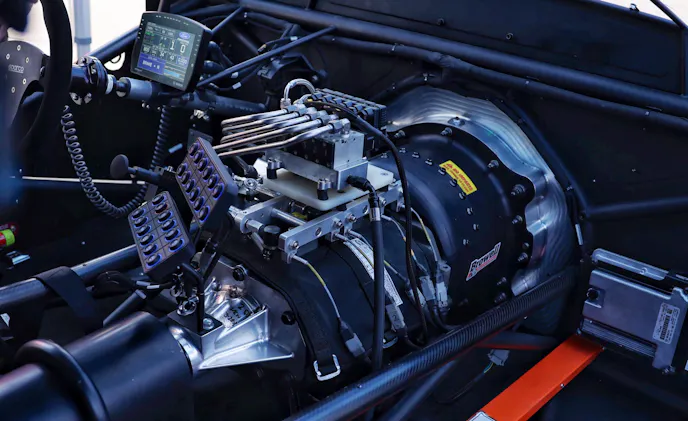
To do so, the Cobra Jet is motivated by a streamlined powertrain. Where its predecessors deployed four electric motors to deliver less horsepower, this one cranks out an additional 600 horsepower courtesy of two custom-built Cascadia Motion motors that not only reduce weight but push roughly 900 volts, with both motors tied together through a summing gearbox to drive a single output shaft. From there, the system routes power through a five-speed manual from Liberty’s Gears and into a triple-disc clutch that Ford developed specifically for this application.
That’s crucial as nothing about 2,200 wheel horsepower is easy to manage. Applying it to the track for consistent 1.260-second 60-foot times takes a bit of engineering wizardry. Rather than relying on direct drive that would annihilate the rear tires with 1,340 lb-ft of torque, Ford went with the transmission and clutch to control how that torque hits the tire. This patented reverse-acting centrifugal clutch arrangement allows the moment of slip necessary to hook the Cobra Jet 2200’s massive output, thanks to an arrangement that works like a Top Fuel clutch, but works in reverse order. This setup allows tuning the launch in concert with the electrified output to optimize traction and elapsed times.
“That, to me, is what makes Cobra Jet 2200 so compelling. The ET and speed are impressive. But to solve the challenge in the right order — create extraordinary power density, develop the driveline control to manage it, and build the protection needed to run it safely at the highest level — is a seriously complicated puzzle of engineering ingenuity,” Nick Kuhajda, Ford Racing Engineering Manager, Electric Vehicle Demonstrators, said. “Especially because in a drag car, everything is compressed into a few seconds and 150 revolutions of the rear tire, which means every decision gets exposed very quickly.”
Torque & Traction
Add in traction control strategies that pull from Ford Racing’s expansive road racing-development programs, and you end up with a quarter-mile rocket that can actually put that power down to the racing surface via its Mickey Thompson slicks.
Battery layout is just as critical as the motors themselves. Instead of a single large pack, the Cobra Jet 2200 uses four separate XALT Energy battery packs, totaling around 32 kWh, positioned throughout the chassis to help manage weight transfer. The largest pack sits under the driver, with additional packs forward of the firewall and behind the cockpit. One of the rear packs can be repositioned, effectively using battery placement as a tuning tool for how the car plants the sticky Mickeys on launch.
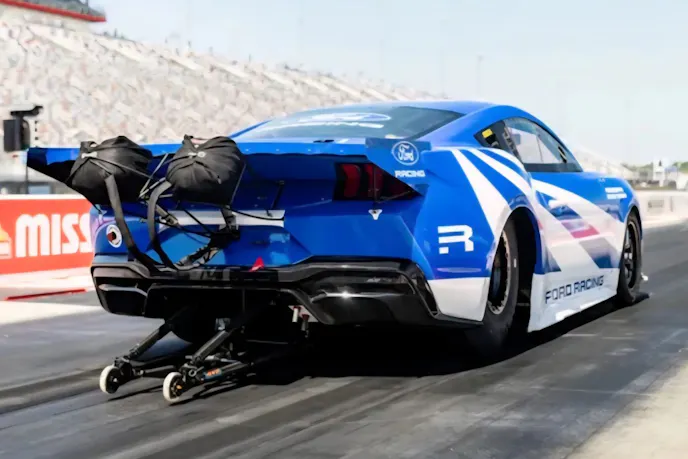
PMR Race Cars built a lightweight, rigid SFI 25.3D-spec chassis designed specifically for this program to serve as a solid, safe foundation for its space-age powertrain. It’s closer to a Pro Mod than anything production-based, with the structure and suspension geometry needed to handle instant torque while keeping the car stable through the back half at over 220 mph.
All of it adds up to a combination that’s not just quicker, but more capable than the earlier 1400- and 1800-horsepower electric Cobra Jets and pushed the technology into the record books once again.
“The official results from the event matter, and we are proud of what the team achieved. But what excites me just as much is what comes next,” Kuhajda added. “Every pass of the Mustang Cobra Jet 2200 gives us information and adds to our understanding. Every milestone creates a new target. That is how serious racing programs evolve, and that is how meaningful technical progress happens to make better products for our customers.”
Love or hate EVs, it’s hard to argue the results of this purpose-built effort. It can charge within 45 minutes to go rounds, tune the launch with the triple-disc clutch, and apply more than 2,200 horsepower to deliver 6-second passes at well over 200 mph. That’s as electrifying as it gets.
You might also like
An E85 Calibration Pushes A ProCharged Fox Past 800 Rear-Wheel Horsepower
A ProCharged Fox Mustang hit the hub dyno for a calibration. Kyle Morris dialed in the blown small-block Ford to surpass 800 horsepower.