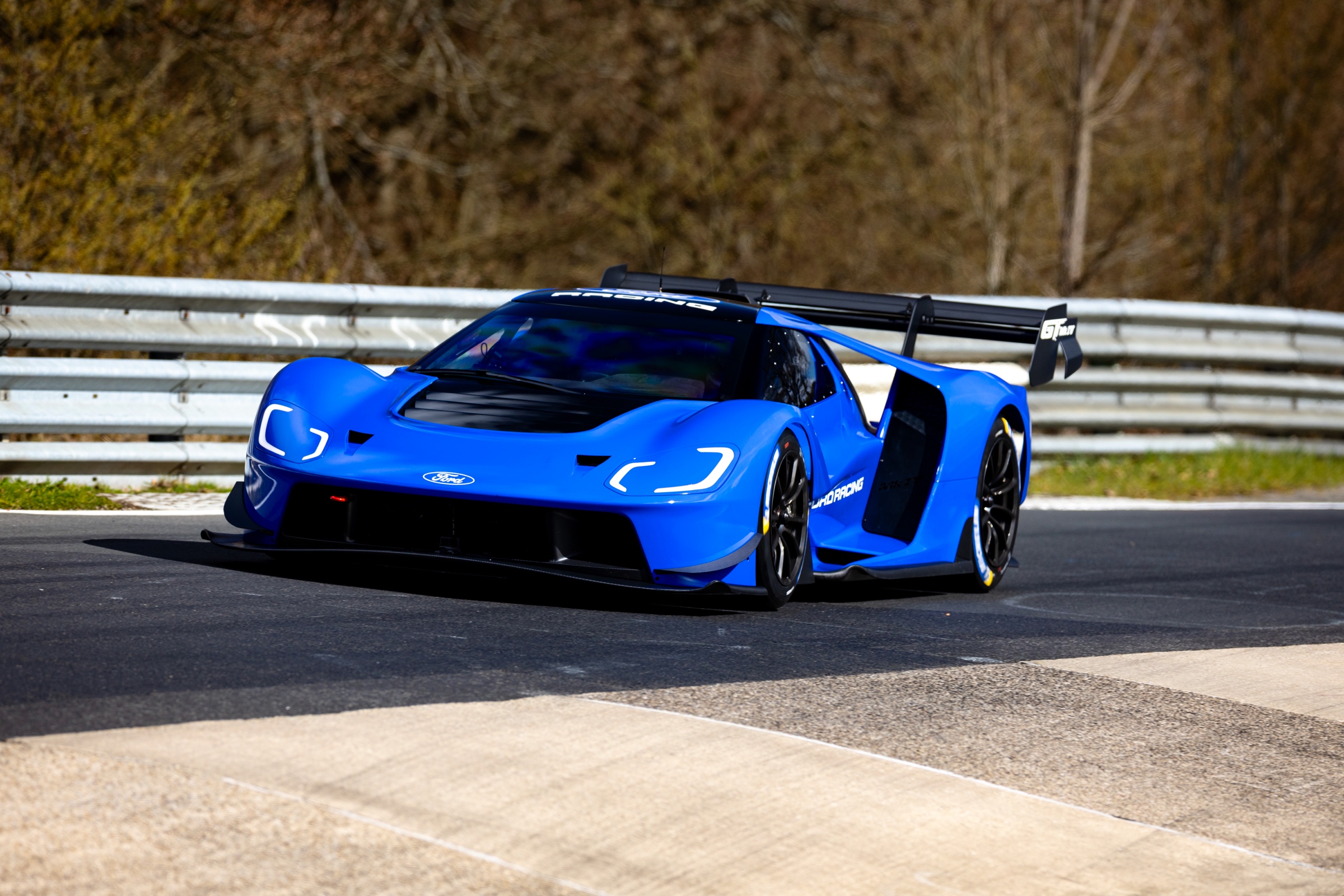
The cold air hangs over the Eifel Mountains, the kind that bites just enough to sharpen everything, including driver focus, tire grip, and engine response. Out on the Nordschleife, the trees blur into a dark green wall as the throttle goes down and a twin-turbo EcoBoost howls toward redline. Through Flugplatz, the car stays planted. Kesselchen comes fast, then faster. There’s no room for hesitation here, just commitment and trust in the engineering.
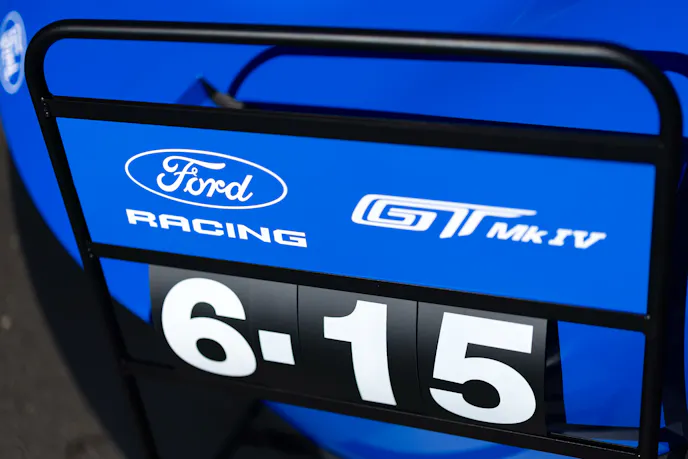
And on this lap, everything lined up. When the clocks stop, the number tells the story: 6:15.977. That’s not just quick. That’s historic. However, if you were expecting a Mustang GTD lap record, the Blue Oval had a surprise up its sleeve…
With that lap, the Ford GT Mk IV became the fastest American OEM to ever circle the Nürburgring Nordschleife, the fastest internal-combustion-only machine to ever do it, and the third-fastest vehicle of any kind to tackle the 12.9-mile Green Hell. Only the Porsche 919 Hybrid Evo and Volkswagen ID.R sit ahead of it, both purpose-built electrified or hybrid prototypes designed to rewrite the rules. Everything else, including the Mercedes-AMG One and even Chevrolet’s Corvette ZR1X, in the same prototype class, appear in the Mk IV’s rear-view mirror.
And it didn’t come easy. Conditions were chilly, which meant a narrower operating window for the tires and a mandated top-speed restriction capped at 310 km/h (192 mph). Not ideal when you’re chasing outright pace on one of the fastest and most unforgiving circuits on the planet. But even with those constraints, the GT Mk IV delivered a lap that redefines what an internal combustion-powered American performance car can do on the world stage.
Purpose Built
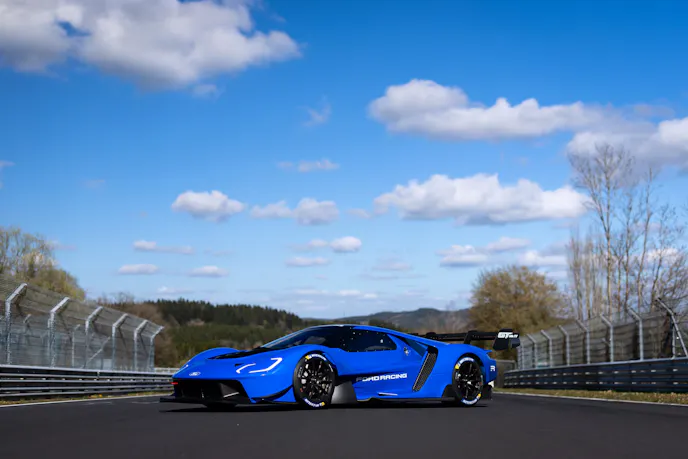
The Mk IV is the final evolution of the third-generation Ford GT, a track-only, no-compromise machine limited to just 67 examples. At its core is a specially engineered twin-turbo EcoBoost V-6 pushing north of 800 horsepower, backed by a bespoke racing gearbox designed to keep the powerband tight and relentless. It rides on Multimatic’s Adaptive Spool Valve suspension, a system that’s proven itself at the highest levels of motorsport with precise damping control that reacts in real time.
The chassis itself is reworked for maximum attack. A longer wheelbase enhances stability at speed, while the extended “long-tail” carbon-fiber bodywork is shaped entirely around downforce and efficiency. This isn’t styling for the sake of it. Every surface, every contour, is there to keep the car glued to the pavement when the pedal is to the floor.
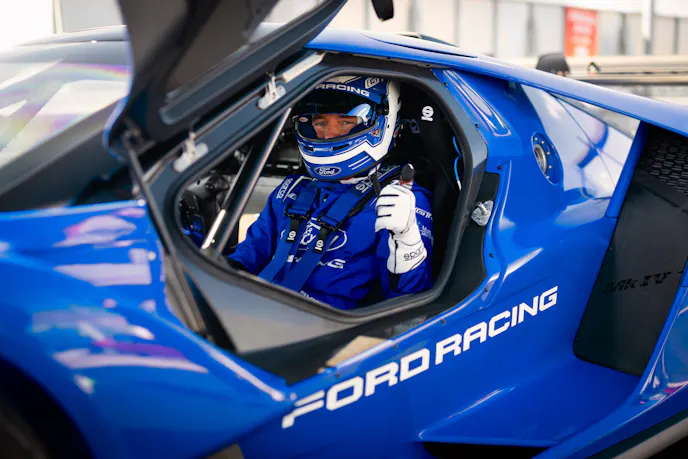
To extract everything from that package, Ford tapped factory driver Frédéric Vervisch, a Nürburgring veteran with multiple 24-hour wins and invaluable track knowledge. He knows where the pavement changes, where the car gets light, where you can lean on it, and where you can’t.
“Driving the Ford GT Mk IV at the Nürburgring is an experience unlike any other. The car is an absolute weapon, a true extension of your will. Every input is met with an immediate, precise response. Through the Kesselchen, over the Flugplatz, it just inspires confidence, allowing you to push harder and harder,” Vervisch said after the record run. “You feel the history of the track, and you feel the immense capability of the Ford Racing engineers who poured their hearts into this machine. To set these records is a dream come true, a testament to what’s possible when passion meets precision.”
Closing Statement
That combination of driver confidence and mechanical capability is what makes a lap like this possible. The Nürburgring doesn’t reward brute force alone. It demands balance, predictability, and the ability to carry speed through sections that never seem to end. The GT Mk IV delivers that in a way few cars ever have.
This record-setting lap arrives with poetic timing. It marks the end of the current Ford GT program, a decade removed from the modern GT’s Le Mans class victory and six decades since the GT40 first carved Ford’s name into endurance racing history. The Mk IV isn’t just another variant. It’s a dramatic closing argument.
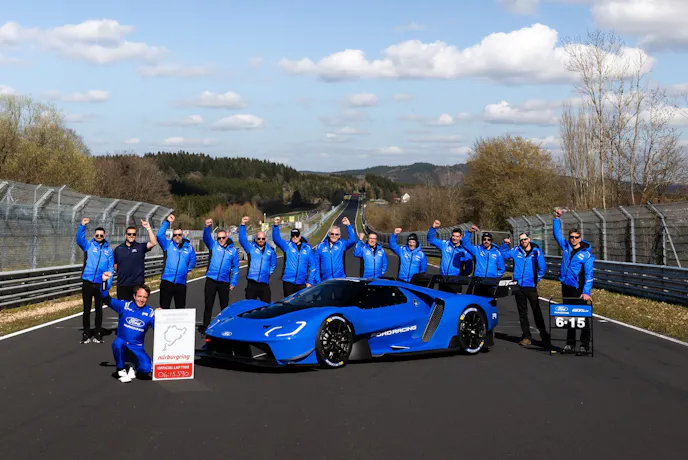
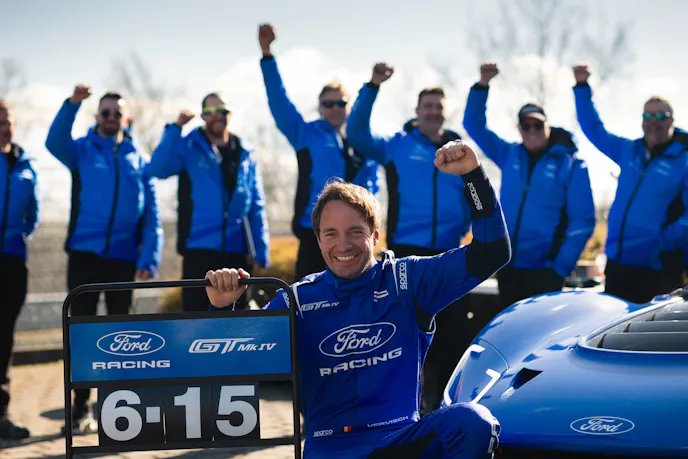
“This moment feels particularly fitting — a true ‘mic-drop moment’ — as we celebrate the final car of this generation of the iconic Ford GT,” Scott Bartlett, Global Sports Car Marketing Manager for Ford Racing, enthused. “It’s been 10 years since the Ford GT debuted and secured a class win at Le Mans, and a remarkable 60 years since the legendary Ford GT40 began Ford’s storied relationship with the world’s most famous endurance race. What better way to honor that legacy than by pushing the absolute limits of engineering and driver skill on another fabled circuit?”
While the headline is the lap time, the bigger picture is what it represents. Ford has been steadily pushing performance boundaries at the Nürburgring with everything from electric demonstrators like the SuperVan 4.2 to track-focused machines like the Mustang GTD. The GT Mk IV now sits at the top of that pyramid, proving that internal combustion still has a place at the bleeding edge of performance.


“Our assault on the Nürburgring with the GT Mk IV was a team effort, with the support of our partners at Multimatic and Michelin,” Bartlett added. “What we learn from these extreme challenges directly translates into making better road cars for our customers worldwide.”
At the end of the day, the GT Mk IV isn’t about practicality. It’s about possibility. It’s what happens when engineers aren’t asked to compromise, but are challenged to go faster, stop harder, and corner with absolute authority. Now we wait to see if that same methodology pushes the Mustang GTD higher up these ranks…
You might also like
Foxzilla Roars Back To Life With An All-Natural, Modernized Mission
Foxzilla returns with a naturally aspirated 7.3-liter Godzilla and an 8HP automatic. It will also add modern traction control and ABS.