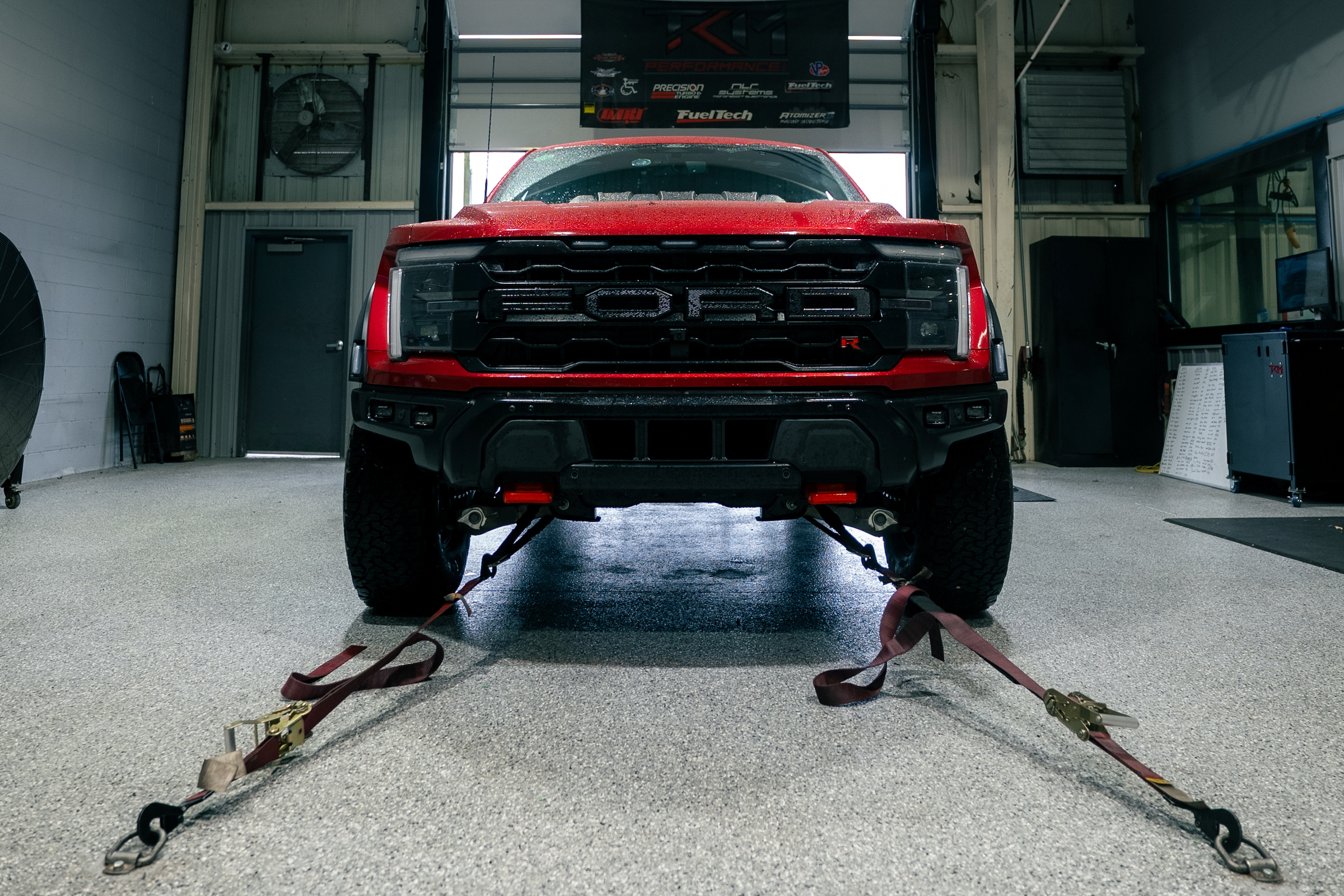
Ford engineered the F-150 Raptor R as the ultimate off-road predator, but for many enthusiasts, the top of the food chain is just the beginning. Brad Deberti set out to transform his 2025 Ford Raptor R into a superpredator. Not just looking for bolt-on gains, Brad and his dad, Doug, decided to see exactly how far Ford’s Carnivore 5.2-powered off-road flagship could go when every system was optimized.
That mindset aligned perfectly with a long-running relationship between the Debertis and Hellion Turbo. Years earlier, Hellion worked with Brad and Doug on a twin-turbo F-150 built under an aggressive deadline for a television project. That collaboration not only proved what Hellion could deliver under pressure, it also laid the groundwork for future high-profile builds.
When Hellion began developing a top-mount twin-turbo system for the F-150, Brad immediately recognized the opportunity. Upon confirming that the kit would fit the Raptor R, the idea of building the world’s first twin-turbo Raptor R quickly turned into a full-scale project.
“I first worked with Brad and his father, Doug, nearly eight years ago when they contacted me to build a twin-turbo system for their SEMA Pre-Runner F-150 on their Discovery Channel show, Twin Turbos,” John Urist, President and Owner of Hellion Turbo, recalled. “We built the kit in less than a month, and I hand-delivered and installed it for the featured episode. That truck had a great run, and the design eventually became our ‘Street Sleeper’ hidden turbo system.
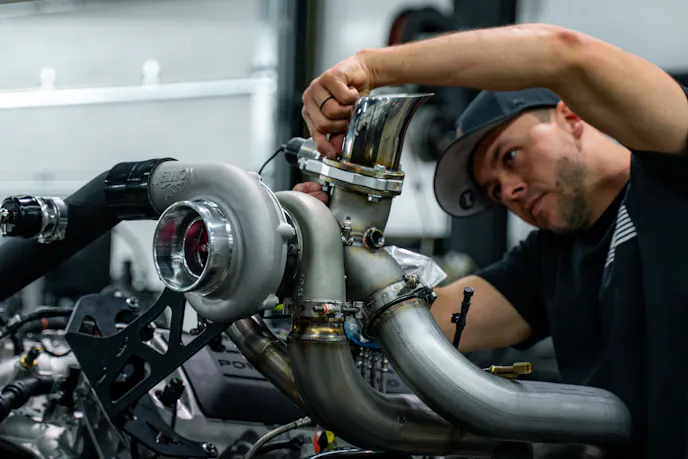
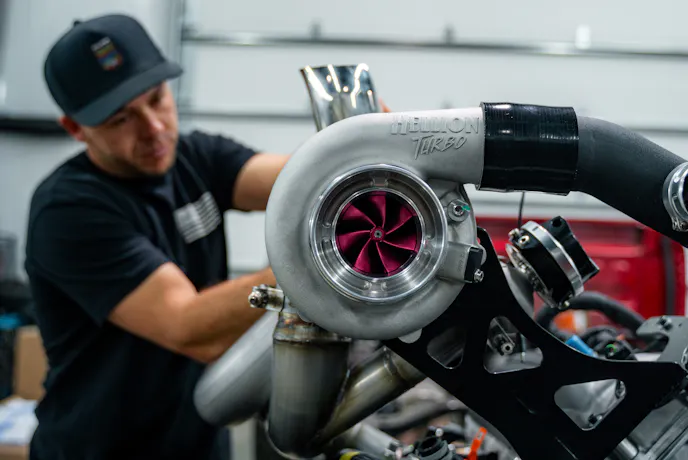
“Earlier this year, due to high demand, we began developing a top-mount turbo kit for the F-150. Our goal was to create a premium, state-of-the-art system that delivered the signature Hellion sound alongside elite performance,” Urist added. “The kit features a 100-percent symmetrical design using mirror-image turbos that point inward for an even, SEMA-quality look. We incorporated everything we have learned about the Coyote engine to ensure maximum power.”
Fortified Foundation
The build started with a clean slate. Brad and Doug pulled the cab, stripped the truck to its shell, and rebuilt it from the ground up with four-digit horsepower firmly in mind. The Carnivore 5.2-liter V8 engine went straight to TKM Performance, where it was fortified to withstand in excess of 2,000 horsepower. TKM upgraded every component so the engine could survive sustained boost and extreme cylinder pressure without compromising reliability. Among the upgrades are Darton Sleeves, Boostline billet I-beam connecting rods, custom TKM pistons, and plenty of race-proven machining techniques.
Power flows through a Race Solutions–built 10R80 transmission packed with full billet internals and matched to a fully custom, billet torque converter from Circle D Specialties. A 2,000-horsepower-rated carbon-fiber driveshaft from East Coast Driveline completes the driveline, eliminating weak points before boost ever entered the conversation.
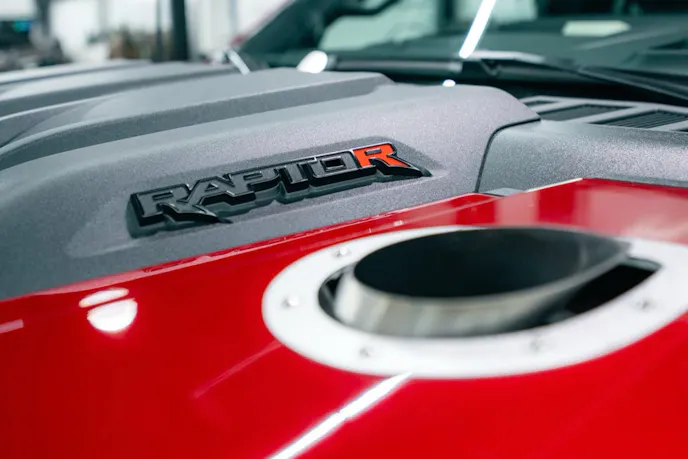
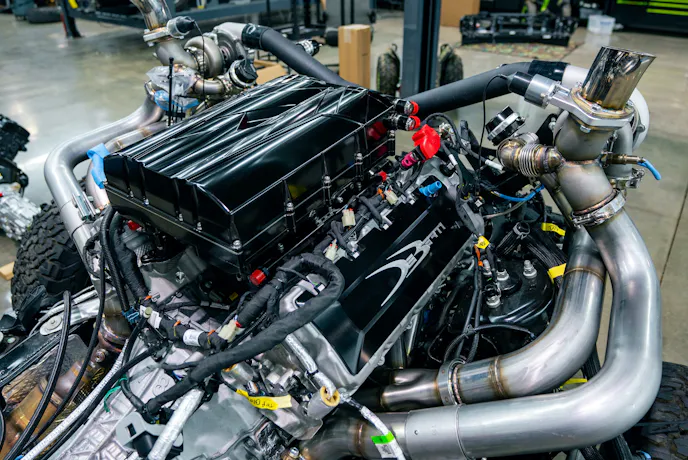
“Our existing Street Sleeper kit for the F-150 would have easily met the needs for this build in all aspects except one: Brad and Doug build in-your-face SEMA trucks. It is only fitting that we put the turbos up top and make it look like it’s headed to SEMA as a feature vehicle,” Urist said.
A Hellion’s mirrored top-mount twin-turbo system, featuring the optional, inward-facing 64/66R V-Band Turbos arranged in a fully symmetrical layout, replaced the factory TVS 2650 supercharger. The top-mount design delivers immediate visual impact while applying proven power to the Raptor R platform. Meanwhile, Turbosmart wastegates, blow-off valves, and an eBoost 3 controller regulate boost with precision, keeping the system stable as power climbs.
Intercooled Induction
“With HP Tuners releasing support for this truck over the summer, the race is on to maximize the Raptor R’s power. Based on our extensive experience with high-power trucks like the TRX and previous F-150s, we know there is significant horsepower to be made over stock form,” Urist explained. “The first step is to remove the supercharger, replace it with an intake manifold, and use turbocharging as the boost source. Twin turbos offer the highest power potential, and our goal was to create a high-quality, bolt-on top mount kit that maintains an OEM feel while delivering massive power and that turbo sound. We believe that we have achieved that and more.”
Devouring the twin-turbo boost is a CNC-machined billet intake developed by Palm Beach Dyno in collaboration with TTR and Whipple Superchargers. The intake, fitted with Whipple’s highly efficient intercooler core, replaces the supercharger entirely and plays a critical role in the truck’s efficiency, resulting in strong spool characteristics while pulling hard to high rpm. Feeding ample OneEthanol R E85 to generate the truck’s four-digit output is a Snow Performance triple-pump fuel system, with two pumps operating continuously and a third activating after 4 pounds of boost to support elevated power levels.
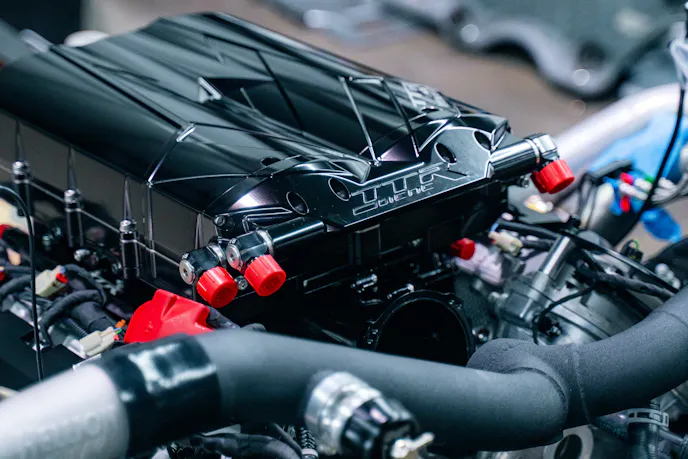
“I think the new TTR Intercooled intake was a key part of the results being better than expected. This was the first time it was run on a vehicle, so we were unsure of how it would respond. The power curve was something I have dreamed of out of an intercooled intake, but I haven’t seen it,” Ken Bjonnes, Founder and Head Tuner at Palm Beach Dyno, stated. “With the optimized runner length, spool time was still great, yet it pulled all the way to 9,000 rpm. If that wasn’t enough, the Whipple intercooler bricks performed so well that it was almost unbelievable. Never once during any dyno pull did the air temps go up. In fact, it would normally start higher, maybe 110-115 with the hood being down, and then wind up at 100 degrees by the top of the pull. If you consider that this was done with the factory cooling system on the Raptor R (heat exchanger, tank, lines, pump), then it’s even more impressive. Normally, we would upgrade all those components at the same time, but I wanted to see what it would do with the stock parts, and it was shocking.”
Turbo Tuned
With Bjonnes handling tuning duties via HP Tuners hardware and software, the result was a calibration that keeps the factory electronics satisfied while allowing the hardware to perform. Despite the extreme output potential, the truck retains smooth drivability at low speeds and predictable behavior under throttle.
“It really starts with the GT500 and F-150. Our main customer base at our shop is made up of GT500 and F-150 builds. The Raptor R takes the engine out of the GT500 and combines it with the F-150 10-speed for the ultimate setup,” Bjonnes said. “Then, as soon as tuning was released, we were bombarded with tuning and builds in the Raptor R, and it’s gone unbelievably smooth due to our background.”
“This is a good time to point out tuning versus configuration. It can all be considered tuning, but in reality, the important part is how to set up the structure of the tune properly to make the computer happy with the twin-turbo conversion,” Bjonnes elaborated. “The fuel and timing changes are the easiest part.”
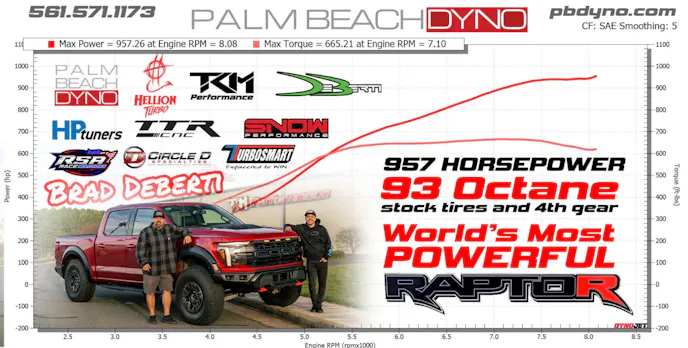
With the combination finalized, the Raptor R headed to the dyno with Bjonnes refining the calibration on TKM Performance’s in-house dynos. On 93-octane pump gas, it produced 957.26 horsepower and 665.21 lb-ft of torque at the wheels on a Dynojet chassis dyno, an extraordinary figure for a full-weight truck burning street fuel.
“The nice thing about the Raptor R engine and the built TKM version of it is the lower compression than what we are used to in the Coyote world. That allows us to make insane power on pump gas. You would never make 900-plus on any other Coyote-based platform on 93 octane,” Bjonnes explained. “That being said, when is 900 enough? Never! So the OneEthanol R allows us to push the Raptor R with the additional octane and cooling effects of an E85 fuel to the limit.”
Powerful Pull
Switching to OneEthanol R E85, they switched the truck to TKM’s hub dyno using custom-built adapters. Bjonnes pushed the combination even further, revving it to nearly 9,000 rpm and pumping out 26 pounds of boost. As a result, the Deberti’s built Raptor R staked its claim as the most powerful example on the planet with an eye-watering 1,615.9 horsepower and 760.3 lb-ft of torque at the rear wheels.
“The dyno results at TKM were impressive. The efficiency at low boost demonstrates a perfect match between the engine, intake, and turbo system. Furthermore, the drivability is exceptional; Ken performed a remote tune, and Brad has raved about how smooth the truck is at low speeds despite the immense power under throttle,” Urist said. “We look forward to seeing what this truck can do at the track. If it is anything like our previous F-150 builds, it will be a wild ride.”
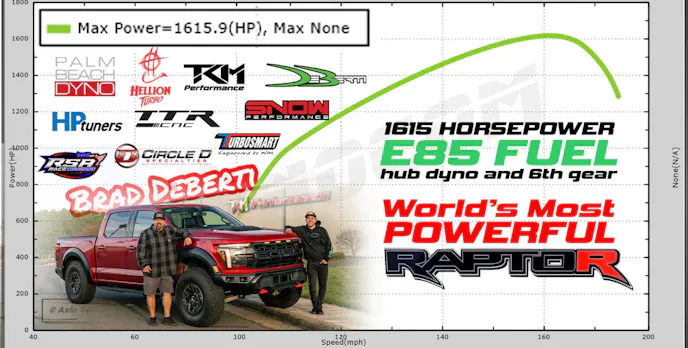
“I felt like I had a good idea of where things would land, but I very much underestimated the results. I didn’t think we would crack 900 on 93. Even on the 957 pull, I think we could have gone much further, but there was no need to get aggressive on pump gas,” Bjonnes explained. “And on E85, I was hoping for 1,600-plus, but it came much, much easier than expected, so we stopped there. I planned to run 30 psi and probably more timing, but it hit 1,600 on only 26 psi.”
With the bold build already exceeding its goals, Deberti still intends to drive this insanely powerful Raptor R daily, putting real miles on a truck capable of more than 1,600 horsepower. But like most projects, it isn’t finished yet. The father and son duo still have additional modifications in mind, so we likely haven’t seen the last of this Hellion-boosted Raptor R.
You might also like
Palm Beach Dyno Sharpens The Raptor R With A Four-Digit Bite
Palm Beach Dyno pushes a stock Ford Raptor R with its package. The shop’s massive PBD1200R option delivers 1,200 wheel horsepower.