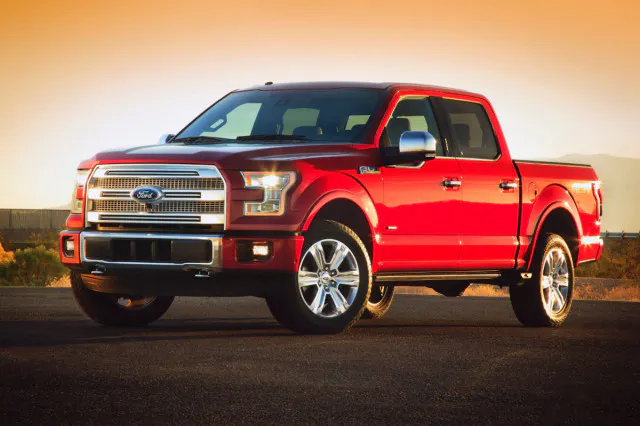
 A lot of ink has been spilled on Ford’s big shift to an aluminum body F-150, but one of the most overlooked improvements is the addition of a smaller but just-as-potent 2.7 liter EcoBoost V6. Slotting in above the base 3.7 liter V6 but below the 5.0/3.5 liter V6 options, its been designed to deliver maximum fuel economy and performance in a compact package.
As Consumer Reports found out, the smaller EcoBoost engine doesn’t just deliver better fuel economy compared to the 3.5 liter twin-turbo engine, but better straight-line performance too. In a head-to-head drag race, the F-150 equipped with the 2.7 liter EcoBoost sprinted from 0 to 60 MPH in 7.0 seconds on average.
The 3.5 liter EcoBoost engine, which has 40 horsepower and 45 lb-ft of torque more than the 2.7 liter engine, took 7.2 seconds to reach 60. This wasn’t just a one-time flop either; Consumer Reports is known for their repetitive testing methods, and the 2.7 liter EcoBoost just kept coming out on top. Not only that, but it also delivered a combined average of about 17 MPG, compared to the 16 MPG of the 3.5 liter EcoBoost motor. The 2.7 liter EcoBoost also proved faster than the V8 offerings from both Chevrolet and Ram, though the Toyota Tundra proved to be slightly faster than the Americans to 60 MPH.
Assuming the two pickups are otherwise similarly equipped, what’s going on here? The answer may lie not with the engine, or even the transmission, but rather the rear end gear ratios. While a 2.7 liter EcoBoost F-150 can have 3:73 rear end gear ratios, the 3.5 liter trucks are limited to 3:55 gears. That may be just enough to make up for a 40 horsepower difference.
You might also like
Fox Mustangs Are Still Booming As The Aftermarket Industry Takes Notice
It’s been more than three decades since the Fox-platform era ended. Today, Fox Mustangs are as popular as ever, and SEMA took notice.